We are developing the social individualist meta-context for the future. From the very serious to the extremely frivolous... lets see what is on the mind of the Samizdata people.
Samizdata, derived from Samizdat /n. - a system of clandestine publication of banned literature in the USSR [Russ.,= self-publishing house]
|
A French blog (well, sort of a blog) which fisked the EU Constitution is one of a new wave of European political blogs which are going to make it a lot harder for the technocrats in Brussels and the various European capitals to just double talk their way past the issues with the connivance or at least indifference of much of the mainstream media.
Hopefully this sort of thing will become more and more common as tools for penetrating the dense fog of half-truths and outright lies thrown up around so many political issues by people who want as little informed choice as possible.
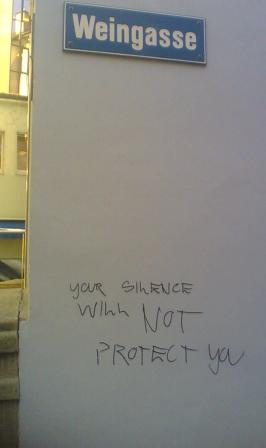
It is strange how English seems so often to be the ‘language of graffiti’
Samizdatista Paul Marks lets rip in the comment section of the new Tory leadership blog at Conservative Home on the topic of that Orwellian doublespeak term ‘social justice’. Check it out.
I have often lamented that with the collapse of the Soviet bloc, the forces of liberalism did not spend nearly enough time ruthlessly driving intellectual stakes through the hearts of all those who supported the ‘Evil Empire’ or preached appeasement or claimed that the Soviet system was ‘just another way of living’ rather than a mass murderous tyranny.
Well in this post-Cold War era in which the fight is now against militant Islam but the enemy within are in many cases the self same people who clearly thought the wrong side won the Cold War. This time we need to not just point out why these people are wrong, we need to grind their faces in their own words for all to see. It is imperative to show that there is often more than just mere ignorance or naivety at work when people choose to take an ‘even handed approach’ between Al Qaeda, the Taliban or the Ba’athists on one hand and the USA and UK on the other.
Now as I have said before on this blog, there are many people who opposed the war in Iraq for reasons that are clearly held in good conscience, fearing the cost to liberty in the West of such entanglements and I think it is important to differentiate between those people and others who oppose military action by the USA and UK for quite different reasons. Folks like Robert Fisk or John Pilger or Noam Chomsky are not neutral or ‘pro-peace’, they are actually on the other side because to them it is better to stand with people which makes women chattels, slaughters civilians intentionally, stones homosexuals to death and hangs female rape victims as well as the rapist, by simple virtue that anyone who is opposed to the liberal capitalist world is preferable to the United States. If the USA can be wounded, making the world safe for burquas and clitoridectomy is a small price to pay.
Well God bless the internet. By their own words they will be revealed. This is something that need to be an ongoing process, taking articles and ‘inviting’ the authors to confront their words and ask what they think now. Do not make the mistake of the 1990’s and be magnanimous in victory. No, before forgiveness must come repentance. If the other side wants to be treated kindly then let them put their hands up in surrender and admit they were wrong. Until then it is time to follow the example of Hussein Shirazi and put the boot in. Hard.
It is astonishing that a potential law could even reach the stage of being voted on in the USA that says if you witness or ‘become aware’ that neighbours or friends have broken the law with narcotics (which presumes you are a competent judge of that), you will be compelled by law to denounce them to the police. Failure to do so means prosecution and the threat of a two year sentence yourself if convicted of simply minding your own business. Even if you disagree with the drug laws, you will be threatened with prison if you do not actively help enforce them against other people.
I have met Congressman Sensenbrenner and I am shocked that he could have come up with such a profoundly authoritarian and illiberal law like this. He explained his support for the ghastly Patriot Act was purely a temporary emergency measure, pointing to the sunset clause as proof of that. Well if this* is his idea of reasonable legislation then I fear that I see all his motivations in a dramatically different light.
Turning neighbour against neighbour like this was how communist states maintained power in the Eastern bloc and anyone putting their name to such a law should be seen for the enemy of civil society that they are, turning people who just wish to be left alone into coerced informers for the state. Truly disgraceful.
*= to see details, enter HR1528 in the search box, then check the enter bill number button, then press search
The usual collection of fabulously rich but economically illiterate show biz twits are going to assemble for Bob Geldof’s Live 8 event timed to coincide with the impending G8 conference in Scotland on 6-8 July. Now God knows lampooning rock ‘n’ roll’s A-list ‘idiocracy’ is fun and easy sport, but I must confess that I have always regarded Geldof as an intellectual cut above your typical gormless entertainer, so perhaps a closer look at what is going on is in order.
Live8 is going to be a freak show, that is for sure, surrounded by pro-poverty activists (by which I mean people who argue for a world structured in a way in which more people will be a great deal poorer) such as identity obsessed feminists, pro-Saddam communists, eco-luddites and all manner of other folks with very strange ideas about the nature of reality.
Yet unlike Live Aid, the objective of which was to raise money to mitigate a clear and present humanitarian disaster in Africa, Live 8 aims to raise political awareness on African poverty. Well that sounds like a splendid idea to me. Clearly the overwhelmingly largest cause of the destitution of large areas of sub-Saharan Africa is cause directly by corrupt African governments. So it would be fair to say that as the main obstacle to African prosperity and liberty is political, then the solution too will need to be political.
To his credit, Tony Blair has often said that it makes little sense to send aid money to corrupt regimes (which makes his infatuation with the UN all the more bizarre, given that it is an institution whose job it is to disburse money which mitigates the political cost of tyranny the world over) and so perhaps if the aim of Live8 is to work up support for the disintermediation of African government from the process of solving African problems, well, that is an idea I could certainly get behind, at least in principle.
Likewise I am all in favour of gathering political support for an end to all trade barriers that keep African products out of First World markets, empowering people at both ends of the trade relationship. Now this is something calculated to split the left in an interesting way as lefties who actually do care about doing something effective for the Third World inevitably succumb to the logic of Free Trade as opposed to the current system of subsidized Western agriculture and discriminated against Third World agriculture.
So it seems to me that although the din of idiotarian drum banging will be deafening, there is actually a fairly laudable message that might, just might, come out of this whole process. Perhaps it is time for some anti-idiotarian meme hacks? I certainly hope Bureaucrash are going to put in an appearance or two in Scotland…
Yes, three days later than last year but that comes as no surprise, right?
We have already had people from the commission this morning talking about how they ‘interpret’ the French vote. What don’t they understand? No is no.
If the government in this country or the commission try to breathe life into this corpse, then we in Britain we must have a say to deliver the final blow.
– Liam Fox, Tory Shadow Foreign Secretary
With the decisive French ‘Non’ to the EU Constitution, clearly the whole project for European super-statist integration has taken a hit unlike any in its history thus far. In many ways the most significant feature of this is that it has made the intellectual and social disconnect between whole peoples in the EU’s constituent nations impossible to paper over. In short, the nation called ‘Europe’ is seen to be a fiction and the ‘inevitable march of progress’ has been shown to be an illusion.
So what happens next? The obvious move by Tony Blair is to cancel the UK’s promised referendum as being moot now that the process has been derailed. Yet there are already frantic attempts going on by the integrationists to prevent that from happening, on the basis that it would be an admission that the process really is over.
Now this attempt to get the UK to vote anyway is really splendid news and I hope that other people who share my views that the EU is an abomination will remember Napoleon’s dictum “never interrupt the enemy when he is making a mistake” as any UK vote will almost certainly be a vote against the EU which will just widen the rift in political cultures between France and the UK.
As I have stated before, unlike David, I wish that France had voted ‘Oui’ so that Blair could not possibly wriggle out of his commitment to hold a referendum and thus allow Britain to vote ‘No’, thereby making the UK a virtual ‘pariah state’ to the French, Spanish and German political elites and as a result making them perverse allies in the effort to disengage the UK from the EU. Oh well, scratch one possible optimistic scenario but the situation is now alive with all sorts of other interesting possibilities.
But it is still hard to see the rejection of the EU Constitution by anyone as bad news. How it will play out remains to be seen but the attempt to sleepwalk Europe into an ever more dystopian regulatory super-state just got a bucket of cold water poured over it. The game is afoot and provided the Tory Party do not go and live up to their nickname name by choosing some member of the Quisling right to lead them, maybe even that collection of risk averse Grandees will realise that taking on the EU is something that can reap huge political benefits. Labour too must be looking at the spectacle of the French power elite being bitten in the arse by millions of common people who want the political system to impose economic and social stasis to a background rap of splendidly unintelligible gibberish from sundry French intellectuals and thinking “there but for the grace of God…”. At least some of them must be wondering if the downside of Euro-integration is worth the political risks.
The dismay is palpable. It is hard not to laugh. 
Whilst in Zürich on business, I was puzzled to see large teddy bears everywhere on almost every street corner in the centre of town and a veritable platoon of them in the Bahnhoff … there seems to be literally hundreds of them scattered around the city. It is certainly interesting but I have no idea why they are there. Does anyone know?




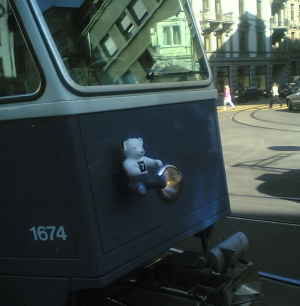
Interesting but… a bit perplexing Who says the Swiss have no sence of humour?
I just saw Revenge of the Sith with a group of chums and I must say it was interesting to see how varied the reactions were. For me, anyone looking for profound meaning in a George Lucas movie is well and truly in the wrong place. With that in mind I went expecting breathless fights, awe inspiring battles between vast starships and Padmé Amidala (Natalie Portman) wearing interesting outfits. And that is exactly what was delivered.
Lucas is at his best when the battlecruiser starships are blowing the crap out of each other whilst the heroes weave their nimble fighters in and out with guns blazing in cheerful disregard of the laws of physics. He also knows a thing or two about choreographing some pretty nifty lightsabre duels. The Yoda vs. Palpatine showdown is a particular eye-popper… who would have thought a 2 foot high gremlin could actually look plausible in a swordfight!
But, and you knew there was going to be a ‘but’, when it really comes down to it, George Lucas is just not that skilled a director. He does fine until it requires people to actually interact other than when they are trying to slice each other in two. At which point he proves that he can produce weak performances even from a splendid actress like Natalie Portman (who was from good to great in everything else I have ever seen her in) and Ewan McGregor (who is debatably my favourite actor). The ‘doomed romance’ between Natalie Portman (Padmé) and Hayden Christensen (Anakin Skywalker) is central to the whole story of the creation of Darth Vader and yet I could not escape the impression that neither of them really cared for each other, for which I mostly blame Lucas’ leaden hand more than the actor and actress in question. Ewan McGregor is a splendid Obi Wan Kenobi when it comes to laying waste to the bad guys with his lightsabre but again, when it comes to his relationship with Anakin, it all seemed a bit unengaged. Only Ian McDiarmid (Palpatine) really managed to transcend the stilted feeling of much of the dialogue and sound like he really meant when he said.
And although I said one does not go to a George Lucas movie to seek profundities, there was one rather splendid line uttered by Padmé whilst in the senate chamber listening to the delegate enthusing whilst Palpatine seizes power to ensure ‘justice and security’:
“This is how freedom dies. To thunderous applause.”
Pity the rest of the movie did not have more such memorable lines. 7.5 out of 10, mostly for the sheer spectacle.
The Taliban is history and Al Qaeda is a mere shadow of its former self, so the question is why are US (and UK) forces still in effective control of Afghanistan? The latest example of appalling behaviour by US interrogators (who appear to have tortured a taxi cab driver to death at Bagram for being in the wrong place at the wrong time) is starting to turn local opinion against the over-mightly US presence. Not only do the people responsible need to be suitably called to account a good way up the chain of command, clearly there are some serious institutional problems in sections of the US military that need to be stamped on pretty harshly.
Given Afghanistan’s history, the fact locals have reacted so well to the US presence for this long is remarkable (and of course understandable considering we enabled the ‘Northern Alliance’ to destroy the Taliban), but staying for much longer is counter-productive. There is no need to kill every single Taliban/Al Qaeda supporter in Afghanistan (or Pakistan come to that) as the infrastructure that supported the September 11th attacks has been well and truly smashed.
Also, the preposterous attempts to curb narcotics production is both utterly doomed to fail and hugely counter productive in that messing with people’s lucrative livelihoods is just about the surest way to guarantee armed opposition to the allied presence in that part of the world. Sure, in an ideal world we would have no heroin and no armed factions willing to tolerate/support Islamic terrorists but in the real world it is likely to be a choice between one or the other. So please, enough with the preposterous obsession with narcotics! If the US and UK states cannot stop tonnes of the stuff coming into their own countries every year, what chance do you think they have of doing so in far off Afghanistan? The effort will of course fail dismally just as it has failed in Columbia but with the extra added ‘goodness’ of encouraging resistance to the pro-Western regime on Kabul. Sheesh.
By all means leave a couple thousand ‘liaison’/training teams behind to bolster the Karzai regime but unlike the clearly unfinished business in Iraq, it is time to declare victory and get the hell out.
Job done. Let’s go home.
|
Who Are We? The Samizdata people are a bunch of sinister and heavily armed globalist illuminati who seek to infect the entire world with the values of personal liberty and several property. Amongst our many crimes is a sense of humour and the intermittent use of British spelling.
We are also a varied group made up of social individualists, classical liberals, whigs, libertarians, extropians, futurists, ‘Porcupines’, Karl Popper fetishists, recovering neo-conservatives, crazed Ayn Rand worshipers, over-caffeinated Virginia Postrel devotees, witty Frédéric Bastiat wannabes, cypherpunks, minarchists, kritarchists and wild-eyed anarcho-capitalists from Britain, North America, Australia and Europe.
|






Recent Comments