This is the question asked by Anthony Daniels over on the Social Affairs Units blog. His article conveys the sense of mounting unease that I certainly share. Read the whole thing.
|
|||||
|
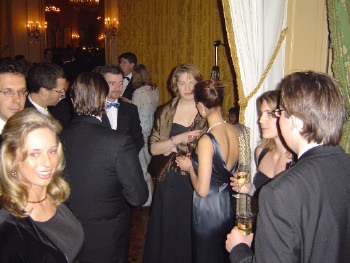
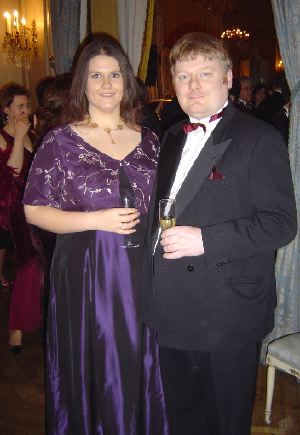
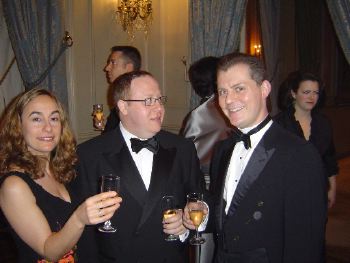
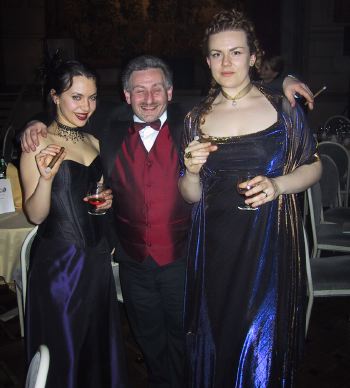
I thought a few more images from the splendid Capitalist Ball last week in Brussels would not go amiss… 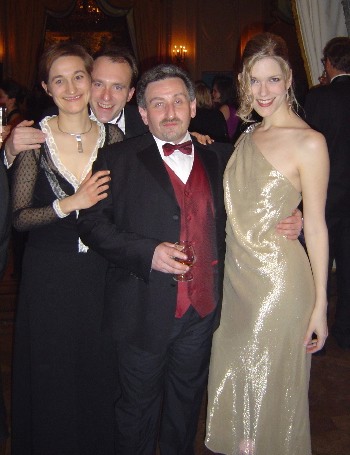
And whilst in the Heart of Darkness, there were some anti-Bush protesters in town (well, I know most of the people who work for the EU fall into that category but that is not what I mean… and as a result security was somewhat tighter than usual. Someone I always imagined Berlaymont, the HQ of the European Commission, as being a place that has a great deal of barbed wire in its future.  The interesting things about the protesters for me were… 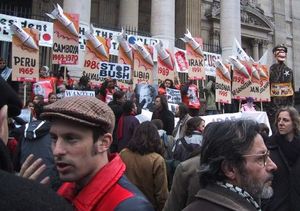 … firstly their very small number and secondly, their fascinating choice of protest placards which decried US military action against a mass murdering fascist regime in Iraq, a mass murdering fascist regime in Yugoslavia, in support of a democratic regime in Bosnia, against a right wing dictator in Panama … Very revealing, would you not agree? February 21st, 2005 | 19 comments - (Comments are closed)
 Leon Trotsky’s views on the role of arts were well known. He argued that art in all its forms existed to convey political messages to the masses and that any other use of the arts was bourgeois nonsense. The idea that it was acceptable for the arts exist to express the personal views of some artist or to simply ‘entertain’ in a non-political sense (not that anything is really non-political to a statist) was just preposterous to Trotsky. Thus if the state wished to advocate or depreciate something, it was the role of the arts to assist with that process. A modern day example of this would be, say, the relentless demonization of smoking. Which brings us to the views of the Orwellian sounding Centre for Tobacco Control. This group of lobbyists is infuriated that their calls for smoking to be censored by the British Board of Film Classification (who were once simply known as the Film Censors) has been rejected.
And so we discover that this lobby thinks is the ‘moral responsibility’ of the state to impose standards on entertainment to make them more in accordance with the wishes of our technocratic betters (them, of course). Not only do they wish to make it as difficult as possible for you to make your own non-coerced choices as to what stresses and chemicals you expose your body to, they wish to prevent you seeing images which do not conform to the message they wish to indoctrinate you with. I would be curious to know if Professor Hastings also supports forcing people to take favoured chemicals? February 11th, 2005 | 19 comments - (Comments are closed)
… is also sauce for the gander, so the old saying goes. The preposterous EU proposal to extend the ban the symbols of the German Worker’s National Socialist Party that is already law in France, Germany and elsewhere, has prompted a move to also ban communist and socialist symbols. So now let us also ban Imperial Roman symbols (they were a slave owning political system), Christian symbols (Inquisitions, religious wars and sundry other nastiness), Confederate Flags… oh hell, let’s just ban all symbols except the ‘peace symbol’ and the EU symbol. 
Via Rex Curry. February 7th, 2005 | 35 comments - (Comments are closed)
The cover of print version of The Economist is titled ‘Taking Britain’s Liberties’ and the issue discusses many of the very serious abridgements of our civil rights that have recently taken place. 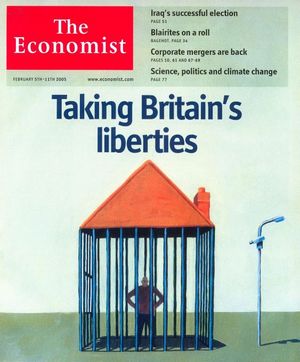 But rather than link to any specific article, what interests me is that the truly grave situation is finally ‘front page news’ in a fairly mainstream publication. It is nothing less than amazing that it has taken this long for the seriousness of the situation to reach the collective editorial consciousness of any significant element of the media outside the blogosphere and other elements of the activist fringe. February 7th, 2005 | 22 comments - (Comments are closed)
Shell, the Anglo-Dutch oil company, is reporting very healthy profits which the Daily Express sensationally reported as £300 per second and there has been a chorus decrying this as ‘obscene’ (sundry Labour MPs) and according to Martin O’Neill (chairman of the trade and industry select committee) ‘beyond the dreams of avarice’. So let me make sure I understand this… of the approximately 80p per litre (about $5.70 per US gallon) charged for gasoline at the pump in Britain, only about 16p is what the oil company charges: the rest is all tax. And the politicians, who are responsible for four fifths of what is paid by British motorists to fill up their fuel tanks, are stamping their feet and threatening additional ‘windfall’ taxes on the companies responsible for the remaining one fifth of what is paid. These politicians and their baying supporters are so wrapped up in a culture of value destroying appropriation and predation that they cannot see the true obscenity. To see that they need do nothing more than look in a mirror. The company should have a large sign on the forecourt of every single petrol station they own in Britain with the following message:
The problem is not Big Oil, the problem is Big Government. February 4th, 2005 | 59 comments - (Comments are closed)
…an angry digital lynch mob. Many fellow bloggers have been attacked by waves of trackback spam by some thieving vermin peddling online ‘texas holdem’ to idiots stupid enough to click those links and part with their money. We have been hit by over 450 trackbacks (which we de-spam swiftly via MT Blacklist every time they change their payload URLs). What is to be done about this? If left unchecked this will simply destroy the trackback system and the beneficial network effect it brings. Presumably the spammers are being directed by companies to drive traffic to target sites, so if a digital lynch mob was to attack those target sites (who are presumably owned by the ones at the end of the chain who pay the spamhaus to do the dirty work), it might impose some cost on their actions, which at the moment involve stealing bandwidth and defacing private property with impunity. As the people involved in this are criminals, it seems to me that the best way to discourage them would be to hurt their ability to make their money. Any ideas? February 3rd, 2005 | 31 comments - (Comments are closed)
If you have not checked out the marvelous Social Affairs Unit blog recently, please let me commend some simply splendid articles that have appeared of late, such as Stumbling towards the EU door marked exit. In particular, keep an eye out for all the ‘Maurice and Gerhard’ articles. January 28th, 2005 | 32 comments - (Comments are closed)
… it pays to ask if they are in a shark-repellent salesman before deciding just how risky swimming really is. Do bad people use the Net to find victims? Without doubt they do and I would not make light of the harm that can be caused by ‘paedophiles’. Yet so often when I hear of the ‘epidemic’ of child abuse going on, it turns out that the story emanates from some agency or NGO who just so happens to have its funding come up for review or who are in some way rattling their begging bowl. But of course who would deny funding to people who only want to protect children? And who would questions the additional motivations of people who make their living in this line of work, not to mention the veracity of the figures for just how serious a problem it really is? To ask those sort of things runs the risk of having your motivations and ‘interests’ questioned in ways that would make most decent folks rather uncomfortable. But just as legitimate grievances about civil rights have in many countries spawned monstrous civil rights industries that are little more than vehicles for shaking down certain sections of society and which have a vested interest in perpetuating the idea that some problems are worse than they really are, I have little doubt that legitimate concerns about internet predators have already led to something similar in the ‘preventing child abuse industry’. Oh, do not get me wrong, I neither doubt child abuse is a real and legitimate issue nor do I think everyone who works to prevent it is just looking to pad their bank accounts, but given how much I surf the net, I cannot help thinking that the scale of this problem does not seem to match the shrill rhetoric we hear on the subject. To listen to some people the fact I managed to grow up going to untended playgrounds and not treating adults as probable abusers… and yet somehow managed to never attract the attentions of a ‘kiddie fiddler’ must make me the luckiest lad around. Yet somehow I rather doubt that. Cynical? You bet. January 27th, 2005 | 12 comments - (Comments are closed)
This is beyond the pale. It is completely insensitive and at a time like this, what idiot would shoot an advertisement for TV that used suicide bombers? Appalling… …Yeah. But I must confess, I howled with laughter. January 27th, 2005 | 22 comments - (Comments are closed)
There is a fine article by Tory MEP Daniel Hannan in the Telegraph called The EU’s four-stage strategy to reduce Britons to servitude. It is an entirely accurate and reasonable article about the process of stripping British (and other European national) institutions of power and replacing them with Euro-level institutions. He finished up with the notion that Michael Howard and the Tories will finally turn things around:
But there is just one problem with that. The slide into the Euro-maw did not start under Tony Blair’s government. In fact it would be no exaggeration to say that the UKIP would not exist today if significant numbers of Euro-sceptic voters were not sick of being lied to again and again and again by Tory politicians. As I said to a table full of captive Tory grandees when I spoke at an event commemorating the end of Exchange Controls, a great many Tory voters simply no longer believe that the Conservative Party actually wish to conserve the things they care about and I very much doubt that any amount of rhetoric by any Tory will win back the trust of days gone by. Many of those former Tories who joined UKIP did so not just to oppose the destruction of Britain as a separate political entity but also because they truly hate their former party and see UKIP as a way to destroy it by making it permanently unelectable. So what Mr. Hannan says is all good stuff, but what makes him think people should trust the party of Michael Heseltine, Ken Clark and Chris Patten to actually turn things around? January 26th, 2005 | 43 comments - (Comments are closed)
The Countryside Alliance continues its quixotic fight to use the approved levers of power to overturn the ban on hunting with hounds. Somehow the realisation that there is nothing at all ‘undemocratic’ about the fact they are being oppressed by the state has still not percolated through those worthy but rather thick country skulls.
But why not? If Mr. Jackson believes that what is being done to him by Parliament is unjust, then why not challenge the supremacy of Parliament? There is nothing sacred about a bunch of lawmakers and a law is only as good as its enforcement. If the Countryside Alliance actually have the courage of their convictions, they must start challenging the right of the state to do whatever it wishes just because its ruling party has a majority in Parliament. Maybe if they realised that they are a minority and will always be a minority they would be less inclined to trust the old way of doing things. There is a long history of civil disobedience to duly constituted authority in the defence of what is right. That matters far more that what is or is not legal. January 25th, 2005 | 44 comments - (Comments are closed)
|
   |
||||

All content on this website (including text, photographs, audio files, and any other original works), unless otherwise noted, is licensed under a Creative Commons License. |
|||||