[AIUI etc, etc.]
In the beginning there were wireless sets. But the government worried that these could be used by spies for a foreign power. So it demanded that wireless owners took out licences. The licences were free the government just wanted to know who had a wireless. Just in case.
Then someone came up with the idea of broadcasting. Music, lectures, news, that sort of thing. The government came up with a scheme. They would charge a fee for the licence. It would also demand that wireless manufacturers make a contribution. To sugar the pill it would make it illegal to sell a wireless set that wasn’t made by a member of the British Broadcasting Company.
The minister responsible for this? One Neville Chamberlain.
And so in late 1922 the BBC, in the shape of such regional broadcasters as 2LO, came into being. And it was very popular – save for the fact that building one’s own set was illegal. But the arrangement had an expiry date. And a committee was set up to decide what to do next.
A hundred years ago it reported and as you can probably guess, the manufacturers were ditched with the recommendation that a public body to be known as the British Broadcasting Commission be put in its place financed entirely through the licence fee.
Why? I seem to remember being told that the Company was in dire financial straits. But there’s not a hint of it in the report as published in The Times. Actually, there is very little justification at all. Although they do say this:
Notwithstanding the progress which we readily acknowledge, and to the credit of which the company is largely entitled, we are impelled to the conclusion that no company or body constituted on trade lines for the profit, direct or indirect, of those composing it can be regarded as adequate in view of the broader considerations now beginning to emerge.
So you are getting rid of something you “readily acknowledge” is a success for something that might work?
We do not recommend a prolongation of the licence of the British Broadcasting Company or the establishment of any similar body composed of persons who represent particular interests.
I’ve got some bad news about how that’s going to work out.
We think a public corporation the most appropriate organization. Such an authority would enjoy a freedom and flexibility which a Minister of State himself could scarcely exercise in arranging for performers and programmes, and in studying the variable demands of public taste and necessity.
The Times’s own report of the report has this to say:
The British Broadcasting Commission will be appointed by the Crown, and the Committee feel that the proposal is an interesting development in the application of the principle of public ownership.
So, the whole thing was a communist experiment. Great. And then there was this doozy:
It is felt that that principle can be easily applied in this instance, because broadcasting must of its very nature be a monopoly.
Clearly that argument falls because it is not true that broadcasting is a monopoly. But even if it were, as a libertarian, in principle I would prefer such things to exist in an unfettered free market.
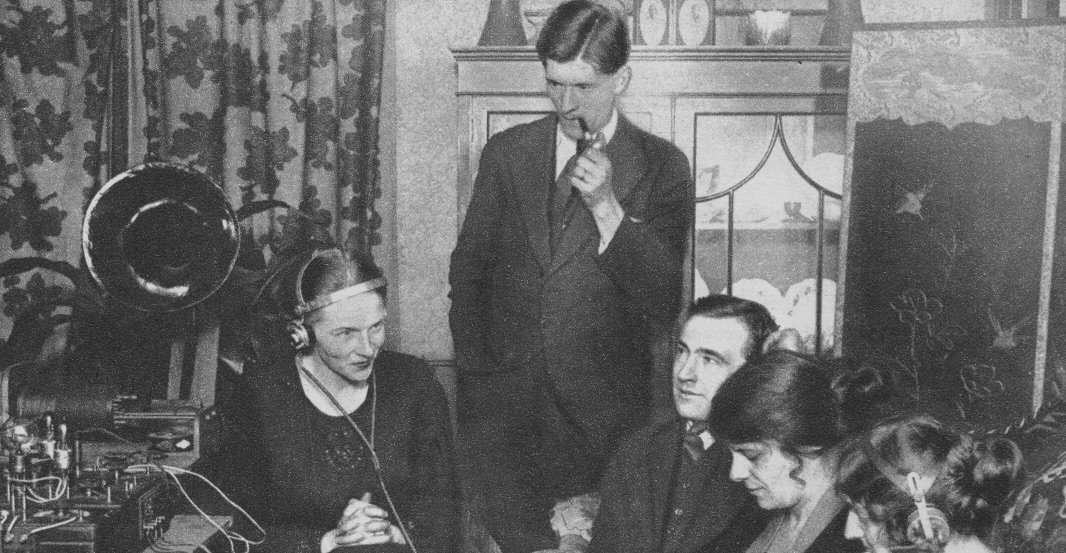
Before it became Lenin in the lounge





“building one’s own set was illegal”
So, no Tom Swifts then? Didn’t Folks tinkering in sheds. Folks tinkering in sheds from the Curies to Steve Wozniak* is where true innovation occurs.
PS. I once built an FM transmitter!
*A lock-up garage in his case but I think the point remains.
IIRC there was some sort of compromise in which you could build your own set so long as you had the appropriate licence and you built the set with British-made components.
From ‘FREE’ to ‘FEE’ is such a slight change – or a big one..
It should be borne in mind that, at the time, radio was seen in a similar light to AI today: there was a great panic about who owned the technology, and The Nation — whichever one you happened to be in — being Left Behind. RCA was a similar kind of a deal to the pre-nationalised BBC, and pre-dated it (it probably gave our lot ideas): a state-ordained patent cartel intended to stop the British Marconi Company from dominating the American radio business.
None of this excuses 1926 and the utterly bizarre continued existence of the BBC, but it does help explain its origins.
People often forget that Neville Chamberlain was not “right wing” (in the sense of believing in smaller government – like Edmund Burke or, later, John Bright), he, like his father Joseph Chamberlain, was a statist – he believed in an ever bigger state, ever more “public services” and so on.
Lord Halifax was even worse – although very mean with his own money, he loved government spending (claiming that ever more government spending “helped the poor”) and wrote essays on political philosophy arguing for a form of Christian Socialism (whilst, at the same time, being a leading member of a supposedly Conservative political party) – the “rights of the community” must be, according to Lord Halifax, held to override the liberties of the individual – and he kept asking for members of the Labour Party to be included in the government, even BEFORE World War II.
It does not surprise me that Mr Chamberlain supported the monopoly BBC – the ideology of statism seems to have captured the British establishment from the late 19th century onwards (although many members of the British establishment were statists even in the early 19th century – for example Lord Stanley – later the Earl of Derby, and Lord Russell – who the absurd history books falsely claim supported laissez faire).
As for modern Conservatives – they have been complaining about far left BBC bias since the early 1960s (more than 60 years), but have done nothing to end the BBC Tax (“License Fee”).
The ideological straight jacket, the refusal to understand that “reform” (appointing this or that “reformer”) to the Collectivist BBC will not work, and that it must be defunded, is deeply depressing.
President Trump at least tries to get rid of taxpayer funding for leftist indoctrination – but British politicians are just puppets of officials and “experts”.
British “Conservatives” even complain to “Ofcom” about the BBC – failing to understand that a body such as “Ofcom” will, by its very nature, always end up controlled by the left.
A Conservative would not appeal to “Ofcom”, a Conservative would GET-RID-OF “Ofcom”.
How many British Chancellors have reduced statism, increased liberty in the economy, over the last 60 years?
One – Nigel Lawson (the overrated G. Howe did NOT reduce statism – quite the contrary).
That is it – one Chancellor in the last 60 years or more, has reduced statism.
That should tell people all they need to know of the British establishment – of the British system of government.
For example, in the early 1970s the Heath-Barber government did not understand that inflation was a monetary matter – that it was an increase in the money supply, they thought it could be tackled by government edicts, and they did not understand that to have a effectively functioning labour market, the powers given to trade unions by government laws needed to be repealed (not new laws added – old ones repealed) – again they tried to control wages by government edicts, not by freeing the market.
The level of economic understanding of someone like Prime Minister Edward Heath was on the same bone-ignorant level as that of the Emperor Diocletian.
And the leaders of the other political parties were the same.
The officials and “experts” did not have to work hard to control these politicians – as the politicians were as ignorant as the officials and “experts”.
Only two Prime Ministers in my life time are worth any respect.
Margaret Thatcher – who was undermined from the start, and eventually overthrown in a squalid anti-democratic coup in 1990, and Liz Truss – who really does believe in liberty (as Margaret Thatcher did), but was never really Prime Minister – being “in office, but not in power” and forced out of office within a few weeks – but an utterly vicious smear campaign that most people still believe today.
Most people still believe that “Liz Truss crashed the economy” – they might as well believe that the world is flat.