We are developing the social individualist meta-context for the future. From the very serious to the extremely frivolous... lets see what is on the mind of the Samizdata people.
Samizdata, derived from Samizdat /n. - a system of clandestine publication of banned literature in the USSR [Russ.,= self-publishing house]
|
The moment you’ve all been waiting for… Okay, I finally found a couple hours free to count and double check the data, relearn how to use an app I used once before, find where I’d left the input data files… So here it is:
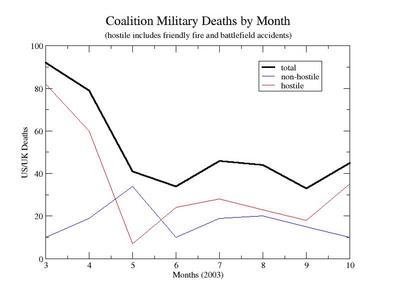
Dale Amon, all rights reserved. May be used with attribution to Samizdata.
All raw data is publicly available.
I’ll leave my discussion for the update in December because the October numbers do not really tell a story unless taken in conjunction with the already striking but incomplete November numbers. I will only comment that a brief look at the data to date speaks very loudly that the enemy forces have recreated a command structure.
Note that I updated the September figures to include some fatalities that were not announced until several days into October.
|
Who Are We? The Samizdata people are a bunch of sinister and heavily armed globalist illuminati who seek to infect the entire world with the values of personal liberty and several property. Amongst our many crimes is a sense of humour and the intermittent use of British spelling.
We are also a varied group made up of social individualists, classical liberals, whigs, libertarians, extropians, futurists, ‘Porcupines’, Karl Popper fetishists, recovering neo-conservatives, crazed Ayn Rand worshipers, over-caffeinated Virginia Postrel devotees, witty Frédéric Bastiat wannabes, cypherpunks, minarchists, kritarchists and wild-eyed anarcho-capitalists from Britain, North America, Australia and Europe.
|
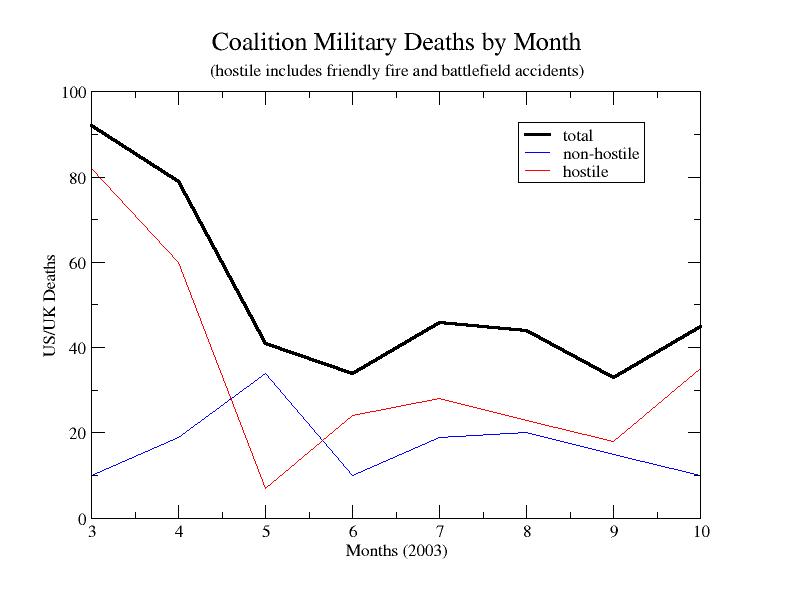





Thanks, Dale. The really appalling thing is that every news organization isn’t creating and using their own version of this graph constantly. That may be because, until September, the trend lines didn’t support the quagmirista agenda.
Now that the trend lines do fit one of the favored media templates, it will be interesting to see if we start seeing more of this kind of thing. Or maybe the media really is just too damned lazy to do anything more than pass on last night’s gossip from the Baghdad Hiton bar.
Without in any way wishing to diminish the valour and dedication of those who have fallen, allow me to say U.S. military losses so far are running at roughly the same level as annual farm and ranch fatalities from accidents.
I would be fascinated to see a comparative study of casualty rates and risk as between soldiers posted in the Baghdad area and law enforcement officers posted in large metropolitan areas in the US. I would bet that soldiering is more risky, but not by much.
But the deaths for Oct (and Nov) so far are rising. It remains to be see whether that trend will continue.
I suspect after November there will be more graphs like this.
I have a number of concerns, which are echoed in Fareed Zakaria’s column this week on MSNBC. What troubles me is we are heading into some of the least palatable options, should people try to hand over power too early.
Say, Dale, would daily updates to the chart be too much to ask for?
Given your generous compensation package here at Samizdata, it seems like the least you could do. 😉
Or perhaps weekly? I agree with R C Dean – this is a great service. Thanks for taking the time and effort both to collect the info and to graph it for us.
Dale– I appreciate your updating the graph despite its conflicting somewhat with your earlier assessment.
But I still question how much the graph really tells us, beyond providing a better sense of each how month’s fatality totals relate to those of other months.
The graph just doesn’t seem sensitive enough to the full reality of what’s going in Iraq to provide us any basis for predictions.
I don’t think the dramatic climb in deaths in November, for example, indicates that conditions are getting significantly worse– this could be the beginning of a steady crescendo, it could be a last gasp, or it could be something in between. The present and future significance of the increase depends on religious, political, military and economic factors outside the ken of the graph.
So while the graph seems like a decent way of representing one aspect what’s happened of Iraq’s recent past, at this point I don’t think it’s a good tool for predicting where Iraq is headed.
Given the quite low levels of fatalaties, one anomolous event, such as the recent downing of 2 helicopters, can create a spike which is not indicative of the events on the ground.
One lucky shot by a jihadi armed with an RPG does not a command structure make.
Thanks for this item and link.
I agree with what A Non said above. If you strip out the helicopter instances the figure for November so far is little different from the other months. If you go further and take into account the truck bomb as being less an instance of rebellion than of terrorism, then everything looks different. The picture that emerges is that the Saddam-lovers/US haters are looking for knockout punches during Ramadan, and are scared of typical guerrilla engagement. They’re reliant on lucky hits of big targets and heavily packed bomb belts, plus a sprinkling roadside bombs that sometimes kill servicemen. It looks very much to me as though the number of ‘attacks’ , or at least their efficacy, might be going down, while the scale of the individual instances is growing more grand.
Consistently what we hear of in the media (chiefly stemming from the BBC) is ‘insurgency’, a word which means rebellion that can only really mean popular rebellion. This is wrong because the attacks are more and more of a terrorist nature- at least if that’s not the case then the little skirmishes are incredibly ineffectual if they are going on at all. The point that the character of the ‘resistance’ (again a loaded term) is changing is an important point. We should be prepared for atrocities, but encouraged if it is the case that they are more isolated. It is my impression that general security is improving- I mean the freedom and to do and be safely in most of Iraq- and has been doing so despite the atrocities of November.
Make that 2 definate shootings down of helicopters and 1 possible in the last 3 weeks.
There have been regular pot shots at choppers which haven’t succeeded, which means it is either a protracted set of luck OR experts from out of field.
We’ll know more soon.