We are developing the social individualist meta-context for the future. From the very serious to the extremely frivolous... lets see what is on the mind of the Samizdata people.
Samizdata, derived from Samizdat /n. - a system of clandestine publication of banned literature in the USSR [Russ.,= self-publishing house]
|
Hundreds hacked or burned to death in Kenya, in response to and election that may well have been rigged. Shootings and suicide bombing by Islamic radicals in many parts of the world. And news of record prison suicides and savage violence here in Britain. And, of course, the centralization and growth of government. Less wildly violent than the preceding, but hardly welcome and based on the same principle – the threat of violence.
Yesterday Cyprus and Malta became part of the Euro Zone. Thus further centralizing power in the hands of the EU and the magic circle of politically connected banks and other business enterprises that depend on the credit money which, in the end, comes from the European Union Central Bank. In this way competition between government currencies, and the possibility, that some might expand the credit/supply less than others, is reduced.
The smoking ban in France is also coming into force, although I hope the French resist. Although other Europeans seem in a passive mood – in “Belgium” the Flemish Liberal party leader is back as Prime Minister although he lost the General Election way back in June – but there is no resistance. And in Switzerland the Swiss People’;s Party got the highest vote of any party for many decades yet its leader is out of office and the Social Democrats, who got only 20% of the vote, remain in office – but there is not resistance. In both cases “Parliament had a vote” is the defence, and it is true it did.
And, of course, it is yet another year of Harry Reid and Nancy Pelosi. Things have come to a strange pass when President George Walker Bush is what pro-freedom people have to rely on – the wild spender facing even wilder spenders, the regulator facing more fanatical regulators.
In Britain also we have regulations being presented as freedom. Prime Minister Brown promises more regulations and calls them a “Constitution for the National Health Service” and there are yet more bans and regulations in other areas.
One can only hope that 2008 does not carry on as it has started.
All the best from Samizdata HQ and wishing all of liberty’s friends success and prosperity in the New Year! Champagne for our real friends, real pain for our sham friends.
In the networked world in which we live, right after New Years struck the ladies started a frenzy of sending greetings to all and sundry friends via…

…IM…

…and SMS…
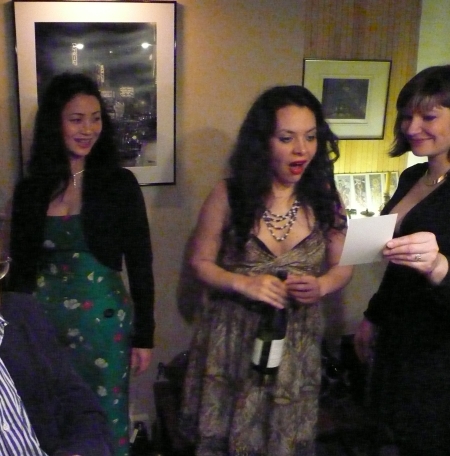
…stopping only to ponder the moral issues involved in sending a compromising picture of a Tory MP to Guido Fawkes…

…resulting in David Carr giving us all his Serious Lawyer Look™ before eating the aforesaid image for the good of the team…
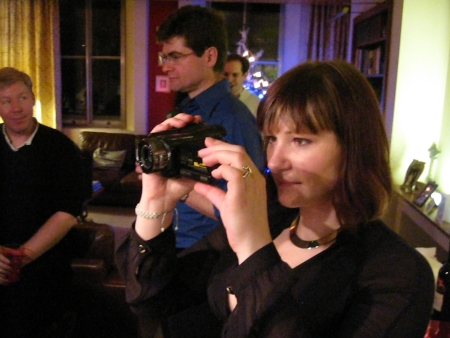
…whilst Adriana recorded everything with her new toy…
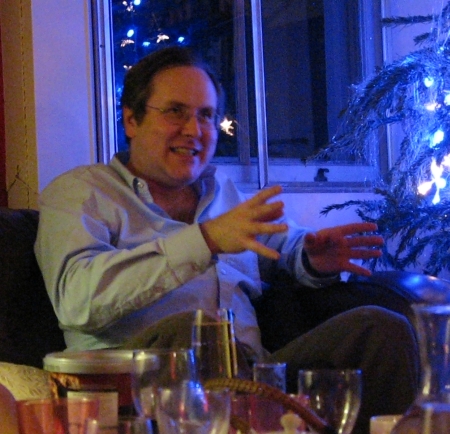
…and I went back to plotting the overthrow of The Evil Machine how to snaggle some more champagne…
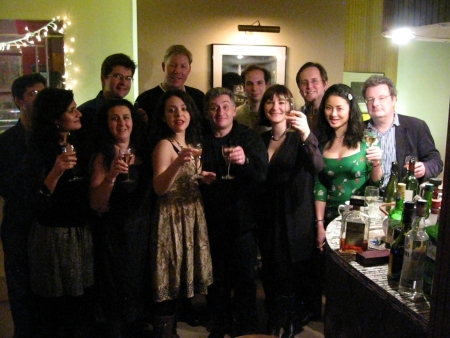
…before everyone else drank the house dry.
This morning Fox and Friends concentrated on three candidates in relation the Iowa caucuses on Thursday night: the two lead candidates in the polls, Mike Huckabee and Mitt Romney – and John McCain… this was in spite of the fact that Senator McCain is not in Iowa (he is in New Hampshire) and that Fred Thompson is ahead of John McCain is most of Iowa polls.
This is a part of pattern: last night Fred Thompson was on Fox News Sunday, but in the panel discussion, later in the show, the panellists ignored Fred Thompson. He is attacked by people, including me, for not going on enough television shows – but when he does go on what he says is ignored, so perhaps I see why he does not clamour to go on. Yesterday morning Fox and Friends, like the rest of the media, was busy laughing at Fred Thompson’s comments about not being obsessed with politics: “If one is not passionate about campaigning one should not run for office,” was the message of the media.
But what sort of person is passionate about the political process? Not getting things done – but the process of gaining votes. Of going around pretending to be close personal friends with lots and lots of people one has never met before?
Fred Thompson is in the middle of a 40 town Iowa tour – so he is hardly lazy. And he does go on television shows – thus dealing with critics, such as myself, who attacked him for not going on enough shows. But what sort of person would enjoy all this?
A lunatic. Someone who was interested in office for its own sake – not as a means to reduce the size and scope of government.
What the media, including Fox News (the only non-leftist news station and, therefore, of vital importance in the Republican nomination process), are saying is that Fred Thompson is too sane to be President. It is not enough to produce detailed policies for dealing with the entitlement program Welfare State (a cancer that is destroying the United States and the rest of the Western World), or producing a new optional flat tax (individuals could continue to use the existing system if they wished to) to deal with the nightmare of complexity that the income tax has become.
It is not even enough to have a long record of service, going back to Watergate and taking down a corrupt Governor of Tennessee in the 1970’s. And having one of the most Conservative voting records in the United States Senate – before leaving it in disgust at how the system did not allow real reform.
No – someone has to enjoy the prospect for office for its own sake, not to reduce the size and scope of government and restore a Federal Republic. One must enjoy the whole process of politics – i.e. be crazy. Or one must pretend to enjoy it – i.e. be a liar.
And then people complain that politicians are either crazy or corrupt. When they shoo away anyone who comes along who is neither crazy or corrupt.
Kevin Hassett, of the American Enterprise Institute, has a pretty good item over at Bloomberg about the good economic developments over the past 12 months, which inevitably get overlooked with so much understandable focus on the sub-prime mortgage snafu and the associated mega-buck losses sustained by some of the world’s top financial institutions, such as Citi and Merrill. But much of the economic news is good; when I punch some numbers on my Bloomberg machine, I am reminded that a goodly number of African stock markets are up strongly this year – that nicely upsets the usual cliches of Africa as a story of unmitigated woe, not that there are not serious problems there of course. China’s stock market looks like a bubble but the growth of the economy is real enough, whatever one thinks of government statistics; one of the best performing stock markets of 2007 has been Germany’s, up more than 20% this year, despite the high exchange rate of the euro. France may be starting to turn a corner, despite my doubts on how far Sarkozy will go in liberalising that country’s economy. A weak dollar should boost American exports and hence help the US economy close its trade deficit. Most Latin American economies are on an upward curve and Venezuela’s Chavez received an admirable rebuff in his attempt to seize permanent power late in the year. (Quick question: what are readers’ bets for most promising economy in 2008?). Russia is problematic: its status as an energy exporter means it is enjoying a bonanza of revenues, but this needs to be matched the emergence of a large, broad middle class able to sustain the sort of entrepreneurial economy for the long term; India is a bright spot; most of central Europe, Scandanavia is in decent shape. Italy is a permanent car accident and a possible quitter of the euro, but Italy seems to have incredible powers of survival.
All of these developments should be borne in mind when you look at how Britain’s economy has performed. On one level, the figures are poor: we have UK public deficits despite years of economic growth; tax burdens are rising and productivity is not what it could be; but from my admittedly biased vantage point in central London, I do not see a country in crisis (what I do see is a statist political culture in decline or at best, paralysis, which is not quite the same thing); the inventiveness and entrepreneurial gusto in this country is impressive, although one worries about the impact of an exodus of bright talents to foreign, sunnier climes. All in all though, I think it quite wrong to end 2007 on a whiny note, so I will not. As far as the cause of liberty is concerned, there is all to play for; the ID card venture is not a done deal and the Big Brother state received a mighty poke in the eye this year with the fiasco of the lost data on 25m people. I get more and more sense from the media that Britons are losing patience with this state of affairs. Let’s hope so.
Wishing my fellow contributors and our readers a very happy, prosperous and healthy 2008.
Fred Thompson or Ron Paul? Like Perry and some others, I would rather see a big government Democrat elected than a big government Republican. At least that would bring back some opposition. Republicans in Congress have a much better record of reining in the Democrats’ presidents than their own. And as I explain later, I think that one of these two is the only Republican candidate capable of winning the national election.
Ron Paul answering the What programs? question by naming three cabinet level departments … Wow. Good answer. If there was no rest-of-the-world, he would possibly have my vote.
“Possibly?!” Yes. Possibly. Why? Because good intentions are not enough. Many people have the right ideas. Even if elected, he needs to maneuver his ideas through both the Washington players and the great ambivalent middle of the electorate. He needs to explain and convince massive numbers of mainstream people that what he will bring is better for them personally. How many think Ron Paul is up to that job? I don’t.
Does any small government candidate have a chance both to be elected and a chance of accomplishing a rollback if elected? → Continue reading: Fred or Ron?
I personally believe that U.S. Americans are unable to do so because some people out there in our nation don’t have maps and I believe that our education like such as in South Africa and Iraq and everywhere like such as and I believe that they should our education over here in the U.S. should help the U.S. or should help South Africa and should help Iraq and the Asian countries so we will be able to build up our future for us.
– Lauren Caitlin Upton, eloquently the making the case for home schooling.
Why is it always sadder when tragedy strikes hot people?
– Ugly Betty, smuggling profundity in with the fluff.
I was channel surfing the other day when I came across a strange caption at the top of my television that caught my eye, causing a definite double take…
WH O RE 1
Anyone care to guess what I was watching?
Christian Michel holds talk-and-discussion evenings at his London home on the sixth and twentieth of each month. If you want know more about these events email him at cmichel@ cmichel.com. I am doing the talk at the next one, the first of 2008, on January 6th. My chosen subject will be: the history of music making in the twentieth century. I have just sent an email to Christian about my talk, from which he will concoct his email invite to all his regulars. I am still thinking about what I will finally say and would greatly appreciate input from the Samizdata commentariat on the subject. So here is my email to Christian:
An extraordinary interlude – an aberration, you might say – in the history of music is now drawing to a close.
The musical opportunities created by modern electronics, in the form of electronic recording, radio, and then later of actual electronically powered musical instruments, were responded to by the music profession in two profoundly contrasted ways.
The “classical” fraternity concentrated first on popularising – and then on recording in opulently perfect sound – their resplendent back catalogue.
“Pop” music has been just as profoundly shaped by electronics. Indeed, it is the creation of electronics.
The most fundamental effect of electronics on “pop” music has been that popular music (by which I mean the old folk traditions) has no longer been obliged to rely either on musical literacy skills, or, for those in whom such skills were lacking, memory. “Folk” music always teetered on the edge of oblivion, relying as much of it did on the human brain as its hard disc, so to speak. And folk musicians were forced to concentrate on remembering the old songs, having little brain space to create new ones (folk music before recording was rather like literature before printing. Written manuscripts were about as perishable as the people who created them, for they lasted about as long).
Recording, for folk/pop musicians changed everything. No longer did the lowest class of musician depend upon their own memories to keep their previous creations and inherited repertoire alive. They could compose at their instruments, and record it, confident that it would then survive, and they were thus liberated to get on with creating the next would-be hit. And pop musicians were as uninhibited in their use of new, electronic instruments as the classical fraternity were mostly stand-off-ish about them (I know: Boulez, Stockhausen etc. They’re worth a mention).
This is a complicated story. Technology takes time to develop and get cheap, and it’s still hurtling along of course. Electronic recording (and CDs) took nearly a century to get good enough to do justice to Beethoven, Bruckner, Mahler and Wagner. At it took a similar time to get cheap enough for working class teenagers to play with it in bedrooms and garages.
The classical recording enterprise is now basically concluded. Oh, there are still occasional gems to be found in among the dross at the battle of the barrel. But, the great works are now recorded, and re-recording them again and again cannot count for as much now as making similar recordings did fifty years ago when classical fans were still hungry to hear their core repertoire. “Classical” musicians must now look to create new repertoire of a sort that can earn them a living, the inverted commas there being because a lot of them won’t really be “classical” musicians anymore and are becoming a lot more like pop musicians, from whom they have much to learn. The music profession will once more be a single (if huge and sprawling) entity, full of varieties of taste and of technique, but without that cavernous gulf that divided it during the twentieth century (in this respect it resembled and resembles politics. Discuss).
I could go on, and on the night I will, but I’ll end by briefly discussing my qualifications to do this talk. Well, first of all, I am a music fan, possessing an small-to-average sized pop CD collection and a gargantuan classical CD collection, having been a classical collector and listener all my now long life. I was a teenager during the sixties musical revolution. I have also been studying the history of the means of communication and information storage for as long as I can remember. I am no great shakes as a musician, although I did play the flute in my school orchestra, and I had a fabulous treble voice as a boy, which I used to sing in choirs of various kinds, at home around the piano and at school. But in the end, I’ll just have to hope that my audience finds my talk illuminating and enjoyable. For the truth is that they know most of the facts pretty much as well as I do. The question is, will I make more sense of those facts for my listeners? I’ll try.
I want to reproduce, in somewhat edited form, a comment I left on Adam’s blog on the political issue of evolution vs. creationism…
The only debate that should be had on the issue of evolution vs. creationism is “does the state have a role in ‘edukshun’?” I say no and I suspect Ron Paul agrees. I have no problem with people believing whatever wacko things they want (and for me that includes all religion), but the evolution vs. creationism debate should be a non political one and the only way that can ever be true is when the state is no longer involved in education.
I think creationism is nuts and it makes me think less of Ron Paul that he has a religious objection to the theory of evolution. But frankly this should not be a matter for political concern and he at least is highly unlikely to force state schools to teach it (or anything else for that matter). The fact that it is a political matter shows something it very wrong and the correct ‘something’ that needs debating is not evolution, it is state schooling. Return all schooling to the private sector and the whole issue goes away from the political sphere. Let the market decide if there is demand for schools that teach creationism, I have no problem with that at all.
To which I would add…
The way to get people behind this is to argue that the only way to make sure your children are not subjected to [choose one: (1) Godless indoctrination (2) religious gibberish] is to make education non-political and the only way to do that is for schools to not take tax money. The moment anything involves ‘public money’, it perforce becomes political because that means you are trying to spend the money of people who do not agree with you. Dis-intermediating the state is in the interests of both sides of this issue.
The same logic applies to homosexual marriage. Get the state out of the ‘recognising marriage’ business and the political issue goes away. Want to shun/accept same sex couples? The only way you can be sure you are free to act on your belief on this subject is to make it a social issue, not a political one, by getting the state out of the way.
Slavery was in fact the very first form of “Renewable Energy”. Slavery was green! And, what is even better, slavery was sustainable – it lasted for thousands of years, until the ability to use fossil fuels gave us the liberty to feel bad about it. Whenever someone waxes eloquent about “Renewable Energy”, think slavery. Because that is where wishful thinking is taking us.
– Commenter Alice.
Bebe is now three, and has taken to the proper feline adult life of sitting in chairs, demanding to be fed at four in the morning, catching lizards, and occasionally waving her claws at people.
|
Who Are We? The Samizdata people are a bunch of sinister and heavily armed globalist illuminati who seek to infect the entire world with the values of personal liberty and several property. Amongst our many crimes is a sense of humour and the intermittent use of British spelling.
We are also a varied group made up of social individualists, classical liberals, whigs, libertarians, extropians, futurists, ‘Porcupines’, Karl Popper fetishists, recovering neo-conservatives, crazed Ayn Rand worshipers, over-caffeinated Virginia Postrel devotees, witty Frédéric Bastiat wannabes, cypherpunks, minarchists, kritarchists and wild-eyed anarcho-capitalists from Britain, North America, Australia and Europe.
|






Recent Comments