We are developing the social individualist meta-context for the future. From the very serious to the extremely frivolous... lets see what is on the mind of the Samizdata people.
Samizdata, derived from Samizdat /n. - a system of clandestine publication of banned literature in the USSR [Russ.,= self-publishing house]
|
I thought our readers might wish to celebrate the end of a very long and arduous road that Carla Howell and her friends have trod. I have heard they have just passed the last hurdle and their initiative to end the income tax in Massachusetts will appear on the ballot this fall.
If you are in Massachusetts, help spread the news. This is your chance to roll back the State like it has never been rolled before.
Get out there and give the Massachusetts government a good extra hard kick in the goolies for us here at Samizdata!
I must admit I have tended to view Naomi Klein, the author of No Logo, the anti-capitalist book, as a committed socialist but not obviously a downright liar. If this scathing review of her recent book, The Shock Doctrine, is accurate, then she he has appallingly traduced the late Professor Milton Friedman, accusing him of holding attitudes that he did not actually hold, such as over the recent invasion of Iraq (she claims he was for it, in fact he opposed it). The book, according to the review, reveals that she cannot figure out what the difference between a classical liberal and a neo-conservative is, for example. As the reviewer, Johan Norberg makes clear, a lot of “shock” events, like terrorist attacks, wars and hyperinflation do not work in the interests of classical liberals, but quite the opposite. In Weimar Germany, inflation destroyed much the middle class, helping to pave the way for Hitler. Wars have been used by national leaders to justify big increases in government powers that are often not rescinded. And so on. Klein either knows this, or cannot be bothered to mention it as it does not fit into her thesis.
Anyway, read the review. It is superb.
Apologies: I got the woman’s surname wrong, now fixed.
That invaluable organisation, the Taxpayer’s Alliance, has worked out that the total cost of the various surveillance and data-gathering services favoured by the UK government is just under £20 billion, or about £800 per household. The figure is a total, not an annual sum. £20 billion is a huge figure, even in these times of inflated financial sums.
Now the question arises whether, if we really do face serious security threats – and I think we do – what else could that £20 billion have purchased that might actually have made us safer?
Of course, £20 billion could also enable quite a few tax cuts, but that is obviously hark heresy these days (sarcasm alert).
Thousands are dying every year thanks to Britain’s health service not delivering the standards people expect and receive in other European countries. Billions of pounds have been thrown at the NHS but the additional spending has made no discernable difference to the long-term pattern of falling mortality. This is a colossal waste of lives and money. We need to learn lessons from European countries with healthcare systems that don’t suffer from political management, monopolistic provision and centralisation.
– Matthew Sinclair, TaxPayers’ Alliance (via Helen Evans)
One of the more annoying features of tennis today – certainly in the Wimbledon Men’s Finals – is how the victor often feels the urge to climb up the side of the stand after he has been declared the winner to embrace his family, girlfriend, mistress, personal trainer, etc. Last night, after winning the thrilling match against Federer, Nadal did all this, and then tried to climb all over the stand. I thought, “Christ, the idiot is going to fall off”. It would have been a bit tragic had this marvellous player suddenly injured himself in this way.
In future, Rafa, keep off the bloody stands.
A report in the Daily Telegraph today over the Group of 8 gathering of political leaders in Japan carries this:
Mr Brown will call for the creation of a new international panel of experts – mirroring a similar panel for climate change – which will examine long-term trends in food supplies and offer advice to individual countries.
A panel of experts? Surely, the best judges of long term trends are those investors who have been putting their own and their clients’ money on the line. Those evil people – speculators – have a strong vested interest in getting these long-term trends right. I would rather listen to the famed investor and commodities writer Jim Rogers than a bunch of academics hired to form some form of panel.
He will also pledge to increase investment in agricultural research and push for an increase in aid to agricultural projects in the developing world. In total, Britain’s contribution to tackling higher food prices has now cost the Government more than £500m.
How about not spending taxpayers’ money on such ventures and instead, removing trade barriers and other trade restrictions, such as production quotas and the like?
As for encouraging research, there is no need for states to do this. Large companies in the agricultural sphere, such as Monsanto and Bayer do oodles of research already. These governments would do better to resist attempts to outlaw GM foods and other “frankenstein” technologies.
That great economist Gordon Brown is at it again. His depth of understanding of real people and the real world is unrivalled after 11 years of prudent stewardship of the UK’s whole economic wellbeing:
Britons must stop wasting food in an effort to help combat rising living costs, Gordon Brown has said en route to the G8 summit in Japan.
Mr Brown said “unnecessary” purchases were contributing to price hikes, and urged people to plan meals in advance and store food properly.
A Cabinet Office study on food policy reveals that the average UK household throws away £8 of leftovers a week.
Back-to-front puritanism. Sounds to me like the ‘problem’ is food is so relatively cheap that Britons don’t mind wasting it. (Encouraged by bureaucratic nonsenses such as use-by dates, no doubt.) If something is genuinely expensive and hard to get, people do not throw it away.They don’t plan meals in advance and store food carefully because they can afford to live at their convenience and with less effort. We are so rich in the western world that the price of basic food and of energy has only a marginal effect on our living standards.
That’s not to say consumers and producers, unless prevented from doing so by state bullying in some unpredicted direction, won’t change their behaviour because of that marginal increase in costs. They certainly will. What they won’t do is simply less of the same thing, nor will they without threats follow the puritan agenda. The whole social and economic system will adapt in a million different ways by changes in factor prices, taste and technology.
Brown seems to think we should always be striving and suffering towards some abstract common goal, however. So the facts don’t suit.
So it is with ‘recycling’. Driven by targets and prohibitions and propaganda, it has become a national obsession. But this is at the cost of subsidy and taxation that uses up resources and displaces people from other activity. Some re-uses are enforced; others are now forbidden. It has more to do with the taboos of governmentalism than any rational allocation of resources.
There used to be quite a lot of voluntary recycling, the measure of the utility of waste reclamation being the price of the materials. Much of it has been stopped. That ‘waste’ food would have had value and been sold to pig-farmers not so long ago. Banned. On no evidence. For no other reason than it suited the bureaucracy.
I began fully-listening when Ellis Cashmore appeared as a ‘witness’. Cashmore is ‘professor’ of Culture, Media and Sport, surely the Andrex of academic disciplines. You can listen to him on the website – it’s the programme about celebrity – he appears at about twenty minutes. You may need a new laptop as these machines don’t take kindly to being flung across the room. The gist of what Cashmore said was contained in his line ‘Cultures are no better or worse than each other’. Right then, Prof, here’s my time machine and, woosh, here we are in Tiananmen Square during Mao’s Cultural – geddit? – Revolution. You, being an intellectual, are about to be stamped to death for the entertainment of the peasants. Luckily, I am on hand to, first, console you with the thought that all cultures are equal and, secondly, to operate the time machine and whisk you off to Germany in the thirties. I, having a Jewish mother, am being dragged off by Brown Shirts, but, luckily, you are on hand to console me with the thought that all cultures are equal. Sadly, you cannot operate the time machine. … Who are these people? What are they for?
– Bryan Appleyard listens to the BBC Radio 4’s The Moral Maze
In 2004 anti-leftists were determined to prevent the Democrats capturing the Presidency. “No Child Left Behind” and all the rest of the Bush’s absurd wild spending (opposed by John McCain and a some other Republicans) were forgotten about. Even Saddam turning out not to have stockpiles of WMDs (although, yes, he had plans to get them) was downplayed by people trying to prevent a President Kerry, and lots of evidence of serious mismanagement of the war in Iraq was ignored (apart from by McCain and a few others). Total focus was on winning the election.
However, even if Senator Kerry had won – the Republicans would still have controlled Congress. Now in 2008 there is the most leftist leadership of House and Senate there has ever been. Speaker Pelosi (who has shown that the “Blue dog” moderate Democrats are either a myth or a joke) and her friends in the House (such as Barney Frank). And a Senate in the hands of people like Senator Durbin – with pathetic “coal makes you sick” Harry Reid acting as front man.
Yet no one cares that the Presidency may be about to fall to the Democrats – indeed a Democrat whose record and background is of the hard left.
Total power over every part of government (from the FCC to the IRS) via control over the Executive and the Legislature – and power over the appointment of judges. And there is no focus – no will to prevent it happening.
“But they are corrupt, Paul”.
Someone can be corrupt and still work for a cause.
For example Senator Dodd is corrupt (and in the most old fashioned sweet heart loan from a corporation way), but this is not stopping him putting a housing bill into law that will send yet more millions upon millions of tax Dollars to leftist activist groups. Think how much more the left will be able to do when they have total power.
Or stay as you are and do not think – after all thinking about it might mean it would occur to you that you should do something.
I make a point of looking at the Economist each week, in order to see what this part of the establishment are thinking. I can not normally stand to read it for than a couple of minutes (as it makes me feel unclean), but that is enough time to find some utter absurdity with which amuse people.
However, this week I think I have come upon the worst Economist article of all time:
The title, featured on the front cover, is “McCain’s lurch to the right”… For those who do not know British “political speak”, “lurch to the right” is what the Labour party (and so on) have long said whenever a Conservative party politician gives any sign of not agreeing with everything the BBC and Guardian newspaper hold to be correct.
However, in the case of John McCain the Economist goes overboard.
First he is, as normal with the Economist, damned with faint praise – for example we are told that although it “may be wrong-headed” he does genuinely believe in the right of individuals to own firearms – so at least he is an honest lunatic. We are to forget the basis of freedom in the right of freeman to be armed, in both Classical Civilization and in English (and other Germanic) Common Law – only a few insane Americans believe in the right to keep and bear arms.
But McCain is worse than wrong-headed – he is also a liar.
For example, he has “recently” been saying that there should only be immigration reform after the borders of the United States are secured – which everyone knows is impossible.
Actually it is not a recent “lurch to the right” as McCain has been saying this (over and over again) for more than a year. And everyone clearly does not include the vast majority of Americans who support securing the borders.
On taxation the evil McCain now supports the Bush tax rate cuts – which he once wisely opposed (no mention of John McCain also opposing the Bush spending increases of course), and the crazy man even wants more tax cuts.
The Economist of course does not mention that the American tax code is absurdly complex and something like a voluntary flat tax would be sensible – but it is more than this.
According to what is implicit in the article this recent “lurch to the right” by McCain, actually – again something he has been saying for ages, is wrong (indeed obviously wrong) – McCain should come out and support higher taxes. Which is what “ending the Bush tax cuts” actually means.
So the Economist holds that taxes should be increased at a time of economic weakness – this is a position that even Lord Keynes would have had trouble with. Even a few months off the Federal fuel tax is an insane thing that the all-wise Senator Obama “cleverly opposed”.
Finally we are told that McCain’s support for off shore drilling, if the States agree, is the sort of thing that centrists and moderates would never go for.
This is odd on two grounds:
Firstly as John McCain’s main task at this election is to bring out the conservative, or rather conservative and libertarian – i.e. the anti left, base (a lot bigger than the Republican base) which includes many people who really dislike him. The stay-at-home threat is a terrible one for McCain.
Secondly – the Economist folk simply do not know what they are talking about.
In reality, with the price of fuel being what it is – and set to get a lot higher over time, about 70% of American voters support an end to the Federal de facto ban on new off shore drilling. Nor does the Economist even mention alternatives like opening up the areas of the Western States for oil shale, and allowing new nuclear power stations (both of which McCain has supported and Obama has not).
So by “centrists and moderates” the Economist in fact means “committed hard core leftists who would never vote for McCain if their lives depended on it”.
I do not expect to influence some people to vote for McCain with the above, John McCain has too much baggage (McCain-Feingold, the amnesty bill for illegals, and so on) for that.
However, I do hope to have finally have convinced the die hards that if the Economist is a “free market” publication then I am the Emperor Augustus.
The Economist is written by a group of people who were taught a lot of semi, and not so semi, collectivist doctrines at university – and simply trot them out each week in vague connection to the events of the time.
As a current resident of Beijing, my social life is already being affected by the slew of new rules and bylaws raining down upon the citizens of this city to best ensure that the upcoming Olympic Games is “safe” and – more importantly – free of episodes that might embarrass the notoriously thin-skinned government of China. Consequently, less easily controlled events in celebration of the Olympics such as street parties, spontaneous parades and other assorted manifestations of public revelry have all been banned. According to a BOCOG website, restaurants, bars and clubs will be subject to a 2am curfew. Even establishments that usually set up tables and chairs on footpaths for patrons to enjoy their food and drink in the balmy evenings have been forbidden from doing so this summer. Considering the above, I can reasonably confidently predict that if the Olympics goes off without a hitch, this colossally expensive event will be the most boring in living memory. Still, at least the fun-deprived foreign visitors will have something to snigger at:
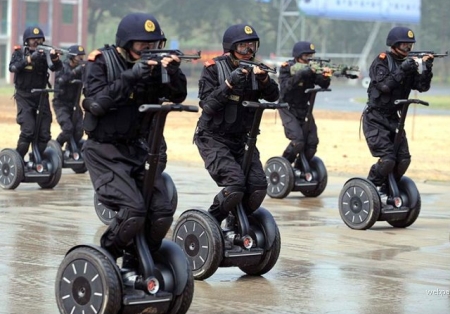 Dinky little machine guns: check. Shiny gold targets on helmets to give opponents something to aim at: check. Segways: check, baby, and welcome to the future. Look out, bad guys – here comes the recently unveiled and Segway-straddled Chinese anti-terror/crowd control unit, charged with protecting the Olympic Games from universally acknowledged threats, as well as those that keep only CCP apparatchiks awake at night. Judging by the way China’s finest are handling their weapons in this photo, however, they look to be more of a danger to each other than to anyone not behaving.
If you want to be a part of the most secretive of the New Space launch companies, here is your opportunity!
|
Who Are We? The Samizdata people are a bunch of sinister and heavily armed globalist illuminati who seek to infect the entire world with the values of personal liberty and several property. Amongst our many crimes is a sense of humour and the intermittent use of British spelling.
We are also a varied group made up of social individualists, classical liberals, whigs, libertarians, extropians, futurists, ‘Porcupines’, Karl Popper fetishists, recovering neo-conservatives, crazed Ayn Rand worshipers, over-caffeinated Virginia Postrel devotees, witty Frédéric Bastiat wannabes, cypherpunks, minarchists, kritarchists and wild-eyed anarcho-capitalists from Britain, North America, Australia and Europe.
|





Recent Comments