We are developing the social individualist meta-context for the future. From the very serious to the extremely frivolous... lets see what is on the mind of the Samizdata people.
Samizdata, derived from Samizdat /n. - a system of clandestine publication of banned literature in the USSR [Russ.,= self-publishing house]
|
I have been reading this book, by Ian Mortimer about Henry IV. King Henry ascended the throne of England after successfully deposing Richard II, and his own reign seems to have consisted of one attempt after another to depose him. Yet Henry IV died in his bed of natural albeit very painful causes.
One of these failed rebellions against King Henry, at the beginning of the year 1400, involved a certain Sir Thomas Blount.
Only six men, including Sir Thomas Blount, received the full traitor’s death of being drawn, hanged, disembowelled, and forced to watch their own entrails burned before being beheaded and quartered. Blount’s execution resulted in one of the greatest displays of wit in the face of adversity ever recorded. As he was sitting down watching his extracted entrails being burned in front of him, he was asked if he would like a drink. ‘No, for I do not know where I should put it’, he replied.
I had no idea that the people who suffered these frightful deaths were able to say anything at this late stage in their ordeal. I guess the executioners were trying to be as nice as they could to Sir Thomas, against whom they presumably had no personal animus, rather like Michael Palin in this. But, talk about too little, too late.
I realise that I keep going on about it, and I realise that I dissent from the view often expressed here that the next British government (Cameron’s) will probably be no better than this government now, but if I were allowed just one more thing to say about Gordon Brown and his government, it would be that I wish people would stop saying or writing this:
Mr Brown is a good, decent man but …
Mr Brown is not a good, decent man. He is an utter shit, and his utter shitness is inseparable from the difficulties he now faces in continuing to be Prime Minister despite his obvious unsuitability, and to the miseries he is still inflicting upon the rest of us.
I will not expand at length about Brown’s shititude. Suffice it to say that Gordon Brown is the living embodiment of the phrase “he won’t be told”. When he is told, he shouts like a spoilt but thwarted seven year old, until whoever it is just gives up or goes home and pretends to be ill. And all his henchmen are like this too. All who care have heard the stories. All who can bear to think about them now know of the blunders, and of the refusal to do anything about them except increase the doses of poison. Brown himself is beyond hope, and he will be subjected in due course to the modern, humane version of hanging, drawing and quartering (which is a whole hell of a lot more humane than he deserves), either by his underlings or by the voters. I will merely content myself now with explaining why otherwise sane-seeming journalists like Alice Miles (the one linked to above) keep repeating this obvious tosh about Brown’s goodness and decency, despite all of them knowing perfectly well that it is tosh. It is just possible that if the explanation – the one you are about to read – of this strange phenomenon were to get around commentators might be persuaded to stop talking this particular brand of tosh.
The explanation, briefly, is that when you are denouncing someone as a complete waste of space and begging the earth to open up and swallow him, you find yourself wanting to say something nice about him, anything nice, to prove that you are being fair, that you are willing to give him credit for his virtues, such as they are. And this is where this absurdly false cliché about Brown’s goodness and decency has come from. Brown is a good and decent man (and I am a kind and fair-minded and good-hearted person for saying so), but blah blah blah. But he is a crap Prime Minister, his decisions have all been disastrous, he has wrecked the economy, he is an unreconstructed state centralist despot despite decades of evidence proving the evilness of such despotic centralism, his speeches are intolerable, he must go, he will not go, they must dump him, they will not dump him, the country cannot take much more of this, blah blah blah. But the truth is simpler. Prime Minister Brown has no virtues. None. He is a bad and nasty man. And blah blah blah. It may not serve the argumentative purposes of commentators to find no nice things to say about Mr Brown at all, but it would serve the truth far better.
I went in search of funny quotes, like the one at the start of this posting, but instead found mostly sensible ones, like this (via here):
The fact that insurance companies refused to insure property located on storm-wracked coasts is not an instance of market failure. A market failure supposedly occurs when the price of goods and services do not reflect the true costs of producing and consuming those goods and services. That’s clearly not what happened here. The market is practically shouting at people, “Don’t build something you can’t afford to lose where hurricanes periodically crash ashore.”
Instead the state “insurance” scheme is an example of government failure which occurs when a government intervention causes a more inefficient allocation of goods and resources than would occur without that intervention. In this case, it’s the government that’s telling people that it’s OK to build in dangerous areas and then not charging them enough for the “insurance.”
And this (via here):
The CRA …
That’s Community Reinvestment Act.
… forces banks to make loans in poor communities, loans that banks may otherwise reject as financially unsound. Under the CRA, banks must convince a set of bureaucracies that they are not engaging in discrimination, a charge that the act encourages any CRA-recognized community group to bring forward. Otherwise, any merger or expansion the banks attempt will likely be denied. But what counts as discrimination?
According to one enforcement agency, “discrimination exists when a lender’s underwriting policies contain arbitrary or outdated criteria that effectively disqualify many urban or lower-income minority applicants.” Note that these “arbitrary or outdated criteria” include most of the essentials of responsible lending: income level, income verification, credit history and savings history – the very factors lenders are now being criticized for ignoring.
And this (via here):
If we really wanted advance warning (and a chance to mitigate) the next financial crisis, we wouldn’t be banning short-selling; we’d be legalizing insider trading.
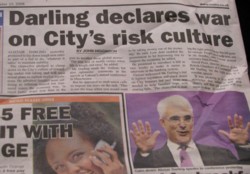
Now there’s a thought. All those quotes are from Americans, about America. But it is at least as bad here. Today, on my wanderings in London, I came across a headline in a free newspaper that went Darling declares war on City’s risk culture.
What new horrors of intervention will be inflicted upon the British economy by this dying government of ours, in its dying months, as they forget about the country as a whole and concentrate on trying to keep the loyalty of their core vote?
The country’s gone to the dogs, the economy’s going down the toilet, crime is through the roof, I’m on half the wages I was two years ago and am barely keeping my head above water and crossing my fingers that I’m going to even have a job in six month’s time, like lots of others no doubt, and all these assorted wonks do is wiffle on and on about which interchangeable dipstick is going to which interchangeable, ineffectual government department next.
Who the chuff is Alan Johnson? Who the chuff is Ed Balls? Who the chuff cares? Just clear off the whole damn lot of you.
– Blognor Regis gives his opinion yesterday about some recent reshuffle speculation
This Sunday Essay at Coffee House, entitled How cutting corporate tax rates raises revenue, written by Matthew Sinclair of the Taxpayers’ Alliance is a reminder that however well libertarianism, free marketism, classical liberalism, whatever, may be doing – in the sense of increasing the number of individual libertarians, free marketeers, classical liberals, whateverists – public opinion about taxation, out there beyond the battles of the mere ideologists, seems to remain stubbornly unaltered. Taxes should be as high as we can afford, but no higher than we can afford. That’s what public opinion still seems to believe, and people like Matthew Sinclair cannot afford to challenge this opinion. The Taxpayers’ Alliance is, you could say, built on not challenging it. It is an alliance between those who want taxes cut, and cut, and cut, until they scarcely exist, and those who believe that, just for now, taxes are too high, and that public spending should be done better, so that public spending can be boosted rather than the very idea of it discredited.
Sinclair justifies lower tax rates, at any rate in this piece, entirely by pointing out that lower corporate tax rates will yield higher tax revenues. As they will. But could the same not be said for other taxes? By talking about lowering corporate taxes, Sinclair confirms the prejudice that tax cuts are only for a certain sort of person and a certain sort of institution. The libertarian political nearly-nirvana – a world in which politicians agree that taxes must be cut and cut and cut (see above) to the point where tax revenue, having done its predictable surge upwards, then starts instead to surge downwards again – but quarrel about exactly whose taxes should be cut first, and exactly whose benefits should be cut first and exactly which tyrannical bureaucracy should be shut first and exactly which costly laws and regulations should be repealed first, even as total tax revenue continues to go down, seems as far away as ever.
I still want to believe that under the radar – under the Laffer Curve, you might say – the change I really want may actually be happening. I want to believe, and I do actually think it makes some sense to believe, that the majority that favours high (as I would call it) taxes and high spending (just not too high) may be diminishing, and that the minority that wants taxes and spending both to be cut radically may be increasing. I also believe that the Taxpayers’ Alliance is doing more good than harm on this front. But Sinclair’s piece tells me little about that, one way or the other.
The Chief Executive of the Taxpayers’ Alliance, Matthew Elliott, is giving the after dinner speech on the Saturday of the Libertarian Alliance’s annual conference in October. He speech will be entitled “Reasons to be Optimistic: Why we are winning the battle for lower taxes”. Lower rather than low is the point there, I think.
It won’t last, but while it does …
An Australian pub offering free drinks to women who remove their underwear and display it to patrons and staff will be investigated by alcohol licencing regulators, authorities said on Thursday.
The Saint Hotel in Melbourne has promised a “No Undie Sundie” event over the coming weekend, where woman who remove their underwear and hang it above the bar will receive A$50 ($39) worth of free drinks.
I wouldn’t like this. It’s not the female anatomy qua female anatomy. It’s more the other men who’d be there, yelling and drinking, and slapping me on my frail back. But me not liking something is not the same as me thinking something should be illegal. Sadly, it seems that “Liquor Licensing Victoria director Sue Maclellan” is not in the habit of making such subtle distinctions.
Good that Guido, to whom thanks, and who currently has this report in his Seen Elsewhere section, doesn’t just babble on about party politics, but from time to time at least notices more fundamental issues.
Lower Marsh, just beyond Waterloo Station from me, is one of my favourite London streets. It has carts loaded up with goodies from vans, and amongst these goodies are classical CDs sold by a bloke called Neil. A few yards due west from where Neil plies his trade, there is Gramex, a regular shop, which also sells an abundance of classical CDs. These CDs cost far less than downloads from the internet, and unlike downloads they are things, which I prefer. When you drop a Wagner opera on CD on your foot, it hurts. That’s what I call real value.
Anyway, yesterday, in the autumn sunshine (finally!) I came across this, which surely says something profound about the current state of the financial markets, although I am not sure quite what:
There was another one next to it, the same only black. These pigs are quite big and very solid, made of cast iron I suspect. Don’t drop one of them on your foot. They were going yesterday for a tenner each. Hurry while stocks last.
More banking and piggy banking photos by me here, and further market speculations here. The smiling china pigs are currently on show in the window of a fancy goods (I think they call such places) shop in Strutton Ground, another market street in my part of London, just off Victoria Street.
For some further commentary on what things cost these days, try this very Dail Mail piece by Robert Hughes. Hughes ought to realise that ‘artists’ these days are like small and badly behaved children. The more you complain, the happier they are, because what they crave most is attention.
It is now officially official as the awaited press release has been officially released:
As mentioned in my update last month, we do expect to conduct a launch countdown in late September as scheduled.
Having said that, it is still possible that we encounter an issue that needs to be investigated, which would delay launch until the next available window in late October. If preparations go smoothly, we will conduct a static fire on Saturday and launch sometime between Tuesday and Thursday (California time).
The SpaceX team worked hard to make this launch window, but we also took the time to review data from Flight 3 in detail. In addition to us reviewing the data, we had several outside experts check the data and conclusions. No flight critical problems were found apart from the thrust transient issue.
Flight 5 production is well underway with an expected January completion date, Flight 6 parts are on order and Flight 7 production will begin early next year. We are now in steady state production of Falcon 1 at a rate of one vehicle every four months, which we will probably step up to one vehicle every two to three months in 2010.
– Elon Musk
I will keep you informed as news comes in and if at all possible will live blog the launch from here on the other side of the planet from Kwaj as I have on each of the previous Falcon test flights.
Monday, Sep 22: The engine test was accomplished successfully over the weekend so we are on track to see a flight 4 launch attempt later this week
Tuesday, Sep 23: The flight is scheduled for today if you are in the US, or ‘tomorrow’ if you are where I sit. Window opens around 2300 UTC and runs until 0400 UTC. That will be afternoon or evening for US readers.
Tuesday, Sep 23: They are swapping out a component in the second stage and the launch is now note expected until Sunday, Sep 28 at the earliest. Current range usage window lasts until next Wed, October 1.
The Spectator has a strong article on just how bad the public finances are in the UK as a result of the private finance initiative (PFI) being used to move lots of public spending items, including traditional “core” activities, “off the balance sheet”. As I have said before, the very notion of “off-balance sheet financing” needs to be smashed into atoms. If someone has a debt to someone else, it has to be recorded somewhere; it does not just vanish into thin air. Gordon Brown was an enthusiastic user of PFI to reduce the recorded total of debt to give the impression that our finances were in better shape than is really the case.
There is a double-standard here. At the moment, there is a chorus of abuse being hurled at investment firms for the problems connected to the credit crunch and some of that criticism may even hold some water. One does not have to be an opponent of the market to be critical of some of the daft investments that have been made. The sheer, brain-frying complexity of financial derivative products appears to have wrong-footed even some of the sharper banks. But politicians have been engaging in accounting practices, such as those involving PFI, which would have corporate executives brought before a court of law or sacked on the spot. The very promises that politicians make over spending commitments such as pensions, for instance, are comparable to hawkers of Ponzi schemes.
There is a real difference between the brutal changes going on in the City, Wall Street and elsewhere, and the unreality of the political circus. With business tycoons, most, if not all of them get the boot if things go wrong, although I doubt many of them will be crying too much, judging by their high salaries. It is a pity that the process of punishing crooked political actions is not as swift.
Meanwhile, the same folk who brought us the likes of PFI will no doubt argue for yet more regulations.
Once the financial markets have hopefully calmed down, this development is likely to gain much greater significance:
Five sharia courts have been set up in London, Birmingham, Bradford and Manchester and Nuneaton, Warwickshire. The government has quietly sanctioned that their rulings are enforceable with the full power of the judicial system, through the county courts or High Court. Previously, the rulings were not binding and depended on voluntary compliance among Muslims.
What has been predicted has come to pass. As I discussed on a previous post while attacking the Archbishop of Canterbury and a senior UK judge on the matter, this move undermines the core principle of a free society, namely, that all are equal under the rule of law, and that a polycentric legl code, while fine in theory, tends to be unacceptable in practice if some people, such as Muslim women, are at risk of being coerced by their families into submitting to such courts. Given that in matrimonial disputes, men are favoured over women under Muslim law, this development is bad for women. Now, where is the chorus of complaint from feminists?
The article continues:
Muslim tribunal courts started passing sharia judgments in August 2007. They have dealt with more than 100 cases that range from Muslim divorce and inheritance to nuisance neighbours. It has also emerged that tribunal courts have settled six cases of domestic violence between married couples, working in tandem with the police investigations.
In tandem?
The rulings of arbitration tribunals are binding in law, provided that both parties in the dispute agree to give it the power to rule on their case.
That has to be the crucial point, but the worry must be that women, for example, will face considerable pressure in marital disputes to submit – that is what Islam means – to sharia law. The whole point about everyone being under the same legal code is that pressure is at least lessened somewhat.
This comment was telling:
In a recent inheritance dispute handled by the court in Nuneaton, the estate of a Midlands man was divided between three daughters and two sons. The judges on the panel gave the sons twice as much as the daughters, in accordance with sharia. Had the family gone to a normal British court, the daughters would have got equal amounts.
Well, exactly. Now that the Tories are miles ahead in the opinion polls, it would not be too much to ask for a future Tory administration to shut these courts down if it can be shown that parties to a dispute had been under any duress to accept them in the first place. Also, where children are involved and therefore the child is clearly not able to consent, such rulings should be declared inadmissable, period. The same point would apply to any other network of courts or arbitrators from any other religion, for that matter. For example, as far as I understand it, Jewish courts do not have binding powers if they are at odds with the existing UK ones.
At the very least, this development plays straight into the hands of bigots of all stripes, including the Far Right, of course. Equality before the law may sometimes be an empty phrase, but it touches on a vital principle in jurispudence in a free society.
Peter Tatchell, selling Green policy under the guise of giving advice to the PM, has a number of suggestions. One of them fully restores the Green Party’s reputation for plain weirdness:
Raise tax-free personal allowances from £6,035 to £8,000 for people earning under £20,000 a year and to £7,000 for those earning £20,000 to £25,000, which would be funded by a rise in tax on incomes over £80,000 and which would assist the lower-paid at a time of rocketing food prices.
That top limit of £25,000 implies he’s leaving personal allowances where they are for people earning over £25,000, so that they drop by £1,000, twice. Lots of people, including me, have suggested reshaping the tax system by raising allowances. But no-one I think has before suggested that it would be a vote-winner openly to treat very large numbers of people to marginal rates over 100% by clawing back an extra £200 when they cross an arbitrary threshold. Twice. At close to the median earnings level so the maximum numbers notice.
In fact, it was a disaster for Gordon Brown when he did it as a concealed one-time-only adjustment. Possibly it was the disaster for Gordon Brown, where he finally came unstuck. It’s probably not something he wants to try again once, Peter. Let alone twice.
Barataria – A new edict was promulgated last night forbidding the people from making public comments on clothing other than their own. The Master of Protocol is also looking at more severe punishments for seamstresses and button-makers who give fashion tips.
The Guild of Tailors has announced itself very pleased. “This is a major contribution to preserving the fine traditions of aristocratic couture, so recently under attack from vulgar speculation,” a spokesman said. “The country only just survived the panic and chaos recently caused to his Imperial Highness’ wardrobe by a malicious peasant-boy, so everyone can now understand where that sort of thing leads to. More sumptuary laws will mean an orderly clothes trade where people are able to buy what experts know is good for them at an approved price. “
|
Who Are We? The Samizdata people are a bunch of sinister and heavily armed globalist illuminati who seek to infect the entire world with the values of personal liberty and several property. Amongst our many crimes is a sense of humour and the intermittent use of British spelling.
We are also a varied group made up of social individualists, classical liberals, whigs, libertarians, extropians, futurists, ‘Porcupines’, Karl Popper fetishists, recovering neo-conservatives, crazed Ayn Rand worshipers, over-caffeinated Virginia Postrel devotees, witty Frédéric Bastiat wannabes, cypherpunks, minarchists, kritarchists and wild-eyed anarcho-capitalists from Britain, North America, Australia and Europe.
|






Recent Comments