We are developing the social individualist meta-context for the future. From the very serious to the extremely frivolous... lets see what is on the mind of the Samizdata people.
Samizdata, derived from Samizdat /n. - a system of clandestine publication of banned literature in the USSR [Russ.,= self-publishing house]
|
Last night I attended a Libertarian Alliance talk/discussion evening at the Evans household, the talk being given by Antoine Clarke. Here is what Antoine said in an email about his talk beforehand. I learned several interesting things which smarter people than me doubtless already realised but which were new to me. The most interesting thing I learned, assuming Antoine was right about it, was that after the first mega-billion dollar bale-out package failed to be agreed by the politicians of the USA, the market immediately went up. But then, as soon as a revised bale-out package, containing more bribes, was agreed, the market went down. “We should do nothing” is a tough political sell, but the smart move, said Antoine. And McCain should have gone with what, according to Antoine, were apparently his instincts and torpedoed the whole damn bale-out operation, and thereby clung onto a chance of being the next President of the USA.
My take on this is that there is a crowding out effect going on here, big time. I trust we are all familiar with this idea. It says that big government plans of any kind not only do harm because the government plans fail and all the wealth it wastes on them is wasted, but, and arguably even worse, because people with better plans in the same line of business are frightened into inactivity. In this spirit, I recall the disgraced former Tory MP Neil Hamilton once saying at a meeting I attended long ago that the money that an earlier Labour government had spent on buying up and ruining the British motor industry would have done a great deal less harm if it had just been put into several thousand suitcases and chucked into the sea (I daresay this would have been good for inflation also). That way, saner motor car entrepreneurs could have gone to work making cars and car stuff in better ways than then prevailed, unimpeded by the fear of great walls of government “investment” screwing up their plans, bidding up the prices of all the people and all the things they wanted to hire and buy and put to good use.
Well, now, exactly the same thing seems to be happening in the banking industry. Were I one of the immensely rich and immensely sensible banking people who had (a) seen this crash coming and cashed out at roughly the right time, and who now (b) has plans to gobble up failed banks and reorganise them along more sensible lines, I would now, despite all my hopes of profitable new business, be sitting on my hands, waiting for all the government plans to do their immense damage before I went wading in and god chewed up too. Only when these government plans had become an obvious failure, and the politicians had just totally given up, would I be ready to move in and sort things out. Only when the politicians lapse into inactivity, which for a brief shining moment looked as if it might happen straight away, does economic optimism, among the people willing to back their optimism with money, reassert itself.
But, as I like to say from time to time when blogging, what do I know? I am no expert on the banking business, and as I say, I only realised this thing about the ups and downs of the world’s stock exchanges when Antoine Clarke pointed it out to me last night. So, did Antoine get this story right? And have I explained this phenomenon, even part of it, even approximately right? Tomorrow afternoon, Antoine, I, and fellow Samizdatista Michael Jennings will be getting together to record a conversation about all this, so comments now would be especially welcome.
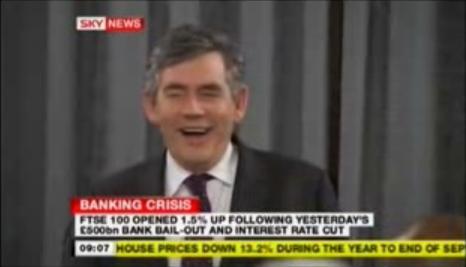
Iain Dale quotes an astonishing piece of dialogue from a Daily Mail interview by Alison Pearson of Gordon Brown. First Dale recycles interminable chunks of sob stuff about Brown’s children and Brown’s eyesight. Pass. But then comes this:
When we finally manage to snatch some time in the study on the first floor, I ask if he has any regrets about his boast: ‘No more boom and bust.’
‘I actually said, ‘No more Tory boom and bust,’ he replies.
He did indeed actually say this, once, at a conference. So, not an actual lie. But, as Iain Dale points out, he said it without the “Tory” on many, many other occasions. The implication is that Labour boom and bust is fine. This is the kind of drivel that this man is now reduced to spouting.
Brown then explains that this particular Labour bust is not really a bust at all:
‘Fifteen per cent interest rates under the Tories! We’ve got interest rates of five per cent, that’s a bit different, isn’t it?’
Yes, and he’s managed to bring the price of oil down too. With his superhuman powers of self-delusion, and his apparently unshakable determination to continue wrecking my country, this man reminds me more and more of Robert Mugabe.
Brown himself is already a failure, doomed to electoral defeat. That is now a given. What interests me is what effect all this insanity, institutional and personal, will have on the Labour Party, whose recent feeble attempts to replace Brown seem now to have fizzled out. Sadly, there seem to be enough faithfully moronic Labour voters to keep a rump of Labour diehards in the House of Commons in quite substantial numbers. But then what? They promised an end to boom and bust. They boomed, after a fashion. They are now busting, and how. And they stuck with the lunatic who said and did all this to the bitter end. What sane person would vote for these incompetent and spineless nutters ever again? Labour could well go the way of the early twentieth century Liberals.
However, I suspect that David Cameron will actually be quite happy, after he wins the next election, to face opposition benches which are clogged up with Labour living dead, rather than populated by people with plausible things to say and serious complaints to voice like lots of new and young and optimistic Conservatives or Lib Dems. Blair coasted along for a decade on the public’s loathing of the Conservatives. Cameron now looks content to do the same, on the back of a near-universal loathing of Labour. I may be misjudging Cameron and I hope I am. But I fear that I am not.
Richard Garriot, son of Skylab astronaut Owen Garriot, will leave Kazakhstan for the International Space Station on Sunday, October 12. He is also going to be a bit creative with his sojourn:
Inspired by his artist mother, Richard will be hosting an art show in space. The show will incorporate art created by his mother, by sculptors, art submitted by artists through a competition and also art that Richard will create during his time in space. After Richard’s mission, the art will be put up for auction to benefit the Challenger Center.
You can find out more here.
I just want to remind any of our readers in Massachusetts to help keep up the pressure for the initiative to end the income tax. The time until eleection day is running out. Money and publicity are the things our folk need so get out there and do your damndest to assist them. The opposition are raising large amounts of money from the people with their snouts deepest into the swill and are doing their best to convince Massachusetts voters to keep feeding them money.
If you are unfamiliar with this ballot initiaitive, or even if you know all about it, you should find this episode of the Glenn and Helen Show is of interest.
Instapundit has been doing yeoman service in covering it and I hope the bar conversations I had with Glenn on this subject back in May had a little bit to do with it!
We could all use a bit of cheering up in these worrying times. Surfing the Net, I re-read some of the funniest content in the blogsphere, thanks to Harry Hutton. This post still makes me laugh out loud. It has not dated at all.
Economic historian Robert Higgs makes some interesting observations at the Liberty & Power group blog. I often disagree with some of its foreign policy views – it verges on outright pacifism – but its economics I like.
At least someone is enjoying themselves. The taxpayer has always paid his bills, except in his childhood, when God did. And now he gets to use unlimited power to seize whatever he likes and congratulate himself that he is punishing bad people for taking risks in the hope of making money for themselves.
pic hat-tip: Guido
What does Bob Barr have to say about the latest debate? “Booorrrrrinngggg!” But then, I knew that ahead of time and did not even bother to follow either it or any of the predictable coverage and pontification about nothing.
If you are interested in Bob’s take on the DC feeding frenzy, you can go here to listen.
I’m at the point I was at a month ago: the two tickets consist one one old guy who frankly should have been put to pasture, two leftist asshats who belong in prison, and a lady who’s the only one of the four who’s worth a damn
– Commenter Sunfish.
Both candidates supported the contemptible bailout. Indeed Senator McCain made a special point of supporting a Federal buy up of mortgages so that “people could pay at the new values and stay in their homes”. As the securities which the United States government is buying up are based on mortgages this is at least “logical” I suppose.
However, there were economic policy differences:
Senator Obama told some truly absurd lies, for example he claimed he would cut more spending than he would increase (in reality he would increase Federal government spending by close to a trillion Dollars on top of the various bailouts), and Senator Obama also repeated his lie about cutting taxes for 95% of the population – a lie because he treats welfare payments as ‘tax cuts’.
But I found the differences on health care policy most interesting.
Senator Obama denounced the very idea of buying health cover over State lines – competition is evil and would allow wicked places to attract business by having less regulation “as Delaware does with insurance and credit cards” perhaps Senator Obama should tell Senator Biden how evil the State of Delaware is.
Clearly the chance of competition being allowed to reduced health costs under a President Obama is zero.
Instead there are to be mandates and regulations. given the absurd notion that lack of regulation, rather than credit bubble finance and the government backing of Fannie Mae, Freddie Mac and ACORN, is the source of all of America’s problems… with fines to make small business enterprises give health cover to their employees. Senator Obama refused to say what size these fines on individuals and business enterprises would be.
This is a good, very fair-minded take on the current financial turmoil and all the more impressive for its insights precisely because the writer is not some sort of ultra-free market ideologue:
“The real roots of the crisis lie in a flawed response to China. Starting in the 1990s, the flood of cheap products from China kept global inflation low, allowing central banks to operate relatively loose monetary policies. But the flip side of China’s export surplus was that China had a capital surplus, too. Chinese savings sloshed into asset markets ’round the world, driving up the price of everything from Florida condos to Latin American stocks.”
Absolutely. China, and the massive pool of savings that Asian economies have been able to provide to Western borrowers, is the 800 pound gorilla in the room in the current saga.
The author continues:
“That gave central bankers a choice: Should they carry on targeting regular consumer inflation, which Chinese exports had pushed down, or should they restrain asset inflation, which Chinese savings had pushed upward? Alan Greenspan’s Fed chose to stand aside as asset prices rose; it preferred to deal with bubbles after they popped by cutting interest rates rather than by preventing those bubbles from inflating. After the dot-com bubble, this clean-up-later policy worked fine. With the real estate bubble, it has proved disastrous.”
Yep, Mr Greenspan has a lot to explain.
“So the first cause of the crisis lies with the Fed, not with deregulation. If too much money was lent and borrowed, it was because Chinese savings made capital cheap and the Fed was not aggressive enough in hiking interest rates to counteract that. Moreover, the Fed’s track record of cutting interest rates to clear up previous bubbles had created a seductive one-way bet. Financial engineers built huge mountains of debt partly because they expected to profit in good times — and then be rescued by the Fed when they got into trouble.”
“Of course, the financiers did create those piles of debt, and they certainly deserve some blame for today’s crisis. But was the financiers’ miscalculation caused by deregulation? Not really.”
Try telling that to the likes of Will Hutton.
“So blaming deregulation for the financial mess is misguided. But it is dangerous, too, because one of the big challenges for the next president will be to defend markets against the inevitable backlash that follows this crisis. Even before finance went haywire, the Doha trade negotiations had collapsed; wage stagnation for middle-class Americans had raised legitimate questions about whom the market system served; and the food-price spike had driven many emerging economies to give up on global agricultural markets as a source of food security. Coming on top of all these challenges, the financial turmoil is bound to intensify skepticism about markets. Framing the mess as the product of deregulation will make the backlash nastier.”
Quite. In recent years, I have often heard fellow libertarians say something on the lines that “we’ve won the economic argument but lost the cultural one” sort of thing. I have never been entirely convinced about that. Yes, old-style central planning and crushingly high tax rates are unlikely to make a comback, but never underestimate the age-old hatred of financiers, of speculators and great wealth. Those of us who might imagine that the big battle of ideas fought after the war against socialism have been won may want to shake off some complacency. But maybe I am being gloomy. After all, much of the current round of government “rescues” are not quite of the same order as the nationalisations of the past. And in some cases, we might hope that eventually states will return banks they have nationalised into private hands.
As the French example of Credit Lyonnais shows – a corrupt bank if ever there was one – state-run banks are just as capable of making a mess of lending as any private one.
Over the last week I kept running across articles and video about a heavy weight couple who lost weight after the embarrassment of being asked to move to a different seat so the airplane could take off safely. On one Fox News show the talking heads went on about the times they were asked to move. None of them were particularly large so they talked overly long about how a jumbo jet could be unsafe to fly because a mere wisp of a talking headess was in the wrong seat.
This riled me a bit and has been roiling about in the back of my mind for some days. The people who write or talk about these things are supposedly educated, but the level of ignorance shown makes me very worried about what schools are actually requiring students to learn, even at the university level.
In hopes some of these ignorant but otherwise intelligent folk happen to drop by Samizdata, I will provide a bit of a remedial lesson in basic physics and a bit on aeroplanes as well.
I am hoping everyone is at least familiar with what a lever is, or at the very least a childhood teeter-totter. If two children sit on a board on opposite ends, they can find a balance point regardless of how fat or skinny the two are. One can move closer to the fulcrum, the thing upon which the board rests, or farther away. A child of a given weight at a given distance from the fulcrum creates what is known as a torque. The two children can balance these torques: Mass of child 1 times distance from fulcrum = Mass of child 2 times distance from fulcrum. In more typical notation: m1 * d1 = m2 * d2.
If you understand a teeter-totter, you can understand everything else I have to say.
An aeroplane has a number of points that are of interest. The most important to this discussion are the ‘center of lift’ and the ‘center of gravity’. If you had a very hefty jack and the underside of your 747 could handle it without a requirement for body work afterwards, a single point at which the aircraft could balance like a toy on a pencil is the center of gravity. This is just like the balance point of the children, but with the entire class and their teddy bears instead.
The fulcrum is the center of lift. This is a balance point created by the airflow over the surfaces of the plane in flight. Ideally, and in the simple case, the center of lift should be near the center of mass and both should be on the center line of the aeroplane. If one wing were longer than the other, the center of lift would shift away from the center line. This would not be a good thing unless you are Burt Rutan and know how to do tricky things which no normal mortal would think of doing.
In practice it is impossible to get the two exactly together. If the center of lift is forward of the cg the airplane will want to pitch up. If it is aft of the cg it will try to pitch down. Similarly if it is to the right or left of the cg. the airplane will want to roll right or left.
You can control the attitude of the aeroplane by neutralizing these forces. If you have a pitch up tendency, you dial in a bit of pitch down on the elevator trim tabs. Likewise for the other directions. In worst case you can use the control column and use deflection of the elevator or ailerons themselves to counteract the problem. It is not wise to fly like this under normal circumstances. If you run out of trim you have either not done your weight and balance papers properly or you are flying a Lancaster to Europe in WWII with a max bomb and fuel load and expect you are going to die anyway.
Airplanes have a bunch of numbers which pilots have to know. Among them are the ‘aft cg limit’ and the ‘forward cg limit’. Basically these mean you are too tail heavy or nose heavy to fly with enough of a safety margin to deal with the unexpected. They are not absolute limits. You are not going to reach the ‘my god we are all going to die!’ limit unless everyone piles into the tail and the pilot can not keep the nose down even with full downward elevator deflection.
Inside the cabin the pilot has readings off the landing gear that tell him what the weight and balance looks like after all the luggage, consumables and passengers are on board. If those indicators show the aeroplane is approaching the aft limit he or she will have a flight attendant pick someone from far aft and move them as far forward as possible.
That is all this whole storm in a teacup story was about. It is standard aviation practice that goes back to the first time Wilbur took Orville along with him.
|
Who Are We? The Samizdata people are a bunch of sinister and heavily armed globalist illuminati who seek to infect the entire world with the values of personal liberty and several property. Amongst our many crimes is a sense of humour and the intermittent use of British spelling.
We are also a varied group made up of social individualists, classical liberals, whigs, libertarians, extropians, futurists, ‘Porcupines’, Karl Popper fetishists, recovering neo-conservatives, crazed Ayn Rand worshipers, over-caffeinated Virginia Postrel devotees, witty Frédéric Bastiat wannabes, cypherpunks, minarchists, kritarchists and wild-eyed anarcho-capitalists from Britain, North America, Australia and Europe.
|





Recent Comments