We are developing the social individualist meta-context for the future. From the very serious to the extremely frivolous... lets see what is on the mind of the Samizdata people.
Samizdata, derived from Samizdat /n. - a system of clandestine publication of banned literature in the USSR [Russ.,= self-publishing house]
|
I think this is great, from regular commenter here NickM of Counting Cats:
The tale science tells about how we got here (and got to the point where we could ask such questions) is not just truer than the bronze-age claptrap of The Bible (or Qu’ran or stories about Marduk or whatever …) but more compelling. We are DNA on the right-handed scroll and it has taken four billion years to make us. We are that amazing. Isn’t that more compelling than some old shit about talking snakes and a job done in six days? Is it not a truly grand narrative? The truth is so much more beautiful than the lie. It is also the truth and that also goes a long way on it’s own.
Ah, c’mon folks … I have heard enough from creationists about how if we’re merely risen slime we’re still slime and that in some unspecified way we are therefore still tainted by the slime. But what slime! This piece of slime can be moved to tears by the music of Palestrina, this piece of slime can be amused by the plays of William Shakespeare, this piece of slime can parse HTML and FORTRAN. This piece of slime can factorize quadratics, do integration by parts and hold an opinion on the Copenhagen Interpretation. This is one hell of a piece of slime and so, dear reader, are you.
I am proud to be slime with post-graduate qualifications. I am stardust (so are you) created in the forge of supernovae (is that not cool?). I am atoms in motion (so are you). I am victory (so are you). I am almost everything you are and you are almost everything I am. We share half of our DNA with cabbages after all.
I entirely agree with all this, but I do not stick it up here to insist that all of you do. I know that all of you do not, which is fine by me. Especially if, from what you do believe instead, you draw political conclusions with which I strongly do agree. I stick it up here because it puts a particular point (call it the “glory of slime” argument) in answer to a common objection to Darwinian atheism (the “sliminess of slime” argument) with exuberant eloquence. Even many of those who think it tosh will at least agree that it is very well written.
The Cat Counter acknowledges the sliminess of slime, but then trumps it with the grandeur. But I bet, when he wrote his bit, that he had, rattling about somewhere in his head, this, which acknowledges the grandeur but then trumps it with slime, or in this case with dust:
What piece of work is a man! How noble in reason! How infinite in faculty! In form and moving how
express and admirable! In action how like an angel! In apprehension how like a god! The beauty of the world! The paragon of animals! And yet, to me, what is this quintessence of dust?
While Hamlet emphasises also what fine and beautiful athletes we are, NickM concentrates only our mental glories. An interesting omission, maybe? There are all kinds of memes floating about now to the effect that although many of us dirt-bags are clever, we are not that beautiful, a blot on the world even, compared to many other more exotic looking animals, who now seem to us much more express and admirable in form and moving. Maybe this is something to do with how we have evolved to admire how we look only when young, yet are clever enough now to have contrived for millions upon millions of us to be shuffling on unattractively into old age instead of reverting to actual dirt at forty and being replaced by younger and prettier dirt-bags.
One of the few financial journalists who rumbled Gordon Brown years ago, Allister Heath, gives his verdict on yesterday’s UK budget. Devastating detail all the way through.
Allister is also pretty scathing about UK Liberal-Democrat economics spokesman, Vincent Cable, who tends to be deferred to as the “politician who talks sense on the economy”.
There is no doubt that – apart from some smart writers like Liam Halligan – not many people in the financial journalist profession saw the current crisis coming or predicted its full extent. Clive Davis, over at his blog, makes that point by linking to an article that goes into what is rather mysteriously called the “shadow banking” sector: ie, any institution that gets involved in trading in or holding credit, such as hedge fund. I wrote about misconceptions surrounding this issue the other day.
So why were financial journalists or many economists unaware of the gathering storms? Well, assuming that they were oblivious, my explanations are as follows. I’d be interested in the comments. Here goes:
First, over-specialisation in the economics profession. One of the great benefits to me in discovering those Austrian economists such as Ludwig von Mises and writers like Henry Hazlitt all those years ago as a callow youth was that it reintroduced me to the days when “political economy”, as it was known in the 19th Century, was not hung up on mathematical models or big, wooly macro-economic systems, but addressed the incentives, laws, and actions of man. I had the benefit of getting a good grounding in microeconomics, in understanding an economy as a dynamic process that changes through time, not a set of artificial “games” with nonsense such as models of “perfect competition”.
Second, I think that for many journalists who did learn economics, the sort of ideas that have given me and other classical liberals/libertarians some insight into the gathering storms are simply not on their intellectual radar, or if they are, they are led to believe that people with surnames such as Hayek, or von Mises, or Friedman, are somehow eccentric, even malevolent creatures. Most of them have either read their JK Galbraiths, or their Krugmans, and get their views from the still-powerful tradition of Keynesian economics. The idea that fiat, state-monopoly money and Big Government – the two are related issues – lie at the core of the issue just does not apply to a group of folk who generally tilt left in their politics (although this is far less the case than in other parts of journalism, in my experience).
Also, as a result of overspecialisation, a journalist who writes about, say, the government bond market may not always join the dots when it comes to information coming out in a different area of the economy. There is also the fact that as sectoral journalists covering their beats such as energy, retail, telecoms, etc, get involved in the day-to-day job of covering these things, that the broader trends get obscured because of the sheer volume of stuff that journalists deal with. Given how financial journalism has developed as a profession in the last two decades – I have some insight into this via my day job – I am not too sure how to deal with this. Part of the trouble may even be what I might call the “showbiz” trend in financial journalism: reporters at channels such as CNBC often talk about the market in a sort of sports-coverage way: who’s up, who’s down, etc.
There are reporters – the FT’s Gillian Tett springs to mind – who have been very good at trying to keep on top of how the credit markets have evolved and some of the risks associated with that. And there are commentators and investors such as Jim Rogers, for instance, who have been pretty astute at seeing the disaster and warning about it. But a lot of people, as Clive Davis says, have not been aware of the magnitude of what has hit us. Maybe, however, Mr Davis has to remember the flip-side of this coin: we may now be blind to the chances of a pretty rapid recovery, at least in some parts of the world.
The title of this article written some months ago by noted US economist, Arthur Laffer, has never been more apt after I finished reading through the UK government’s latest outrage, its annual budget statement.
A new, top rate of income tax of 50 per cent comes in from next year, applying to annual incomes of £150,000 and above. The government, which probably knows it is doomed anyway, has made the base calculation that the Tories won’t dare to repeal it. I actually am not too sure about that: while £150,000 a year is a lot of money, for many self-employed folk with lumpy income streams, such a new tax band will hit them very hard in marginal terms, encourage further emigration from the UK, deter anyone with any entrepreneurial brio from entering the UK, and probably reduce, not raise, revenues. It is also a boon to the tax-planning and accountancy profession, since anyone who can restructure their affairs to convert income into a capital gain – CGT is just 18 per cent in the UK – will do so.
Update: I share Guido’s reaction. No wonder, by the way, that the G20 nations – hypocritically – chose to attack “tax havens” and create a global tax cartel. If you are someone like Gordon Brown or The Community Organiser, the last thing you need is for your high earners to escape abroad. But I’d be willing to bet that there will be quite a rush now of people out of this country. Expect to read lots of stories about how “Mr X, who runs a small business in the Midlands, said he was heading off to Australia/Canada/wherever to get away from high-tax, high-crime Britain”. Expect there to be a relentless, drip-drip of such stories in the months ahead. (Mr Jennings snorts about my mention of Australia: yes but at least there are other benefits to moving there).
Update: Madsen Pirie of the Adam Smith Institute and some top wealth management folk give the budget a thorough hammering over at CNBC. The guy from Denton Wilde Sapte is particularly good.
Samizdata commenter Marc Sheffner (thanks Marc!), spotted this story in a thread comment about this.
Makes you so glad that all our precious details are going to be looked after by those clever political folk and their friends, does it not?
Talking of IT, the debut UK edition of Wired has a look at some of the folk that run Britain’s IT and other vital infrastructure systems.
This, by Clay Shirky, is a truly fascinating blog posting. And the bit of it that I am about to quote (which is as far as I have so far got in it) is (to use a word I usually resist) awesome, at any rate in its long-term potential impact:
Just to pick one example, one I’m in love with, but it’s tiny. A couple of weeks one of my students at ITP forwarded me a project started by a professor in Brazil, in Fortaleza, named Vasco Furtado. It’s a Wiki Map for crime in Brazil. If there’s an assault, if there’s a burglary, if there’s a mugging, a robbery, a rape, a murder, you can go and put a push-pin on a Google Map, and you can characterize the assault, and you start to see a map of where these crimes are occurring.
That does not sound ‘tiny’ to me. It sounds huge. Finally, here might be a system worth reporting crimes to.
What this says is that those maps you see in TV cop shows will stop being a cop monopoly and become something everyone can consult, and contribute to. A golden age of private sector law enforcement beckons. In the words of the title of the blog (now alas not alive any more) where this particular posting appears: “Here comes everybody”. And against everybody, the criminals will be put back on the defensive where they belong, in other words where they were before TV took almost all law-abiding citizens off the streets (by showing them such things as TV cop shows), leaving behind only actually existing (as opposed to TV fantasy) government policemen, idiotically droning their mantra: leave it to us. Which has worked really well, hasn’t it?
Apologies to all those to whom this is stale news, what with this blog posting being based on a speech that was delivered exactly one year ago tomorrow. But if only a small fraction of the Samizdata readership has not seen this posting before, then from where I sit this is a very good mission accomplished. My thanks to Lynn Sislo, for mentioning it here.
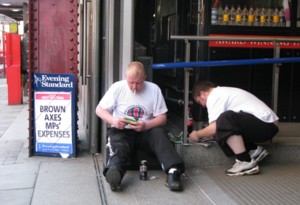
This afternoon, outside Waterloo Station, I photographed a couple of Members of Parliament. One was attending to his constituency paperwork, while the other was rolling a joint.
I wish. Whenever they introduce a new scheme the idea of which is to make things cheaper, they invariably end up making things more expensive. The only sure way to cut government spending is to shut things down. The idea that things can be made cheaper by being streamlined but perpetuated is folly.
The Evening Standard is jumping to all sorts of conclusions with its headline. Its actual story includes things like this:
Both Labour and Tory MPs could rebel over the plans, as many would stand to lose substantial sums currently used to pay their mortgages.
Plans. Nothing has changed yet.
However, some critics claimed that there would be big winners as well as big losers under the new scheme. Those who have paid off their mortgage on a London flat or man and wife couples could gain by claiming the maximum daily rate.
What’s the betting that there will be big winners, and little winners?
The present system means MPs have to produce receipts, which they hate. The new system that Gordon Brown is proposing sounds like it will simply do away with the receipts and, by the time the dust has settled in a few weeks or months time, double their salaries. They will get a salary on account of being an MP. And they will get another salary for turning up.
The idea that this will put a stop to muckraking by the likes of Guido Fawkes, by cleaning away all the muck, is very fanciful.
I am not terribly convinced by this:
“…after decades and decades of instability in the 1800s and early 1900s, followed by the massive bank failures of the early 1930s, regulations were imposed to stabilize the banking system. The result was sixty years of calm in the financial sector. That’s hardly a failure of regulation. It wasn’t until the shadow banking system began growing outside of the regulatory umbrella that problems began to re-emerge. A central theme of the posts this week has been that bringing about another decades long period of relative stability will require the regulatory umbrella to be extended to cover all firms within both the traditional and non-traditional (or shadow) banking system, hedge funds included.”
That does rather ignore the fact that, in the early 1970s – in the period of “calm” that this writer talks about, we had stagflation, the collapse of the Bretton Woods banking system, etc. Hardly very calm. And if the system was calm, as claimed, how come it collapsed? (Hint: it was not the fault of evil private bankers or tax havens).
In the absence of a return to sound money and an end to fiat monetary systems, there may be something to be said for rules to at least limit some of the damage that monetary mistakes can cause. This is a second-best solution, I would say. I have heard it argued, even by some pretty ardent free market types, that there is a case for splitting the roles of risk-taking investment banks from those of more utility-like retail banks, as under the old US Glass-Stegall rules in the US. But had Glass-Stegall been in force today – it was abolished in the late 1990s – it would not have been possible for investment firms such as Morgan Stanley and Goldman Sachs to remodel their businesses as full-service banks, as happened in the autumn of last year when those firms were partly bailed out by the taxpayer. The ironies abound.
On this issue of the “shadow banking” system, the author and others need to understand how the business of securitising debt and selling it off to investors started, as well as why hedge funds and other non-bank institutions developed. This market, and the fiendishly complex derivative products that drove it, was given much of its early impetus by a banking regulation system, known as the Basel system, that told banks they had to set aside a certain portion of capital to one side to protect against risk.
It was, if you like, a partial acceptance that fractional reserve banking, if it is allowed without any “safeguards”, is dangerous. But what happened? Banks took out tradable insurance policies, such as credit default swaps, and used this insurance to get a better credit rating, and hence, reduce the amount of capital they set aside. The “shadow” banking system, then, and the derivatives market that gets so much heat, was partly driven by regulations, as well as by the application of sophisticated – if flawed – mathematical and scientific techniques to the business of finance.
The article does at least, in a backhanded sort of way, recognise that not everyone is signed up to the narrative that “unregulated capitalism” has failed. I am glad that has been noted. After all, it is a myth that supporters of capitalism, such as yours truly, oppose regulations per se: what I oppose is state-imposed, one-size-fits-all regulations. For example, if a privately run stock market wants to create its own listing rules to build and develop a reputation for high standards, it will be in its self interest to do so, since a track record for honesty, transparency and efficiency reduces the costs of capital because investors are more willing to hold equities traded in honest places rather than dodgy ones, and so on.
If the state has a role, it is that of going after thieves and fraudsters. And as we have seen in the case of US Ponzi scheme conman Bernard Madoff, the powerful US Securities & Exchange Commission did not act, despite certain suspicions about him, for years. By focusing on the basics, rather than trying to regulate everything under the sun, the state might even do some good.
Obama’s speciality is shaping up to be particularly dangerous because it’s hard to dispute given the average American’s sensibilities. No call for liberty and constitutional principle seems convincing when Obama is arguing that those relying on government giveaways should have to follow government-set rules. That is, once you’ve allowed them to go ahead with the handouts, the political game is almost over. Under the guise of “managing the taxpayers’ money”, Obama and his crew are rewriting mortgages, deciding executive compensation, tossing out CEO’s. And note carefully that his plans for where taxpayers’ money should go continue to swell, from healthcare to the environment to energy policy to expanded “national service” programs. When taxpayers’ money is everywhere – and Obama is doing his best to make sure it is – then Obama’s control is everywhere. The Octo-potus is claiming his space and flexing his grip. As far as he’s concerned, it’s Barack Obama’s country. We’re just living in it.
– Brian Doherty
If all those ‘libertarians’ who dallied with The Community Organiser had been reading our own Paul Marks, who was onto Mr Obama’s agenda months ago, they would have saved themselves a lot of buyer’s remorse.
Welcome, Instapundit readers. Some rather grumpy folk out there wondered where there was a link to one of Paul Marks’ comments (the archives on the side of this blog, so please use them!). Anyway, here is one reference.
Coffee House links to the latest example of a government minister/official leaving potentially sensitive information on the train. As usual, one expects such stories to undermine yet further the credibility of government-created ID systems and databases. But I think it was our own Brian Micklethwait who wrote, a few months back (cannot find the link, sorry) that there is a chance that such “cockups” are deliberate.
What if such papers are being left lying around to create a false trail? Fanciful? Maybe. But it may just be that such officials are not quite as moronic as these stories suggest, or at least that another intepretation is worth thinking about.
Oh scratch that: they are all morons!
Meanwhile, in the Strasbourg Village, it is being called a “huge scandal”, but Der Spiegel describes this huge scandal somewhat strangely:
The economic crisis has hit countless retirement funds, including that of members of the European parliament. They may take the controversial step this week to use taxpayers’ money to top up the pension fund.
I am sure that Der Spiegel did not mean to suggest that this will be the first splurge of taxpayers’ money ever to arrive in this pension fund. But, they rather do, don’t they? My guess is that the original pension fund is a pretty big scandal to start with.
And indeed it is:
The scheme was already in disrepute because MEPs’ contributions are taken automatically from their office expense allowance of €4,202 (£3,700) a month rather than their salary. MEPs are supposed to reimburse this account but there are no checks and it is accepted widely that many do not repay the money, potentially making the pension an entirely taxpayer-funded perk.
That was from the Times, last Friday. The same piece goes on:
Senior MEPs are proposing several changes to the second pension to reduce the deficit, such as increasing the retirement age from 60 to 63 and stopping early retirement at 50. But these are likely to be blocked after the fund chairman, the Conservative former MEP Richard Balfe – who now acts as David Cameron’s envoy to the trade unions – warned that such moves were “not permissible under European law”, in effect leaving the taxpayer with the entire bill.
So, who is this Richard Balfe? There’s been no mention of him here until now. It seems that in 2002 he stopped being a Labour MEP, in disgust, after having a fight with some other Labour people, and became a Conservative MEP instead.
Further googling got me to this Balfe-ism:
“You have got a situation now where the Conservative and Labour parties have overlapped so significantly that the ideological collapse of both parties must be mirrored in a new relationship with the unions, just as it is mirrored in a new relationship with business.”
Well, that is one way of looking at things. Balfe didn’t change. There is just so much ideological overlap between the big parties these days that Balfe could switch parties without himself moving his position. Another way of looking at it is to say that Balfe was a member of the politicians party, and that his allegiances are unchanged.
In its ironically titled ‘Lexington’ section the Economist magazine attacks those who point at the influence of collectivist ideologies on American government policy. Rather than refuting the evidence and argument the critics of government policy produce, the Economist (in the best education system and mainstream media tradition) just ignores evidence and argument, and denounces those who point to Marxist and Fascist origins of much modern “Progressive” government policy.
One example of the Economist approach really caught my eye:
For years Glenn Beck has denounced wild spending Republicans (especially President Bush) and since moving to Fox News he has continued to do this. He has also (with the help of many people who have written scholarly books on these matters) continued to try and explain the influence of collectivist philosophies on American politics over the last century – from Teddy Roosevelt to Barack Obama.
The Economist collapses all of this into – Glenn-Beck-claims-Obama-leading-the-United-States-to-Fascism.
If ‘Lexington’ was attacking me this would make some sort of sense, as I have often pointed out the Marxist background of Barack Obama (and Marxists sometimes evolve into Fascists – as this involves no rejection of their basic collectivism). However, Glenn Beck has clearly stated (many times) that he does not believe that that Barack Obama is a Communist or a Fascist – what Beck is trying to do is to show how collectivist philosophies have increasingly influenced American government policies over time, often without the leading politicians being fully aware of the origins and nature of the principles they try and put into practice.
Anyone who has seen the show, as opposed to tiny bits of the show taken out of context, would know this.
However, ‘Lexington’ would rather write about something without bothering to watch it – getting his “information” from the far left smear site “mediamatters” instead.
And the mainstream media wonder why libertarians and conservatives despise them.
|
Who Are We? The Samizdata people are a bunch of sinister and heavily armed globalist illuminati who seek to infect the entire world with the values of personal liberty and several property. Amongst our many crimes is a sense of humour and the intermittent use of British spelling.
We are also a varied group made up of social individualists, classical liberals, whigs, libertarians, extropians, futurists, ‘Porcupines’, Karl Popper fetishists, recovering neo-conservatives, crazed Ayn Rand worshipers, over-caffeinated Virginia Postrel devotees, witty Frédéric Bastiat wannabes, cypherpunks, minarchists, kritarchists and wild-eyed anarcho-capitalists from Britain, North America, Australia and Europe.
|





Recent Comments