We are developing the social individualist meta-context for the future. From the very serious to the extremely frivolous... lets see what is on the mind of the Samizdata people.
Samizdata, derived from Samizdat /n. - a system of clandestine publication of banned literature in the USSR [Russ.,= self-publishing house]
|
Okay, since we are in Lunar mode today, here’s another quotation:
“No event in contemporary culture was as thrilling, here on earth, as three moments of the mission’s climax: the moment when, superimposed over the image of a garishly colored imitation-model standing motionless on the television screen, there flashed the words: “Lunar module has landed” – the moment when the faint, gray shape of the actual model came shivering from the moon to the screen – and the moment when the shining white blob which was Neil Armstrong took his immortal first step. At this last, I felt one instant of unhappy fear, wondering what he would say, because he had it in his power to destroy the meaning and the glory of that moment, as the astronauts of Apollo 8 had done in their time. He did not. He made no reference to God; he did not undercut the rationality of his achievement by paying tribute to the forces of the opposite; he spoke of man”. (page 186).
Ayn Rand, The Voice of Reason.
For all that I broadly share the sentiment expressed here, I don’t think that any of the astronauts, even if they were religious, would have thought of their faith as somehow undercutting the sheer, grandeur of rational thought that got them up there in the first place. For them, I think, belief in a Supreme Being might even have been strengthened by wondering about how the universe came about in the first place, although cosmology comes in many forms. But still, Rand was right to make the point: in a culture that sometimes denigrates science and reason, the Moon landings were a potent reminder of just how far Man has travelled through the use of both.
Niklas Järvstråt has invested in a simulation of a lunar settlement using an old Swedish mine which he bought some years ago.
Just a short note to mention that the moon-mine inauguration and moon landing 40-year anniversary will take place tomorrow at Storgruvan, Nora, in the middle of Sweden. We will start the pumps and make footprints in lunar regolith simulant FJS-1, donated by Shimizu cormoration. Maria Aldrin, Buzz Aldrins great great great grandfathers great great great great great great granddaughter, will make the first footprint for the mine. We are looking forward to an interesting program of local and national interest, and a recorded well wishing message from the Romanian Space agency. Happy anniversary, all “lunatics” and space buffs!
Niklas is part of a world wide conspiracy to settle the moon and planets. Shhhh. Forget I told you that…
The Moon Society is looking Beyond NASA. While I would prefer a pure free market opening of the moon, the practicalities are that libertarian ideas are not globally influential enough to let us have our way. Peter Kokh discusses ideas that might at least let us get an opportunity to plant and grow the tree of liberty off world.
Today has been declared a space settlement blogging day and Samizdata is one of the participants. We hope you will also check out some of these sites for other stories on this topic.
Ad Astra… and may the high frontier be settled by free men and women, from whence ever they come.
Today is the 40th anniversary of the Apollo 11 landing, and it seems only fitting to show what ‘Tranquility Base’ and the other sites look like today. NASA recently photographed the landing sites at high resolution.
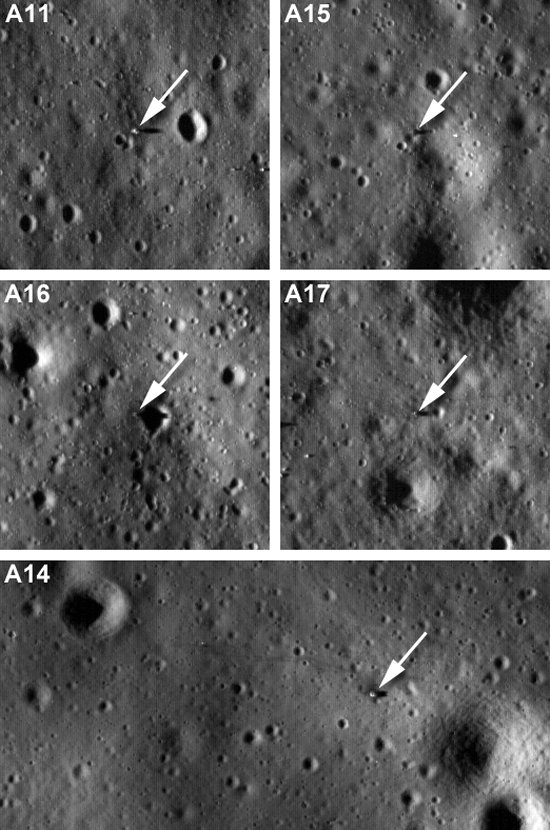
Apollo landing sites 40 years later.
Photo: NASA
If you look closely at the Apollo 14 landing area, you can see the very off-road tracks made by the Lunar Rover.
The recent embracement of the so-called Reform Treaty, which is in all important aspects identical with the old Constitutional Treaty, is a defeat for all true European democrats and should be interpreted as such. The down-playing of its true essence is intellectually unacceptable and morally inexcusable.
Nevertheless, there is another threat on the horizon. I see this threat in environmentalism which is becoming a new dominant ideology, if not a religion. Its main weapon is raising the alarm and predicting the human life endangering climate change based on man-made global warming. The recent awarding of Nobel Prize to the main apostle of this hypothesis was the last straw because by this these ideas were elevated to the pedestal of “holy and sacred” uncriticisable truths.
– Vaclav Klaus
Apparently it is news that the UK is still in recession, or as the headline says Economic recovery in UK ‘on hold’.
On hold? The government is debasing people’s saving as quickly as possible and stripping money out of productive sectors and pumping it into unproductive sectors, and generally trying their damnedest to drive businesses and wealth creators out for years now… and the fact this is tearing a huge hole is surprising to who exactly?
University of Essex Professor Vic Callaghan has a paper addressing issues of privacy and intelligent environments. In his review of a video on the subject he notes:
I just watched the video of your talk “Open Source Physical Security: Can we have both privacy and safety?“.
I think you raise a number of very important points about the potential for misuse of technology. I research in pervasive computing (Intelligent Environments, Pervasive Sensing, Digital Homes, Smart Homes etc) having previously been heavily involved in robotics. In this work I became aware of how technology could be misused, in a similar way to the nanotechnology you describe. We became so concerned that we gave a talk to the UN (as we felt it needed legislation or guidance at a very high level). More recently we wrote this up as an academic paper which suffered some opposition and modification before we were able to find and outlet willing to publish it (its a rather unpopular message). We are mainstream researchers in intelligent environments, that spent most of our life promoting this technology so it was, perhaps, a little unusual that we wrote an article that might be counter to its unfettered deployment.
Although I do not think the UN is going to have the effect he would wish, the worries he expresses are ones we all need consider. The era of ubiquitous sensing has already begun.
PS: Watch the referenced Christine Peterson video for a good summary of the right way to approach this problem (and not just because she’s a very old friend of mine!)
Which is why you can’t trust nature. Anatole Kaletsky is worried about stagflation. Can this be the same Anatole Kaletsky who only six month ago called for government to “punish savers”?
As I wrote at that time,
[Unsubbed original:] The purpose of banks used to be to make a profit by using the deposits in their care productively at second-hand. That is why they pay interest: to bring in funds to be lent. If they don’t do either then they are no longer banks but state-sponsored rentiers.
Far from encouraging productive capital, Mr Kaletsky’s prescription would have us reverting to a pre-capitalist economy where those with savings dare not recycle them. Their personal cash will end up converted to valuables, hoarded, and hidden to keep them safe from predatory tax farmers. Printing money is also a well-tested means of encouraging the same sort of behaviour.
For a recovery we need capitalism and the market to do their work. However painful, that is better than reversion to the Dark Ages because governments and their advisors want to be seen to be doing *something*. Doing nothing may be the best alternative.
Mr Kaletsky has got what he asked for and now finds he does not want it. Human, all too human.
“It is often wrongly assumed that the free market is always on the side of life’s heavy hitters. But sport gives plenty of examples that it is the market which corrects received wisdom in favour of untrumpeted stars. The internet has done something similar in publishing.”
What Sport Tells Us About Life, by Ed Smith. Pages 88-89.
Brian Micklethwait had thoughts about this short and excellent book a few months ago. A good book to read as the Ashes cricket series continues with the second Test at Lord’s starting later today. Bliss.
A good article over at Reason by Ronald Bailey, the magazine’s science correspondent. He talks about the factors that explain why humans haven’t been back to the Moon since the early 1970s. It is, he says, because of a lack of profit.
Every time I write something about the incredible feat of putting someone on the Moon, as happened almost exactly 40 years ago, there is an inevitable chorus of criticism – much of it justified – about how the huge sums of taxpayers’ money involved rendered the project beyond the pale, even if the critics grudgingly accept what a great adventure the whole thing was. It has to be accepted that by “crowding out” private space initiatives in the way they did, government agencies both in the US, former USSR and elsewhere have arguably retarded more promising, long-term space ventures that might have got off the ground. The existence of large, politically directed agencies like Nasa do not help innovation, either. Consider how quickly the aircraft design process occured from the Wright Brothers and through to the jet age, and then compare the rate of progress of space flight over the past 40 years. It is not a flattering comparison. So this is precisely why Dale Amon is so right to comment on stuff like this.
The best way to honour the likes the astronauts, both the living, such as Buzz Aldrin, and the dead, such as Gus Grissom, is not to continue down the statist path of space flight. This is too important an issue to leave with bureaucrats.
I always thought gleaming, European or US wooden motorboats were the height of cool. One can imagine David Niven, Cary Grant or Sophia Loren behind the wheel of one of these beauties. Yes, I know that in technology terms, some of the modern stuff is much better, but never mind. All I need now is my private Italian lake, and I can use one.
(You can tell I have been out of the country for a few days and my mind is not entirely on TARP, Gordon Brown’s mental health, taxes, ID cards…..)
|
Who Are We? The Samizdata people are a bunch of sinister and heavily armed globalist illuminati who seek to infect the entire world with the values of personal liberty and several property. Amongst our many crimes is a sense of humour and the intermittent use of British spelling.
We are also a varied group made up of social individualists, classical liberals, whigs, libertarians, extropians, futurists, ‘Porcupines’, Karl Popper fetishists, recovering neo-conservatives, crazed Ayn Rand worshipers, over-caffeinated Virginia Postrel devotees, witty Frédéric Bastiat wannabes, cypherpunks, minarchists, kritarchists and wild-eyed anarcho-capitalists from Britain, North America, Australia and Europe.
|





Recent Comments