We are developing the social individualist meta-context for the future. From the very serious to the extremely frivolous... lets see what is on the mind of the Samizdata people.
Samizdata, derived from Samizdat /n. - a system of clandestine publication of banned literature in the USSR [Russ.,= self-publishing house]
|
The following is an account of a visit to Chernobyl I made over the summer. However, first an only slightly related personal plea, if anyone in our wonderful techie readership has expertise in the electrical systems of Hitachi hard drives, or knows a business with specific expertise in data recovery from such drives, could you please read this and get back to me. I would stress that expertise is more important than location: if you are or know someone really good in Taipei or Fresno, that is still greatly helpful.
In 1986 I was in my final year of high school in Australia. The Cold War was still in force, and although some liberalisation had occurred in the Soviet Union, it felt like part of the natural order of things. The USSR was dark, strange, mysterious, and seemingly eternal. There was a wall down the middle of Europe, and nothing was more stark than the two sides of that wall. In April that year, workers at a nuclear power plant in Sweden detected excessively high levels of radiation. After briefly panicking about their own reactor, they realised that the radiation levels were higher outside than inside the building, and that the radiation was coming from somewhere else. Within a few days we knew that there had been an accident at the Chernobyl nuclear power plant north of Kiev in the Ukraine. Over the years, we have learned more about what happened, and the word “Chernobyl” has entered the world vocabulary, at times as a general word denoting a terrible catastrophe or destruction. We learned of firemen sacrificing their lives to contain the disaster, of evacuations of cities, and eventually of a strange forbidden zone that reflected the times and earned a place in certain kinds of popular culture. Even culture that preceded it sometimes now seems to have a strange sense of being about it.
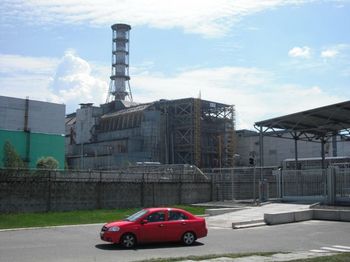
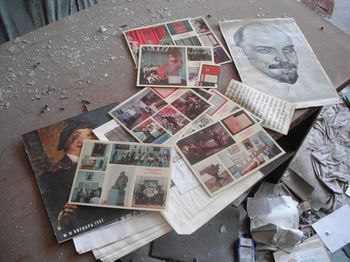 I am not usually one for organised tours, but there are places where one has no other alternative. Sometimes one needs the expertise of a local, and sometimes there are places in which one is simply not permitted to go other than on an organised tour. The so called Zone of Alienation around the Chernobyl nuclear reactor is such a place.
In any event, in June I visited Kiev (*) in the Ukraine. I have been pushing further east into the former communist countries on my travels in recent times, and going to the Ukraine was an obvious next step. I have still not been to Russia – the amount of nonsense that one must go through to simply get a Russian visa rather puts me off – but the Ukraine is now in an interestingly semi-westernised state where one can get there on discount airlines and most westerners no longer require a visa, but which is outside the EU and NATO. Democracy and what middle class that exists is relatiely fragile, and one still can encounter Soviet style bureaucracy. Businesses from further west tread cautiously.
However, my main reason for going was that I wanted to see that mysterious forbidden zone. → Continue reading: A trip to Chernobyl and the USSR
Rupert Murdoch is not a stupid chap, but I cannot understand how he can fail to see the absurdity of his latest remarks. His threat to block his online content from search engines is an indication he does not grasp the fact his content is almost entirely fungible in a world where the plentiful alternatives are simply a click away.
Rupert Murdoch says he will remove stories from Google’s search index as a way to encourage people to pay for content online.
Let me correct that…
Rupert Murdoch says he will remove stories from Google’s search index as a way to encourage people to find alternative content elsewhere online.
Not only will people not be motivated to pay Rupert Murdoch for content if they cannot find it via google, they will not even be aware of the content Murdoch is hiding from them. In short, Murdoch will become completely irreverent irrelevant on-line almost overnight and I am not sure why he thinks all too many people will care one way or the other. This is a bit like threatening someone that if they do not give him their money, Murdoch will cut his own throat. Er, sure Rupert, whatever. I suspect folks at the Guardian (who may not be my favourites ideologically but they certainly ‘get’ the internet better than most) and elsewhere can hardly believe their good luck.
“I can easily see how there’s a connection between individualism and depression. Once you manage to throw off the social-collectivist hive-mind and think for yourself, you cannot fail to see how deeply into-the-shit ‘society’ has got itself.”
Tanuki, a Samizdata commenter, writing about this.
Sorry to obsess on the subject but I just keep seeing these howlers by the professional journalists who we are told are so essential for democracy/social justice/world rotation/whatever. The latest giggler comes from Ed Pilkington writing in the Guardian:
There is also evidence that Hasan purchased a high-powered pistol three weeks ago as well as several high-capacity ammunition rounds that would allow him to continue firing without reloading.
Well… a 5.7mm pistol round is kind of low-powered really, at least in terms of ‘stopping power’ and I suspect the main reason that traitorous Muslim creep at Fort Hood killed so many people was they were defenceless and thus died from multiple point blank shots… therefore I can well believe he purchased several high-capacity magazines… you know, the sticky-down bits that hold the “ammunition rounds” (presumably as opposed to “newspaper rounds” or “doctor’s rounds”)… hehehe…. and I assume he got several so that he could reload quickly during his shooting spree.
It seems a crime reporter writing for a ‘quality newspaper’ does not need to know even the most rudimentary technical terms when describing a firearm used in a crime. The fact the editor of the Guardian lets a journalist make a ass of himself writing about something they obviously both know nothing about tells you a great deal about the state of the ‘indispensable’ news media.
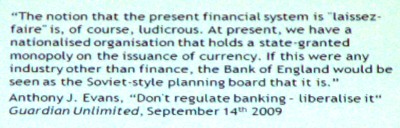
Snapped by me a fortnight ago, at the LA/LI Annual Conference at which Anthony Evans was the final speaker. I’ve straightened and sharpened it as best I could. A copyable, pastable and more readable version of the text from which this is taken may be read here. More photos of the speaker taken that same day can be viewed here.
UPDATE: Anthony Evans website, articles, blog.
Mark Wallace of the TaxPayers’ Alliance, writes, at Devil’s Kitchen, thus:
Part of the problem for eurosceptics has been that we have too often only engaged in one half of the argument. To be fair, we’ve all made a pretty good case that the EU is a costly, harmful, antidemocratic monstrosity – so much so that the public are in great majority convinced of that.
It is the second half of the argument which has been somewhat lacking – what is the positive alternative? Convincing people there is a problem with the current situation is not enough; we need to lay out what life would be like without the EU, how things could be better and, crucially, how it is perfectly feasible to get there.
To that end, the TaxPayers’ Alliance is publishing a new book, Ten Years On: Britain without the European Union which lays out a vision of what Britain could be like in 2020, governing ourselves and with the freedom to cooperate and trade with whomsoever we like.
Even better, it is available free to pre-order through this link!
I think this is spot on, not necessarily in the sense that Britain would be better off out of the EU, but in the sense that this is the bit of the argument that has been neglected. After all, the same lying politicians, stubborn bureaucrats, town hall little Hitlers and idiot voters that got us into this mess would still be around to screw up the alternative. So how would being out of the EU necessarily make their position weaker? Might the alternative actually be worse? I believe – partly because I want to believe (see paragraph one of the quote above) – that it would an improvement, but I would like to hear this argument made.
Also, would we, Norway style, still have to endure EUrocrats making our rules for us, for the privilege of trading with the EU? Seems unlikely, but again, I’d like to hear the argument.
So, as Instapundit would say, it’s in the post. The ordering seemed to work very smoothly. Nothing like free of charge to simplify things.
Inexplicably many seem to have been surprised by Dave Cameron’s predictable backtrack on confronting the EU’s constant slow motion power grab… however even those credulous enough to have not sussed Cameron’s weathervane nature ages ago are now getting the message loud and clear.
After abandoning plans to hold a referendum on Europe, following last week’s ratification of the Lisbon Treaty, Mr Hague said the Tories accepted that constitutional reform would not be on the EU agenda for some years.
The solutions are actually quite obvious and straightforward:
1. simply do not vote for a Cameron-lead Tory party as a vote for them is a vote for more of the same. Vote UKIP instead. This could mean Cameron will win anyway (which means we get more of the ways things are now but at least does not reward the Tories for being BlueLabour) or Labour wins again (which means we get more of the way things are now). Either way it makes sense to vote UKIP.
2. get rid of the disastrous Cameron, who is in effect the UK version of the disastrous George Bush (i.e. a nominal ‘conservative’ who will continue to expand the state) and get a Tory leader who has some balls and at least a modicum of principle.
This is not rocket science, it is just stating th bloody obvious. Hague’s Cameron mouthpiece statement is already setting up the Tory party for a lengthy period of doing nothing meaningful on the issue of the EU. Anyone who thinks “constitutional reform would not be on the EU agenda for some years” does not mean “constitutional reform will not be on the EU agenda ever” is a jackass and I have no interest in even debating with them.
Either… clean house within the Tory Party and get rid of Cameron… or vote UKIP. Voting for a party under a jackanapes like Cameron makes no sense at all, unless the current state of affairs is actually what you want.
I am grinding my teeth trying to restrain myself from commenting on some of the drivel being written about the recent murder of US soldiers by a muslim US army officer… but this is just a measure of the ignorance that permeates the profession and which is directly responsible for the growth of so called ‘new media’, i.e. things like blogs. Nick Allen writes in the Telegraph in an article titled “gunman used ‘cop killer’ weapon in massacre at US Army base” (a catchy ‘yellow journalism’ title if ever there was one):
Major Nidal Malik Hasan, 39, used an FN Five-Seven, a semi-automatic pistol popular with SWAT teams, that can fire armour-piercing bullets.
Oh for fuck sake. Any weapon can fire ‘armour-piercing bullets’. I know little about Nick Allen, but I assume he is a Brit and therefore knows bugger all about firearms and thus parrots the equally dismal urban US journalist propensity to describe any handgun firing a round capable of penetrating (some) body armour as a “cop killer”. Also I strongly suspect 9mm and 10mm handguns are far more popular with SWAT teams, as SWAT teams have rifles for use against armoured targets.
The weapon is designed for high(-ish) penetration for use against low end body armoured targets (the victims at Fort Hood were almost certainly unarmoured), but it has rather poor stopping power (that said, when it comes to handguns, bullet placement rather than calibre is the largest single determinant of stopping power), making the FN actually a poor choice… presumably the high magazine capacity may have been why the murderer chose it, knowing he was going to commit his crimes at very close range in a ‘target rich’ environment.
If journalists want to be credible, they need to try to avoid loaded (no pun intended) and rather ignorant terms like “cop killer” and not make meaningless remarks about weapons being capable of using “armour piercing” rounds (which is just another way of saying “they can shoot the rounds they are loaded with”). This ghastly incident contains more than enough news fodder that such sloppiness is inexcusable from ‘professionals’.
I am the only libertarian who has read all six VAT directives
– Philip Chaston.
Researchers are claiming that there is a link between individualism and depression. Some may take offence to this notion but it does not surprise me at all. That said, I am far too cynical to automatically assume that the ‘researchers’ are not grinding some ideological axe, but nevertheless I find the basic idea quite believable.
Frankly collectivism is a form of mass delusion, an ‘opiate for the masses’ method of replacing profane objective truth with sacred, subjective ‘acceptable’ truth… i.e. ‘truth’ is what the collective wants it to be. Indeed I would say much of the allure of collectivism is relief from the weight of individual responsibility, the sense of moral externalisation that comes from outsourcing choice to a ‘higher power’.
Individualism on the other hand is a more lonely path without a nebulous ‘them’ to absolve you from consequences and that can be stressful. And so it comes as no surprise to me that some collectivist societies may be less anxious (at least for those who actually buy into the collectivist meta-contextual assumptions) because collectivism depends on a view of the world that filters reality through the comforting, blame deflecting, wilfully ignorant lens of what is politically tolerable… and ignorance is bliss.
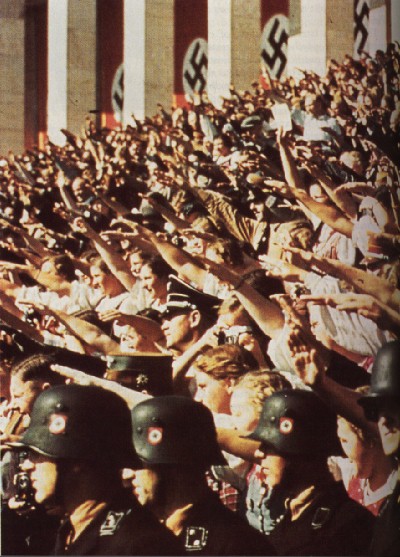
Collectivists… happier apparently
It is Friday, and I cannot be bothered to ponder the latest outrages of our political oligarchy. For our mental health, let us ponder the lines of this new little beauty from Porsche.
Burn that carbon, baby!
|
Who Are We? The Samizdata people are a bunch of sinister and heavily armed globalist illuminati who seek to infect the entire world with the values of personal liberty and several property. Amongst our many crimes is a sense of humour and the intermittent use of British spelling.
We are also a varied group made up of social individualists, classical liberals, whigs, libertarians, extropians, futurists, ‘Porcupines’, Karl Popper fetishists, recovering neo-conservatives, crazed Ayn Rand worshipers, over-caffeinated Virginia Postrel devotees, witty Frédéric Bastiat wannabes, cypherpunks, minarchists, kritarchists and wild-eyed anarcho-capitalists from Britain, North America, Australia and Europe.
|





Recent Comments