And that is called paying the Dane-geld; but we’ve proved it again and again, that if once you have paid him the Dane-geld you never get rid of the Dane.
– Rudyard Kipling
|
|||||
|
And that is called paying the Dane-geld; but we’ve proved it again and again, that if once you have paid him the Dane-geld you never get rid of the Dane. – Rudyard Kipling January 31st, 2011 | 31 comments - (Comments are closed)
 Strange to see an article like this in what is still sometimes called the Torygraph: Mortgage lenders penalising couples with children
Emphasis added by me. All the terms emphasised relate to a metaphor of punishment. But it is not meant to depict just punishment; the author, Teresa Hunter, apparently feels that parents who are lent less money than non-parents are having something unfair done to them. This is reinforced by having the first person quoted in the piece as saying:
The whole story is presented as being one of discrimination akin to racial discrimination. Did the author notice that there was a little financial unpleasantness in 2008 that had something to do with indiscriminate lending? Does she feel that encouraging people to to borrow more than they can afford is doing them any favours? Has she not noticed that children cost money? January 30th, 2011 | 132 comments - (Comments are closed)
As in BBC Radio 4, this coming Monday, January 31st, 8.30 pm: 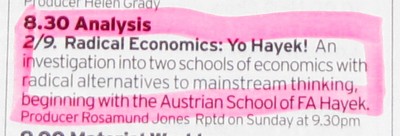 That’s from the current Radio Times. As you can tell from the pink, I will be paying close attention. My thanks to fellow Samizdatista Chris Cooper for alerting me to this radio programme. But will it be an attempt at a hatchet job? It seems not:
I think I first encountered Jamie Whyte at a Cobden Centre dinner. I was disappointed with the recent Robert Peston TV show about the banking crisis, despite appearances on it by Toby Baxendale, the founder of and Chairman of the Cobden Centre. All the fault of the banks was the basic message, with governments looking on helplessly. No mention (that I can now recall) of those same governments monopolising the supply of money and relentlessly determining the price of borrowing it, all day and every day, all the time. But, my understanding of Baxendale and of the Cobden Centre is that he (it) is playing a long game, giving broadcasters whatever they ask for (in Peston’s case Baxendale messing about with fish), while all the time asking them to give the Cobden Centre’s ideas at least something resembling a decent hearing. Don’t compromise on the ideas, but be endlessly mellow and accommodating at the personal level, intellectual steel in velvet glove, and so on and so forth. If that’s right, then it may be starting to work. January 29th, 2011 | 12 comments - (Comments are closed)
I don’t know about my fellow Samizdatistas, but I am having a hard time responding to the latest events in Egypt with anything other than a resigned shrug. My understanding is that this is not one of those enjoyable melodramas where there are Good Guys and Bad Guys, when we here in the comfortable seats (the ones outside Egypt) can all cheer the Good Guys and jeer the Bad Guys. My understanding is that there are the Bad Guys as in the government, the Good Guys as in the people who would just love to be living in a nice civilised country which respects human rights and where there is dignity and freedom and whatever is the Egyptian for apple pie, with a thriving economy for all etc. (with no Jews or Americans screwing everything up) … and then there are the Other Bad Guys, aka the Muslim Brotherhood, who would like nothing better than to see Egypt reduced to ruins, to take charge of the ruins, and then to ruin the ruins a whole hell of a lot more. The Good Guys are now so angry with the first lot of Bad Guys that they either don’t realise or don’t care that they may be playing right into the hands of the Other Bad Guys. I would love to be proved wrong. Whether I am proved wrong or not, I would still bet that there are lots of others out here in non-Egypt who now think exactly as I do. January 28th, 2011 | 58 comments - (Comments are closed)
I have seen some Sci Fi action scenes in my time, but for sheer, oh-my-god-that’s-incredible-when-can-I-see it? sort of level, this India-made film is extraordinary. Another sign, by the way, of India’s economic prowess, I think. There are robots, lots of them, and of course, the all-important hot brunette in a tight costume. That’s got your attention, Perry! (H/T, Boing Boing). January 28th, 2011 | 22 comments - (Comments are closed)
The government can take away my freedom, but if they take away my internet porn, they’re going down – @arabist January 27th, 2011 | 32 comments - (Comments are closed)
January 26th, 2011 | 60 comments - (Comments are closed)
… that ‘tax pros’ are worried that tax evasion will be greatly increased by new regulations in the USA
“Tax evasion could go viral”… what a pleasing concept. Well all I can say to these unnamed ‘tax pros’ laboring away tirelessly to make people ‘compliant’ is “from your lips to God’s ear”. Few things would help the growth of the culture needed for a fight back of liberty to succeed than something that not only induced contempt for the state but actively motivates self-interested resistance to the supra-constitutional tax gathering arm of the US government… and perhaps the single best form of resistance to an over-mighty state is keeping as much money as possible out of its hands. Encouraging tax evasion: far from being an ‘ugly side effect’ it is the unforeseen silver lining that may tip millions of apolitical business folk into unwitting de facto alliance with liberty’s anti-statist friends. January 26th, 2011 | 25 comments - (Comments are closed)
“The moon shot has long been a favorite trope of politicians plugging for new government programs, right up there with the Marshall Plan. It was a wondrous achievement, but it presented a relatively discrete engineering problem. If only reforming education, a complex task involving the crooked timber of humanity here on earth, were as straightforward.” – Rich Lowry, giving his less than joyous take on the State of the Union address by The One. January 25th, 2011 | 5 comments - (Comments are closed)
A rat has been photographed outside 10 Downing Street. Presumably the only thing that makes this news worthy is it was not exiting the building and getting into an official chauffeured government vehicle on its way to Parliament. January 25th, 2011 | 16 comments - (Comments are closed)
I look at this item over at Wired, the technology/culture publication, and think that this is all very geeky, very Sci Fi and very clever, but it also makes me think, as a commenter does on the article, that it is hardly surprising that defence procurement costs are so high, and getting higher. Which is possibly not very smart if government budgets are under so much strain. January 25th, 2011 | 26 comments - (Comments are closed)
John Hawkins: Now, in recent years we started to hear more people calling to get rid of the Federal Reserve. Good idea, bad idea? What are your thoughts? Thomas Sowell: Good idea. John Hawkins: Good idea? What do you think we should replace it with? What do you think we should do? Thomas Sowell: Well it’s like when you remove a cancer what do you replace it with? January 24th, 2011 | 63 comments - (Comments are closed)
|
   |
||||

All content on this website (including text, photographs, audio files, and any other original works), unless otherwise noted, is licensed under a Creative Commons License. |
|||||
Recent Comments