I never had a mammogram and never hope to get one, and far from dreading mastectomy, the subject makes me positively canty: I could get a better fit in a shoulder holster.
– Florence King, “The New Hypochondriacs”.
|
|||||
|
I never had a mammogram and never hope to get one, and far from dreading mastectomy, the subject makes me positively canty: I could get a better fit in a shoulder holster. – Florence King, “The New Hypochondriacs”. July 27th, 2011 | 9 comments - (Comments are closed)
 In front of an admittedly pro-“Austria” crowd at the LSE, it seems that academics defending the free market views of the late F.A. Hayek managed to fairly heavily beat those speaking up for JM Keynes. This may not amount to much, but what I think these things accomplish is to remind the defenders of people such as Keynes (such as Lord Skidelsky, his biographer), that there are now hundreds, in fact thousands, of smart young economics and politics graduates and undergraduates who regard, say, Keynes and other economic interventionists, as wrong. Some of these people will become teachers and lecturers themselves, or, if they want to make serious money, work in banks and the like. Slowly but surely, all those people teaching stodgy, wrong Keynesian ideas are getting older and greyer and newer people with other ideas are taking over, however slowly at first. This LSE debate is the sort of event that makes me think that while the 2008 financial crash might be seen, in one way, as a supposed setback for “unregulated capitalism” (yeah, right), it has also pushed attention on ideas that got out of focus in the lazy, fat years of the dotcom boom and the early parts of the past decade. (And then of course there are all those tens of thousands of book sales of Atlas Shrugged, etc). Libertarians and other non-socialists like to moan how our places of Higher Learning have been gradually taken over by people with bad and wrong ideas. We need, I think, to realise that that argument can cut both ways. People with good, insightful ideas can also enter these institutions, however slowly at first, and make a key difference. I think this is happening more than people realise. I know that optimism is deeply out of fashion these days. Wallowing in despair is, in my view, a cop-out. July 27th, 2011 | 13 comments - (Comments are closed)
“I close this sermon with these words: Avoid anger, recrimination, and personal attack. Those with whom you are angry are probably (taken by and large) at least as filled with or as empty of virtue as you. Moreover, they are the very ones you might wish later to welcome as your allies. Avoid panic and despair; be of good cheer. If you’re working in freedom’s vineyard to the best of your ability, the rest is in the hands of a higher authority anyway. If you can see no humor in what’s going on (and even at times in your own behavior) you’ll soon lose that sense of balance so important to effective and reasoned thought and action. Finally, take comfort in the thought that the cause of freedom can never be lost, precisely because it can never be won. Given man’s nature, freedom will always be in jeopardy and the only question that need concern each of us is if and how well we took our stand in its defence during that short period of time when we were potentially a part of that struggle.” – Can Capitalism Survive? Benjamin A. Rogge, page 300. Originally published in 1979 and republished by that splendid organisation, Liberty Fund. July 27th, 2011 | 7 comments - (Comments are closed)
I have been reading this book, Aerotropolis: The Way We’ll Live Next, by Greg Lindsay and John Kasarda, and it is full of gems. We take the ability to order a book or other item online and have it delivered in days for granted, and perhaps tend to forget how much we have got used to this unless, that is, such services are disrupted by things such as security clampdowns or Icelandic volcanic eruptions. Here’s a couple of paragraphs:
(Page 29)
(page 33). July 26th, 2011 | 4 comments - (Comments are closed)
Andrew Gilligan, journalist, reflecting on the wider implications of the horror in Norway. I would add that security authorities should also not forget such threats as from remnants of the IRA in Northern Ireland, Deep Greens, and parts of the Far Left. There is, alas, plenty of fanaticism out there. I have a few Norwegian friends and they are, thank god, safe, but in a small country, almost everyone in that fine nation has been touched by this act of mass murder. By the way, do any Samizdata commenters know about what the laws are about firearms in that country? I am appalled at how easy it was for this man to kill so many without challenge for so long. But then this bastard had clearly planned out his attacks, knowing that it would take time for the police to get to the island. July 26th, 2011 | 35 comments - (Comments are closed)
Given enough time, the primary function of any bureaucracy becomes the employment of its employees. – Daniel Hannan ruminates on the gap between what people think that NGOs do, and what NGOs do. July 25th, 2011 | 5 comments - (Comments are closed)
A few days ago, I mentioned that England were 127 for 2 at the end of the first day of the first (five day) test match (I’m talking cricket – again) between England and India (numbers two and one respectively in the test match rankings), at Lord’s, the world’s most famous cricket ground. Now we approach lunch on the final day, and it has become a truly fantastic occasion. Even the weather has obliged. Earlier in the game, the weather was threatening to spoil the end of the game, but on Saturday the forecasts turned good for the duration, and so it has proved. The reason I keep going on about how important it is that India and England are numbers one and two in the test match rankings is that, well, it is important. In the matter of the test match ranking system, here is one of those delicious times when I can confidently say: I told you so. Nobody else in the world will remember this, but I do. The test ranking system gives this series a whole extra dimension. This is especially the case now that Australia are past their McGrath/Warne peak (McGrath was a great bowler and Warne was a transcendentally great bowler), which meant that the recent Ashes series in Australia had the feel of something that Australia had lost by getting worse rather than that England had won by getting better. India are now trying to save the game on the final day, but lost two important top order wickets just before lunch, and at lunch are now 142 for 4. If and when they lose ten wickets, that’s it, England win, which they will be desperate to do, having got into this winning position. The Indians will get better as the series goes on and as they get used to English conditions, because they always do. They have got better during this game. In the first England innings, the top Indian bowler Zaheer Khan picked up an injury and is probably out of the series, and the other bowlers were poor. But in the second innings, the other Indian bowlers found their form and had England struggling to add to their huge first innings lead. But Zaheer’s absence told in the end, because well as they had bowled in the morning, the also-rans got tired, and England built a big stand and were able to declare, setting India an impossible target. Last night, India made a determined start, but did lose one wicket. The great Sachin Tendulkar is now at the crease, and everyone wants him to get a hundred, because that would be his hundredth hundred in international (i.e. test and one day together) cricket. What a day that would make it. England supporters want Tendulkar to get a hundred but England to win despite that. Indian supporters, lots of whom are present at the ground, want Tendulkar to get a hundred and for India to save the game, and if India do save the game it will feel like a win for them. One of the frustrating things about cricket is how great finishes often attract such small crowds. This is because fans like to plan their attendance at cricket matches and you just cannot rely on the end of a test match being very interesting. It might end in a tame draw. Worse, what with the one-day-cricket-influenced attacking habits of modern batsmen, the game is all too likely to have ended on day four or even day three. So it is that the final day of a test match, if the game lasts that long, can either be a horrible anti-climax watched by almost nobody, or a great opportunity for non-regular cricket fans to turn up on the final morning and get in for a knock down price, to watch a great day of cricket. This game is a fine example of the second sort of game, although those who got in this way today had to queue very early. If you turned up a mere half an hour before the start of play, you would have had no chance. I toyed with the notion of doing exactly that, and just as well I didn’t bother. The most bizarre kind of last day happens when it looks certain to be a draw, everybody buggers off home, nobody else local gives the game the time of day, and then it suddenly springs to life when the batting side that thought they were relaxedly batting out time suddenly loses a huge clatter of wickets and loses. This was exactly what happened when England, much to everyone’s amazement, beat Sri Lanka earlier this year in Cardiff, watched by, approximately speaking, two Welshmen and a Welsh sheepdog. I had a bath that afternoon. When I got into the bath, Sri Lanka had one wicket down. By the time I got out of my bath they were about eight down. Something like that. Like I say, bizarre. What the hell kind of game stages a great finish like that, which nobody is there to see? It’s circumstances like that, perhaps even more than the boring draws, that have people saying that test cricket is doomed. But test cricket has been doomed for as long as I can remember. During great five day cricketing contests like this one between England and India (or during a great series like the one here against Australia in 2005), you find yourself saying: every game should be this doomed. They’re now back playing. I just had an incoming phone call and missed it, but apparently Tendulkar has just had an LBW escape, LBW being, minus all the refinements, when it hits your padded legs and would have hit the stumps, which would mean you are out. The umpire gave him not out. LBW machines, which the Indians have vetoed for this series, would have given him out. Tense. Very tense. Tendulkar stuck on eleven, but still there. I suspect that the illness which had him off the field yesterday may still be affecting him. I suspect he’s not quite himself. All over the world, people like me are listening in on the radio, and they’re reading out emails from such people, the latest one being from a lady in Switzerland saying she hopes (reprise) that Tendulkar gets a hundred but England win. Michael J tells me that Australians aren’t so fond of Tendulkar, because of his habit of skipping the more irksome foreign tours, like the one the Indians did in the West Indies, just before coming here. But … Tendulkar out!!! LBW (see above) to James Anderson, who has now taken three wickets. Glad I don’t now have to explain that. I promise you I put in that bit about Tendulkar not being at his best before he got out. Later: India still resisting hard, past 200, still only for 5. India’s captain, the redoubtable Mahendra Singh Dhoni is now batting. The second new ball (new balls do more in the air and are more threatening to batsmen) will probably decide this thing. It’s due in four overs (i.e. twenty four more deliveries). If England don’t then get wickets … What a game. Am I talking about cricket itself, or merely this game? Both. LATER: No Tendulkar century, but England win by 196 runs. July 25th, 2011 | 2 comments - (Comments are closed)
The easy part is taking all the photos. The slightly harder part is knowing which are worth foisting on other people, not least because foisting is more complicated than taking. Anyway, I hope you enjoy these Brittany holiday snaps which I took a couple of months ago and have now picked out as worth exhibiting here. My usual Brittany airport destination has been Brest, quite close to where the friends whom I regularly visit live, in Quimper. But, probably because of the new and very obviously architect-designed buildings, all plate glass and shiny metal at peculiar angles, that have been constructed at Brest airport, Ryanair no longer sends its 737s from Stansted to Brest. It either costs them too much or it takes them too long to turn their planes around, or some combination of the two. Ryanair prefers its airports to be not very glorified sheds. So instead I arrived in Brittany at Dinard, near the coastal town of St Malo. And when my friend came by car from the other end of Brittany to collect me, it made sense for us to have a wander around St Malo, which has a particularly fine smaller and older version of itself, right next to the sea, with a wall around it that you can walk on top of. On the evening of my arrival I observed this: 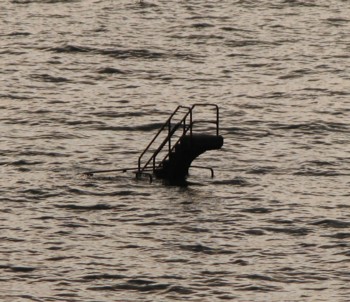 What could it be? A wreck perhaps? Odd. A week later, in the course of my return home, we visited St Malo again, and once again took a stroll around the old town walls. The tide, having been in when I arrived, was out, and all was revealed: 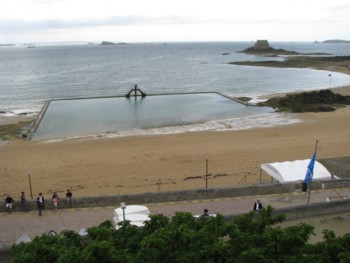 It’s a swimming pool, refreshed and replenished every time the tide comes in. Which makes a lot of sense. When the tide goes out in that particular part of coastal France, it goes out a long way, and wherever the sea is, my guess is that the currents in it can play evil tricks, what with the tides having such a long way to travel, and through such complicated places. How much nicer to wait for the tide to be out, and to take a swim in a nice safe pool, as this person obligingly proved for me. 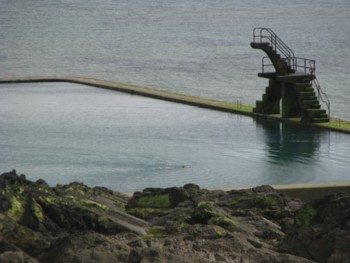 Now here are a couple snaps of images done by other people, both timeless and universal in their different ways. First, an advertisement, on a bus shelter:  I don’t think I need comment on that, other than to say that I haven’t seen this particular advert in England. Which proves … I don’t know what. Second, another universal set of circumstances:  Not very well photoed by me, for which apologies, through a shiny shop window. Had I been a cleverer photoshopper, I might have been able to straighten that out, but you surely get the picture, and clicking on it makes it that bit clearer, as with all of these snaps. A sheep in the middle is saying “Excuse me, excuse me, excuse me”, to get to the precipice quicker. Again, I’ll let readers draw their own conclusions about what particular contemporary circumstance is being portrayed. Euro purchasers perhaps? You decide. Finally, a surfer, photoed through rain:  This was taken at something called the Baie des Trépassés, which does not mean the Bay of the Very Out of Date. Trépassés means people who have trespassed as in “crossed over”, in other words people who are dead. The very same complicated coastal currents which caused anyone drowned at sea anywhere near it to wash up at the Baie des Trépassés (hence the name) now cause the waves in the Baie des Trépassés to be bigger than in any nearby places, hence the surfers. Of the many intriguing places I have visited in Brittany, this was the weirdest. The vile weather when I saw this place only added to the weirdness. July 24th, 2011 | 11 comments - (Comments are closed)
What a pity there is no culture of personal defence and widespread concealed carry in Norway as it would have been nice to see one of the victims shoot back at the bastard. – A sentiment much echoed in various armed self-defence forums regarding the recent atrocity in Norway. July 24th, 2011 | 18 comments - (Comments are closed)
July 23rd, 2011 | 3 comments - (Comments are closed)
“The early aircraft business resembled that of the shade-tree mechanics who, in building hot rods, gave rise, then as now, to true advances in automobile design. See also the chopper shops of California and their influence on the world of motorcycling. A list of these shade-tree mechanics includes the Wrights, Cyris McCormick, Henry Ford, Tesla, Tom Edison, Meg Whitman, Bill Gates, Burt Rutan, and Steve Jobs. How would they and American industry have fared had government gotten its hands upon them at the outset – if it had taxed away the capital necessary to provide a market for their wares; if it had taxed away the wealth, which, existing as gambling money, had taken a chance on these various visionaries? One need not wonder, but merely look around at the various businesses that government has aided. And now it has taken over health care.” – David Mamet, The Secret Knowledge, page 79. July 22nd, 2011 | 10 comments - (Comments are closed)
Guido reports that various opposition unworthies were at Lord’s today, watching England v India, “while Rome burns”, as he put it. Ed Balls, Charlie Whelan, and someone equally important called Kevin whom I do recognise from the picture and whose name I do know but have forgotten. MacGuire, is it? But it was far worse than that in the fiddling while Rome burns department. As soon as it started raining, they had no less a personage than Sir Mervyn King, Governor of the Bank of England, talking on the radio, with BBC cricket commentating supremo Jonathan Agnew. I know this, because I was listening. Is this not, I thought, rather an odd day for Governor King not to be at his desk? Sir Mervyn talked a lot about the Chance to Shine initiative which encourages school kids to play cricket. He has an interest in cricket and its organisation that goes way back, it would seem. It all sounded very encouraging for England cricket fans like me, provided we were able to set aside details like the world’s financial system going into melt-down. Sure enough, towards the end of their chat Aggers asked King about “events in Europe today”. Had he not done this it would have been even more surreal. King blocked all these queries with straight-batted cliches about how he and his various banking opposite numbers were in constant touch with each other, getting on top of the crisis, blah blah. If only. Geoff Boycott (scroll down here (17:23) for a report) had a go at King for bailing out failed banks. Boycott didn’t talk to King face to face, which I am sure they took very good care to prevent. But he did send a note, which Aggers read out:
King didn’t lose his cool, but he definitely sounded rather ambushed. Basically, his answer was: “When you are the BBC’s economic correspondent, I’ll answer your questions. I’m here to talk about cricket.” Was King doing that central banker thing of deliberately not cancelling irrelevant engagements, to give the impression of business as usual, no panic, steady as she goes and all that? If so, does he seriously think anyone will be fooled? Come to think of it, do you suppose that this is what the Emperor Nero himself thought he was doing, when he played on his instrument all those years ago? Fire? What fire? No no, just a little local difficulty. Soon blow over. Relax. Everything under control. Maybe Nero was just doing music so he could ignore awkward incoming phone calls. England are 127-2, this having been the somewhat disappointing (because cut short by rain) first day of a potentially very absorbing four match series. I’m watching the highlights now on the telly. India and England are, in that order, now to two top ranked test playing international cricket teams. If England can win this four match series by a margin of two matches or more, they will go top. England have a definite chance of doing that. As for the chance that Mervyn King and his various opposite numbers will manage to stop that financial crisis from getting any worse, well, that I wouldn’t rate quite so highly. July 21st, 2011 | 9 comments - (Comments are closed)
|
   |
||||

All content on this website (including text, photographs, audio files, and any other original works), unless otherwise noted, is licensed under a Creative Commons License. |
|||||
Recent Comments