We are developing the social individualist meta-context for the future. From the very serious to the extremely frivolous... lets see what is on the mind of the Samizdata people.
Samizdata, derived from Samizdat /n. - a system of clandestine publication of banned literature in the USSR [Russ.,= self-publishing house]
|
Now call me a big kid, if you will, and Stephen Pollard certainly doesn’t pull any punches in his article, on the topic, but I used to really enjoy reading the Harry Potter novels, even in public, even on trains, and even in preference to Murray N. Rothbard economics textbooks. (No, I hear you cry, how can you say such a thing?) But not any more.
For me the magic is either dying, or has already died. And it seems I’m not alone, for a Booker-winning author, A S Byatt, has also just slated the latest tome. Which is a relief, because I thought it was just me. → Continue reading: Potter losing his magic?
I wonder if there could be more to this civil unrest in Hong Kong than at first meets the eye? I only say that because what started out as a ‘people power’ mass protest at proposed anti-subversion laws has caused not just the Hong Kong government to backpeddle furiously but it also appears to be tightening a few sphincters on the Chinese mainland as well:
In a sign of China’s deep concern about the situation, pro-Beijing politicians said a team of middle-ranking mainland officials had arrived in the territory to assess developments.
A BBC correspondent says the officials are reported to have been present at Wednesday night’s protest, which saw tens of thousands of people gather outside the territory’s legislative council.
No great leaps of imagination are required to here. The nabobs are going to be reporting back to the poobahs on just how deep this river of discontent runs and the poobahs are going to lose a few nights sleep worrying whether all this uppityness could spread to the mainland. Well, you never know.
On the face of it, it seems unlikely that this show of bolshiness in Hong Kong could threaten the regime in China itself if only because, to outsiders, the old commie apparatchicks appear to have the country in such an iron grip. But the truth is that all authoritarian regimes are shot through with insecurity. They know only too well that their power rests solely on their monopoly of and willingness to use lethal force. But if that force ever fails, even once, then the whole house of cards comes down. → Continue reading: A little trouble in big China
Evidence, if you ever needed it, that surveillance cameras are getting smarter:
Britain’s first digital speed cameras are being installed today and will go “live” next month.
The new “super cameras”, which need no film or servicing, are being tested at Limehouse, in east London. With traditional cameras, motorists hope that there is no film in the camera and that they can get away with speeding.
But there will be no escape with the new digital version, which sends a stream of images and data along a phone line to a Metropolitan Police centre in Kent.
The first cameras are being installed at the Limehouse Link tunnel, which is an accident blackspot. Surveys have shown that drivers of nearly all of the 80,000 vehicles using the tunnel each day break the 30mph speed limit.
In the last three years, 14 accidents there have led to death or serious injury.
And evidence too of why surveillance cameras are widely believed to be a good thing, not just by the surveilling classes, but by the surveilled also.
The BBC’s political editor Andrew Marr has reported that “senior Government sources” believed that weapons of mass destruction would never be found in Iraq.
Oh dear.
Now let me state my position. I was all for the war against Iraq, and still believe the UK took the right decision to go in, with our US allies, to remove its disgraceful socialist dictatorship. But spare a thought for poor old Tony. He had to convince all of those Guardian readers, and all of those who marched against his policy, as well as those of us who’d already decided the rules changed, when two hijacked planes flew into the twin towers.
So Tony spiced things up, a bit. And thereby hoisted himself on the petard of WMD. And now he’s beginning to twist on it, ever so slightly, in the wind. In the last two days, in a subtle, nay, almost undetectable, change of emphasis, he’s abandoned the line of saying the weapons will be found. He is now saying, quite categorically, that evidence of the weapons will be found.
Now weapons of mass destruction are one thing — a bit of plutonium here, a bit of uranium centrifuge there — but evidence? What constitutes evidence? An old copy of the Cairo Times, with a handwritten Arabic scrawl on the back, saying ‘The Fist of God is in place, Sire’. Will that do? I suppose that depends on either how many people in GCHQ can write Arabic, or whether you’re a fan of Frederik Forsyth.
But the interesting thing is this. Did you spot the change of emphasis, when Blair switched to it on Tuesday? I must fess up, and say I didn’t. He’s a slippery devil.
But those nice kind clever people, at the BBC, did, bless them. Isn’t self-inflicted fratricide, between lefties, simply excellent entertainment.
Reuters reports:
A future European Union constitution will include a flag, an anthem, a motto and a Europe Day, despite British reticence about such state symbols.
The 105-member Convention on the Future of Europe decided at its final session on Thursday to add a reference to the symbols of the 15-nation bloc, due to be enlarged to 25 states next May, in a draft constitution submitted to EU leaders.
The official EU anthem is the “Ode to Joy” from Beethoven’s Ninth Symphony, the flag is the dark blue banner with 12 yellow stars in a circle, and the motto is “United in Diversity”, not dissimilar from the first motto of the United States, “e pluribus unum”.
Europe Day is May 9, commemorating a historic speech by French Foreign Minister Robert Schuman, one of the EU’s founding fathers, proposing the creation of a European Coal and Steel Community. [emphasis added]
Oh no, we are not imitating anybody!

The French and German ministers recently tasked with boosting bilateral cooperation have already agreed on one important point – the need for summer crash courses to learn each other’s language. French European Affairs Minister Noelle Lenoir and her German counterpart Hans-Martin Bury said each would spend part of their holidays in the other’s country sweating over grammar rules and vocabulary lists.
They met to prepare an October conference bringing together the heads of France’s 22 regions and Germany’s 16 federal states to discuss boosting cooperation in education, culture, economic development and environmental issues. Lenoir told journalists in French after talks with Bury:
German must gradually become almost as widely spoken and as easily spoken as English is today.
Heh.
I suppose that, one way or another, this will all get smoothed out in the long run but, nonetheless, we can enjoy it while it lasts:
Gerhard Schroder, the German chancellor, called off his summer holiday to Italy yesterday, as the worsening row between the countries began to unravel years of carefully orchestrated co-operation at the heart of Europe.
More and faster, please.
I’ve just watched the film Wall Street for the very first time. I know I’m a few years late, but c’est la vie. The movie subjects viewers to the economic fallacy that asset stripping does not create wealth.
When financiers asset strip a company, they do something very useful. They take assets that are not being used efficiently, and change their use to something more valuable. It may not be nice for those employed by the company, but the country as a whole is better off as a result.
Make no mistake, the moves afoot to ban hunting in Britain have very little to do with animal welfare but everything to do with class warfare. It is nothing less than a clash between those who believe civil society must be tolerant to those who share different minority views and who wish to freely associate in the pursuit of a beloved activity… and those who believe that state and violence backed political interaction, rather than society and voluntary social interaction, is the core around which all activity must revolve.
The class warriors of the Labour and LibDem Parties, and a few statist Tory confreres, wish to regulate notions of free associating civil society out of existence and replace it with a regulatory democratic state in which no aspect of rights or affinity are beyond the reach of regulatory politics… nothing less than an intolerant dictatorship of the political plurality.
Well a bunch of people met in front of Parliament today who said that regardless of what the bigoted class warriors of Westminster say, they are not going to cooperate.
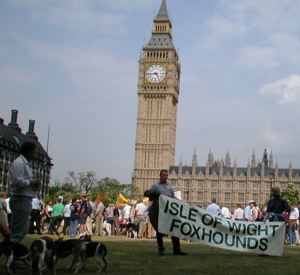
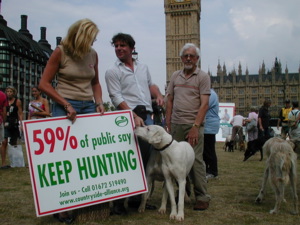
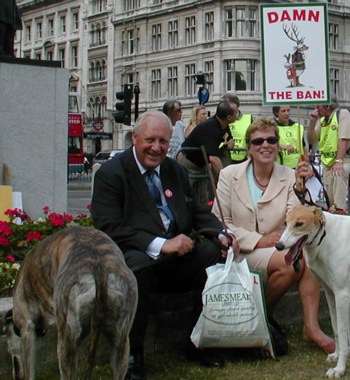

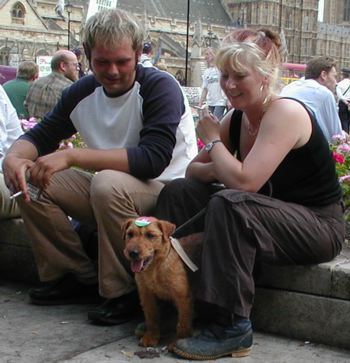
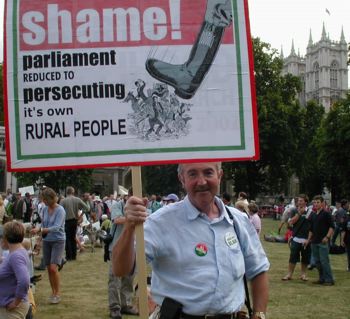
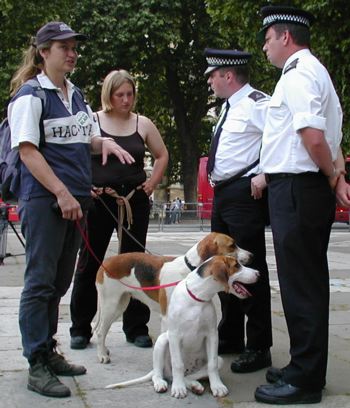
The class warriors are not ‘progressive’ at all… they are in fact the heirs to a view of the role of the politics which in days gone by used law to oppress other despised minorities, such as homosexuals or Roman Catholics. They are just hate filled sanctimonious collectivist bigots.
(the photos taken today courtesy of The Dissident Frogman because my camera is knackered)
“But it may be that I shall leave a name sometimes remembered with expressions of goodwill in the abodes of those whose lot it is to labour, and to earn their daily bread by the sweat of their brow, when they shall recuit their exhausted strength with abundant and untaxed food, the sweeter because it is no longer leavened by a sense of injustice”.
– Sir Robert Peel, British statesman (1788-1850)
The quote by Peel above, coming as it does from one of the greatest of British statesmen and a free-trader who paid a high political price for his convictions, ought to be remembered as we contemplate the recent trip by President George W. Bush to Africa, and indeed the trips by numerous western leaders to the poorer parts of the world.
We live in times when we are constantly told that it is the duty of the prosperous industrial nations to help lift their poorer peers, such as in Africa, to a wealthier state. And yet nothing could be more useful in that aim than if governments, such as those which support the EU and U.S. farm subsidies, chose the path of genuine laissez faire.
Sir Robert Peel may not be a name familiar to many people today – more’s the pity. He may be mainly known as the man who established London’s Metropolitan Police (which is why our police are still sometimes called “bobbies”).
When one considers how he put the industrial future and prosperity of the masses before the vested interests of the land by embracing free trade, the dimwits who inhabit our government today look very small indeed.
Sir John Stevens, head of the Metropolitan Police, has supported removing the automatic right to trial by jury in some serious cases.
In a speech he argued that the move was necessary to fight organised crime by preventing “jury nobbling”. BBC report here.
If juries are in danger then it is the job of the police to protect them – not throw out a fundamental part of our constitution because it is inconvenient and expensive.
To be fair Stevens did say that the restriction to trial by jury – proposed in Big Blunkett’s discredited Criminal “Justice” Act – should be limited to special cases and determined by a judge. However any erosion of this basic Magna Carta right is unacceptable. This proposal is akin to saying “we already know you’re guilty so we won’t give you the same rights as anyone else.”
Remember how door-to-door DNA testing was initially introduced for “special cases” only? Now any time there is a serious crime police roam the neighbourhood asking innocent citizens to “volunteer” a DNA sample.
Special cases have a tendency to become commonplace.
Partially cross-posted to The Chestnut Tree Cafe.
A reminder for our readers: the next few days are a time of demonstration in support of Iranian students. Oxblog has posted a list of times and places he is aware of. If any are near you, by all means go!
|
Who Are We? The Samizdata people are a bunch of sinister and heavily armed globalist illuminati who seek to infect the entire world with the values of personal liberty and several property. Amongst our many crimes is a sense of humour and the intermittent use of British spelling.
We are also a varied group made up of social individualists, classical liberals, whigs, libertarians, extropians, futurists, ‘Porcupines’, Karl Popper fetishists, recovering neo-conservatives, crazed Ayn Rand worshipers, over-caffeinated Virginia Postrel devotees, witty Frédéric Bastiat wannabes, cypherpunks, minarchists, kritarchists and wild-eyed anarcho-capitalists from Britain, North America, Australia and Europe.
|





Recent Comments