We are developing the social individualist meta-context for the future. From the very serious to the extremely frivolous... lets see what is on the mind of the Samizdata people.
Samizdata, derived from Samizdat /n. - a system of clandestine publication of banned literature in the USSR [Russ.,= self-publishing house]
|
Our “Quote of the day” below, links to an information page about a new film called ‘Slap her… she’s French’.
I was sufficiently intrigued by the title to inquire further and, judging from the serious reviewer, it would appear to be nothing more than a run-of-the-mill, formulaic teen comedy which I shall most likely never see.
But, for some people, it is something far more sinister. Beneath the professional review is a comments box where members of the public (and the clinically insane) can leave their own reviews and where I stumbled upon this hilariously deranged rant:
Hollywood has always been very good at serving Republican propaganda. In the 80’s we had brainless flicks such as Rambo 2, Rocky 4 and Top Gun, just to name a few of them.
Since Bush Junior took the presidency in a quite dictatorial manner, his team and him have separated America from the rest of the world at a point never reached before.
From late 2000 till 9/11, they started spreading hateful propaganda against Russia (trying to wake up ghosts of the cold war?) and racist propaganda against Chinese people, calling US citizens not to treat them as full American citizens. Mr. Bush was desperately looking for an ENEMY. Their ARROGANCE and VIOLANCE is matched only by the one of the Islamist terrorists.
On September 11, 2001, he and his team were served the best pretext they could have ever dreamed of, by people as crazy as them. Instead of analyzing the situation in a pro-active way and fighting terrorism cleverly in order to eradicate it, the reacted like dumb, immature, arrogant teenagers and preferred bombing innocent civilians.
The order given to Hollywood was to use the nations preferring peace than war as villains in their industrial products they deliver to the rest of the planet they so ARROGANTLY SCORNED. Part of this was the `French Bashing’ of which we have excellent examples in NO-BRAINERS such as “Slap Her She’s French” (no comment), `Master&Commander’ (In the book, the villains are British. France saved America from the British invasion in late 18th century; remember La Fayette), `Johnny English’ (ha, ha, ha, a French King trying to take over the British Queen), `Matrix Reloaded’, `SWAT’, `Along came Polly’, etc.
Let’s hope that when Mr. J.F. Kerry has been democratically elected in 2004, this virulent arrogance should come to an end, and America is part of the world again.
But, apart from that, how was the film?
It is official: food is the new enemy of the international left.
While the crashers were doing their stuff on the neatly-manicured lawns of Geneva, dark plots were being hatched inside the gleaming towers:
All 192 countries in the World Health Organisation have tentatively agreed to an unprecedented policy on diet and health to tackle global obesity.
Did that include the Ethiopeans?
The voluntary plan was hammered out at talks in Geneva in the face of stiff opposition from lobbies such as the sugar-producing nations.
We are privileged indeed to witness the birth of a brand, new imaginary straw-man. Ladies and gentlemen, making its debut on the world stage, but soon to making regular appearances in the columns of every angry, left-wing polemicist in every media venue on earth, please give a warm welcome to….. “the Sugar Lobby” (boo, hiss). Stand right here in the spotlight, Sugar Lobby, and take your place among right-wingers, big tobacco, industrialists, zionists, gun manufacturers, motorists and George Bush.
Nearly one in six people worldwide is now considered overweight.
Amazing is it not? Seems like only five minutes ago that the battlecry of the social-working class was “feed the starving”. Now, in the blink of an eye, they have changed it to “starve the fed”. Astonishing stuff!
The BBC’s Imogen Foulkes in Geneva says this is the first ever attempt to regulate the world’s eating habits.
And we all know that it will not be the last.
Dr Kaare Norum, a Norwegian obesity expert who advised the WHO on the development of the plan, said the agreement was a victory for public health.
DR. NORUM: “I have been studying obese people for many, many years and the incontrovertible data I have collected as a result leads me to conclude that these people are very fat”.
WHO: “You are obviously an expert. Come join our committee”.
Honestly, the whole article sounds as if it has been lifted from an old issue of Pravda. Mind you, it comes courtesy of the Beeb.
So be warned you choca-holics and doughnut-dunkers: your stodgy, sticky delights are on the hit list. Lock them away in secret bunkers while you still can.
Gabriel Syme and I (and a certain Frogman) have been away from our keyboards for a few days because we have in Geneva, adding our efforts to that most worthy of activist groups, Bureaucrash, on the occasion of the first outing of Eurocrash in Switzerland. The target for our attentions was the Fifty-seventh World Health Assembly held by that hotbed of socialist obscurantism, the World Health Organisation.
The simple message of the Eurocrash was not something all too many of the people participating in that tax funded Tranzi event wanted to hear: Capitalism Heals/Socialism Kills
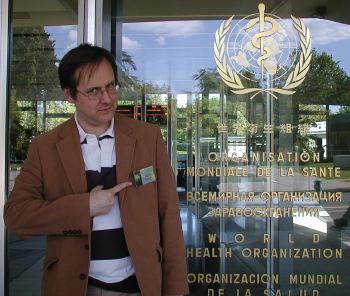 Step One: Infiltrate the WHO events by getting a badge… Step One: Infiltrate the WHO events by getting a badge…

Step Two: wander over to the UN Palace of Nations…

Step Three: take embarrassing pictures of UN type folks smoking in front of where WHA sessions are going on…

Step Four: hand out pro-capitalist leaflets designed to demonstrate that there is more than one point of view…
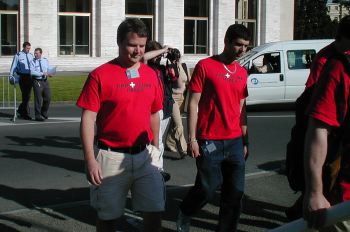
Step Five: get run out of town by UN cops…
Although it was all only a very small fly in their ointment, it was all worth it just to see the incredulous expression of people at the notion of pro-capitalist demonstrations on UN property.
The next round of jolly japes immediately afterwards was to crash the screening of a new film by socialist activist German Velasquez, called ‘Profits or Life?‘, which criticises attempt to uphold the intellectual property rights of pharmaceutical companies who have developed many life saving drugs. Velasquez was supported on a Q&A panel afterwards by Marxist activist Carlos Correa. Twenty or so Crashers turned up to to ask a few rather awkward questions and distribute some rather clever leaflets which dissented from the movie’s message…
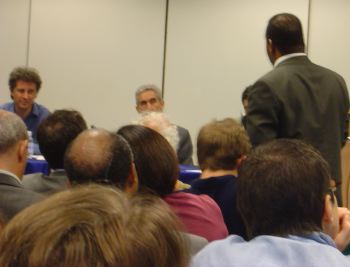
Crasher Niger Innes asks why, given that the
panel was representing itself as the voice of the
poor in Africa, there were no Africans on the panel? Ouch.
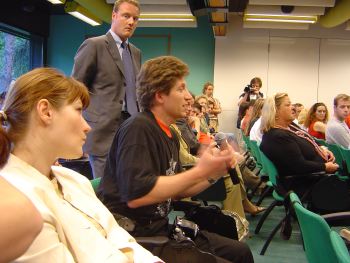
Crasher Stefan Metzeler points out that as the
majority of drugs are not under patent anyway,
blaming intellectual property rights for the Third World’s
health problems, rather than massive regulatory statism and
a lack of free trade, is rather idiotic…
And then who should appear in the audience but Dr. Harvey Bale, who Velasquez’s movie has cast as ‘the ugly American Bad Guy on the side of the evil pharmaceutical companies’. Far from being the sinister character ‘Profits or Life?‘ portrayed him to be, he turns out to be an urbane and very articulate fellow as he addressed the point which had been made on-screen. Never have I heard a man demolish another man’s arguments so systematically and yet remain utterly charming and polite.
And then Dr. Harvey Bale, the Director General
of the Geneva-based International Federation of Pharmaceutical
Manufacturers Associations had a few words…
And with that, the Crashers vanished into the surroundings… well, into Geneva actually in search of food and drink. A fairly interesting time was had by all and I found the event a very useful networking opportunity as well.
If something sounds too good to be true then it is most likely untrue but if something sounds too bad to be true you can probably take it to the bank.
If there is anything axiomatic about that proposition then perhaps I should claim proprietory rights on it and call it ‘Carr’s Law’ or something. I am not sure how much use this law will prove to be on a practical day-to-day basis but it may oblige as a useful yardstick against which to measure my natural cynicism about opinion polls, surveys and related statistical exercises.
For example, take this one, published last month:
David Blunkett has pledged to push ahead with ID card legislation after an opinion poll said most people would be happy to carry one.
The MORI survey was commissioned by an IT consultancy which has worked on projects with the government.
It revealed 80% of those questioned backed a national ID card scheme, echoing findings from previous polls.
And published yesterday:
Most people would support closing a legal loophole that allows parents to smack their children, says a survey.
A total of 71% of people would favour such a ban, according to a survey commissioned by the Children are Unbeatable! Alliance.
And published today:
A majority of British adults favour a total ban on smoking in public places, a survey suggests.
A poll of more than 1,500 people by market analysts Mintel found 52% support for a ban, including two-thirds of non-smokers.
Despite my ingrained reluctance to pay these wretched surveys even a jot of heed, I do accept that a sufficient number of such polling exercises (if conducted scientifically and honestly) can, correctly identify a trend if not quite reveal great truths. → Continue reading: All those in favour say “aye”
“As the great German philosopher Fred Neechy once said: That which does not kill us is gonna wish it had because we’re about to FedEx its sorry ass back to Skank Central where it came from. Or something like that.”
– The words of Starla Grady (played by Jane McGregor) in the opening credits of Slap Her… She’s French
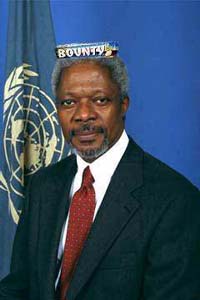
Ben Hammersley has put a bounty on Kofi Annan’s head.
Annan is an object of undeserved worship, and the way to treat objects of undeserved worship is to blow raspberries at them. This Bounty Bar makes a fine raspberry. I make that three incompatible metaphors. Salutations to Photoshop, and to Normblog for the link.
I’m watching Robert Kilroy-Silk on Question Time, and I think he’s doing rather well.
Kilroy started out as a Labour MP, believe it or not. But he was never really convincing in the role. The others did not like him, and he sensed that he was not one of them, was my impression. Too keen on personal advancement, and not nearly keen enough on concealing it under a veneer of class solidarity. So he stopped doing that and switched to Kilroy, one of those early to mid-morning mini-amphitheatre televised bore-ins with Kilroy himself as the roving interlocutor.
Kilroy’s basic problem with Kilroy was that he seemed to regard everyone present except himself an idiot, a feeling which must have been hard to fight, given that everyone present except himself was at the very least behaving idiotically. (I speak as one who used to appear on this show myself from time to time, until I saw the pointlessness of my ways.) Kilroy tried to conceal his contempt for everyone under a layer of somewhat overdone good humour and what I presume he thought was charm, but what everyone else called smarm.
As his show moved away from semi-intelligent debate into the territory already occupied more entertainingly by Jerry Springer – my mother is a cross-dresser, I want to have a fight with my step-dad, my twin sister is a prostitute and I am a nun and I want to have a fight with her, etc. – Kilroy’s manner became ever more off-putting and false and desperate.
But Kilroy-Silk’s manner on Question Time was downright … appropriate. Gone was the layer of smarm. And out from under it came this really quite attractive and intelligent man. He used to be hated because he was appalling. Now he will be hated because he is not nearly as appalling as his enemies would like him to be.
Most of us are familiar with the Peter Principle, the one that says that people are promoted until they arrive with a thud at their level of incompetence, at which they then remain for ever. But in politics as in life generally, I think we sometimes observe the opposite process. Sometimes, people arrive at their level of competence, having just buggered about pointlessly for the previous two decades until they reached it. Kilroy-Silk strikes me as a fine example of a man who is now, as a Eurosceptic politician with the right, the duty, and the inclination to speak his mind, at last arriving at his level of competence.
It could turn out that by switching off Kilroy the talkshow host, and unleashing Kilroy-Silk the reborn politician, the BBC has made one of its most important contributions to the EUro-debate, in favour of the NO side.
Please understand that I am talking here about competence, rather than about the rights and wrongs of it all. I generally hate what politicians do, but my point is: some of them do it very well, while others mysteriously run out of steam, seem woefully miscast, and should have carried on with what they had previously been doing.
For the opposite tendency, a perfect example of the original Peter Principle rather than of the reverse version of it which I am here offering: Glenda Jackson. What a fine actress. And what a sad, drab failure as a politician.
After Thatcher glassed the unions, you would think they would have the manners to lie prostrate and bleeding amongst the spit and sawdust. Not a bit of it. Once their pet party returned to power under a business-friendly sneer, all they had to do was lie back and wait for pro-Europeans to pass the relevant regulation.
Lo and behold: the new Information and Consultation Regulations, where you, the employee, gain state mandated power to put forward a collective voice in how the business that employs you is run. You may not have put any money behind the business, but as a stakeholder, you should have your interests taken into account by the union that will represent you.
Tim Lang, partner at law firm George Green views this regulation as “a ticking time bomb”.
Initially, the new laws will only apply to firms with 150 or more employees. However, by 2007 the laws will extend to those with 100 employees and, by March 2008, the threshold will drop to 50.
Under the new rules, employ-ees will be able to request information and consultation arrangements from their employer with a petition from ten per cent of the workforce.
There would then be a period of time for negotiating a voluntary agreement, detailing exactly what information must be provided, when, to whom and what level of consultation is required. If nothing can be agreed then a default framework, set out in the legislation, will apply.
Since these works councils will provide a huge fillip to unionisation and wage demands, we can now see that the European Union, with Labour’s acquiescence, is rolling back Thatcher’s labour market reforms and jeopardising the potential growth of the British economy.
The costs for business will always be greater than the state estimates:
The Department of Trade and Industry estimates that for those firms with no pre-existing structure, who just implement the standard legislative process for informing and consulting, the total set-up costs per firm would be £4,000 for medium-sized firms and £6,300 for large firms.
But Mr Lang disagrees. He said: “The cost in management time of this new directive could be huge, with companies having to think through their processes and then actually provide the information. Time is already short for the first businesses affected to start the process of putting measures in place.”
Like all socialists, the Labour party wishes to return to a closed shop in politics and the workplace, gerrymandering our unwritten constitution and providing new institutions for the enemy class to take over the private sector.
What Went Wrong? Western Impact and Middle Eastern Response
Bernard Lewis
Oxford University Press, 2001
The Multiple Identities of the Middle East
Bernard Lewis
Schocken Books, 2001
In Goodbye to All That (pub. 1929), Robert Graves reports witnessing an encounter between Lawrence of Arabia and an American oil financier who had come over from the United States to ask him a single question: Did Middle-Eastern conditions justify him putting any money in South Arabian oil? Lawrence, without rising, simply answered: No. That was all the man wanted to know, and he left. At that time, the US produced almost three-quarters of the world’s oil, Iran less than three percent, while its presence in the Arabian pensinsula, if suspected, was unknown.
This exchange, some time in the nineteen twenties, though not alluded to by Bernard Lewis, is a reminder that in the absence of oil the whole region, from the Mediterranean to Iran, now detached from the Ottoman Empire after the First World War, might have been expected to slumber on as it had already done for centuries. Britain was burdened with the administration of Palestine, Transjordan, Iraq and the Gulf States, but its only real interest was in safeguarding the route to India via the Suez Canal. It might feel responsible to do rather more for the region than merely keep the peace, a valuable enough favour to the inhabitants, but, in the way of active development, there would be little it could do. One of Lewis’s more surprising statements quotes a World Bank estimate that “the total exports of the Arab world other than fossil fuels amount to less than those of Finland, a country of five million inhabitants (p. 52).” Admittedly there is perhaps little need to export anything else, indicative of the lack of any incentive to do so which has stimulated countries without much in the way of natural resources, but this merely leads us by another route to the question posed by the author: why has the Arab world remained stagnant for something like a thousand years? → Continue reading: Bernard Lewis on what went wrong in the Middle East
If something sounds too good to be true then it is most likely untrue but if something sounds too bad to be true you can probably take it to the bank.
If there is anything axiomatic about that proposition then perhaps I should claim proprietory rights on it and call it ‘Carr’s Law’ or something. I am not sure how much use this law will prove to be on a practical day-to-day basis but it may oblige as a useful yardstick against which to measure my natural cynicism about opinion polls, surveys and related statistical exercises.
For example, take this one, published last month:
David Blunkett has pledged to push ahead with ID card legislation after an opinion poll said most people would be happy to carry one.
The MORI survey was commissioned by an IT consultancy which has worked on projects with the government.
It revealed 80% of those questioned backed a national ID card scheme, echoing findings from previous polls.
And published yesterday:
Most people would support closing a legal loophole that allows parents to smack their children, says a survey.
A total of 71% of people would favour such a ban, according to a survey commissioned by the Children are Unbeatable! Alliance.
And published today:
A majority of British adults favour a total ban on smoking in public places, a survey suggests.
A poll of more than 1,500 people by market analysts Mintel found 52% support for a ban, including two-thirds of non-smokers.
Despite my ingrained reluctance to pay these wretched surveys even a jot of heed, I do accept that a sufficient number of such polling exercises (if conducted scientifically and honestly) can, correctly identify a trend if not quite reveal great truths. → Continue reading: All those in favour say “aye”
There is some interesting new information about the 155mm Sarin shell on Blaster’s Blog:
Iraq never declared any binary 155mm artillery shells. In fact, they never claimed any filled with sarin at all in the UNSCOM Final report (Find on “Munitions declared by Iraq as remaining”). Not declared as existing at the end of the Gulf War, not having been destroyed in the Gulf War, not having been destroyed unilaterally. The only binary munitions claimed by the Iraqis were aerial bombs and missile warheads. Not in an artillery shell.
I was just thinking about this as I returned from breakfast. One of our commentariat pointed out the missing shells were of a smaller size and were of a type with a fairly short shelf life. Suddenly this single shell becomes even more troubling.
This is a very different story now. Is there a whole class of large binary munitions no one was even aware of?
Something rather remarkable has just happened. I am watching Baddiel and Skinner Unplanned, and they have just had a serious discussion about how they really did not like the fact that the Government can tell exactly which internet sites you have just been visiting, and read all your emails, and send you to prison if you encrypt them and do not tell them the key, or whatever it is. Baddiel and Skinner never have serious discussions.
A bloke in a beard (of the trimmed sort rather than ZZ Top style) asked a question about this, and instead of him being laughed out of the studio, they found themselves discussing it quite seriously. Bearded bloke was allowed to add a further comment (about the emails). Baddiel in particular seemed quite upset.
Interesting.
|
Who Are We? The Samizdata people are a bunch of sinister and heavily armed globalist illuminati who seek to infect the entire world with the values of personal liberty and several property. Amongst our many crimes is a sense of humour and the intermittent use of British spelling.
We are also a varied group made up of social individualists, classical liberals, whigs, libertarians, extropians, futurists, ‘Porcupines’, Karl Popper fetishists, recovering neo-conservatives, crazed Ayn Rand worshipers, over-caffeinated Virginia Postrel devotees, witty Frédéric Bastiat wannabes, cypherpunks, minarchists, kritarchists and wild-eyed anarcho-capitalists from Britain, North America, Australia and Europe.
|





Recent Comments