We are developing the social individualist meta-context for the future. From the very serious to the extremely frivolous... lets see what is on the mind of the Samizdata people.
Samizdata, derived from Samizdat /n. - a system of clandestine publication of banned literature in the USSR [Russ.,= self-publishing house]
|
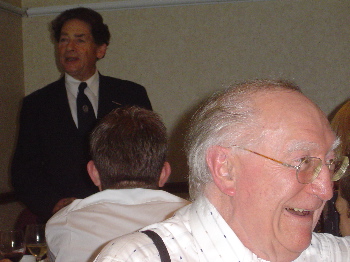
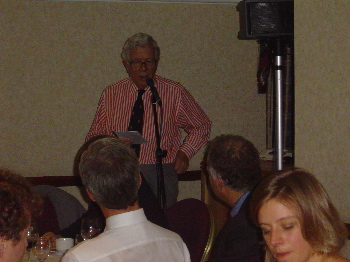
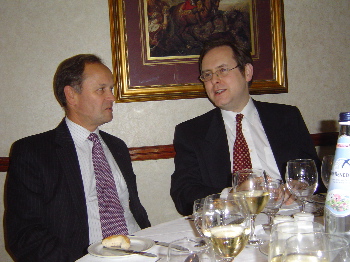
Tonight I attended a very interesting event hosted by the Adam Smith Institute which commemorated the 25th anniversary of the abolition of exchange controls. Speaking at this dinner were Lord Howe and Lord Lawson, the people actually responsible for the action which set off a cascade of events not just in Britain but across the world. This in no small measure led to the second age of globalisation in which we live today. The third speaker, acting as the warm up act and comic relief, was yours truly.
From yesterday’s Guardian.
The creation of spin-off companies by university researchers, one of the chancellor’s key policies, has ground to a halt because of a catch-22 in tax legislation, say frustrated academics.
Gordon Brown, who today hosted a seminar on science and wealth creation at 11 Downing Street, has been alerted to the problem, but has so far failed to sort out the muddle over the aptly named Schedule 22.
Plans for scores of companies to work on developing science and research projects have been put on hold by universities after they learned that their academics were threatened with multimillion pound tax demands as soon as the companies started operating, long before they made any profits.
To add insult to injury, the universities themselves are responsible for collecting the tax from their enterprising academics.
University business development officers believe that spin-offs have almost ground to a halt and fear that delays will be damaging to many ideas and projects.
This arose because of one of those tax loopholes that our Chancellor so loves to close. → Continue reading: Schedule 22
If this bothers you, please sod off and go read Atrios or Kos
– Instapundit
It has been a couple of hours since I watched The Power of Nightmares on BBC 2, the first programme in a major new BBC series. I put off writing about the program so I could decide whether I really wanted to get into what, I suspect, will be a can or worms. However, the issues this program raised are too important to be ignored.
Many libertarians will find the thesis of the programme attractive. This thesis being that a group of statists called ‘neo conservatives’ (inspired by the philosopher Leo Strauss) has created a series of imaginary threats to the United States, myths, to justify government power and to (in their own view) give the mass of ordinary people meaning and purpose in their lives. The Platonic ‘noble lie’ of our time. I can see in my mind the joy of (for example) people at the Ludwig Von Mises Insititute and the joy of people in the Libertarian Party, and the joy of old style Conservatives.
And I must say that have great respect for many aspects of the people in the above paragraph. I too dislike neocons (a neocon on BBC Radio Four’s Start the Week show on Monday defined neoconservatism as acceptance of the Welfare State, of deficit finance, and of a positive duty for the United States government to spread democracy all over the world – and I oppose all those beliefs). I also questioned the Iraq war (and got attacked here for asking what the war was supposed to be about – although I accept that once Britain and the United States are at war with a bunch of terrorist scum it is too late for opposition “I would not start from here” directions are not very good). → Continue reading: Nightmares about Nightmares
Because she’d never heard of me, she made the quite reasonable assumption that I was a Dante writer – one so new or obscure that she’d never seen me mentioned in a journal of literary criticism, and never bumped into me at a conference. Therefore, I couldn’t be making any money at it. Therefore, I was most likely teaching somewhere. All perfectly logical. In order to set her straight, I had to let her know that the reason she’d never heard of me was because I was famous.
– Neal Stephenson, describing an encounter with a “literary” writer in a quite wonderful interview over at slashdot. His answer to the question “In a fight between you and William Gibson, who would win?” is so magnificent that it would make me go and buy all his books if I didn’t own them already.
Washington Post reports that Rep. Jim Turner sent a letter to Homeland Security Secretary Tom Ridge, who wrote that terrorists who alter their fingerprints have about an even chance of slipping past U.S. border watch-list checks because the government is using a two-fingerprint system instead of one that relies on all 10 prints. He mentioned a study by researchers at Stanford University who concluded the two-finger system is no more than 53 percent effective in matching fingerprints with poor image quality against the government’s biometric terrorist watch-list. Turner said the system falls far short of keeping the country secure.
Turner accused homeland security officials of failing to be “more forthcoming” about the limitations of their approach.
I understand your desire to deploy biometric screening at our borders as quickly as possible. But more than three years after the 9/11 attacks, we have invested more than $700 million in an entry-exit system that cannot reliably do what the Department so often said it would: Use a biometric watch-list to keep known terrorists out of the country.
How about not using terrorists as an excuse for tagging the citizens?
The Mesopotamian writes about the US Presidential Election. This quote is also quoted by Alice in Texas (also of Samizdata). It is, you might say, another letter to voters in America (see immediately below)..
So, I have been, personally very attentive to the debates and positions of both candidates, and I have some thoughts which I would like to share with you, my American friends. To start with, Senator Kerry may be a very good man and quite patriotic. Also we have to respect the almost 50% of the American people who lean towards the democrats. I don’t know much about domestic issues in the States so naturally, as might be expected, the position of any Iraqi would be mainly influenced by the issue that most concerns him. Thus, regardless of all the arguments of both candidates the main problem is that President Bush now represents a symbol of defiance against the terrorists and it is a fact, that all the enemies of America, with the terrorists foremost, are hoping for him to be deposed in the upcoming elections. That is not to say that they like the democrats, but that they will take such an outcome as retreat by the American people, and will consequently be greatly encouraged to intensify their assault. The outcome here on the ground in Iraq seems to be almost obvious. In case President Bush loses the election there would be a massive upsurge of violence, in the belief, rightly or wrongly, by the enemy, that the new leadership is more likely to “cut and run” to use the phrase frequently used by some of my readers. And they would try to inflict as heavy casualties as possible on the American forces to bring about a retreat and withdrawal. It is crucial for them to remove this insurmountable obstacle which stands in their way. They fully realize that with continued American and allies’ commitment, they have no hope of achieving anything.
On the other hand if President Bush is reelected, this will prove to them that the American people are not intimidated despite all their brutality, and that their cause is quite futile. Yes there is little doubt that an election victory by President Bush would be a severe blow and a great disappointment for all the terrorists in the World and all the enemies of America.
I have received this letter from an Iraqi concerned citizen, who wishes to remind U.S. voters of the historic importance of their choice on November 2.
Dear voter,
I am an elderly man. Under the Clinton administration I had an excellent well-paid job. I took many vacations and had several holiday homes. Since President Bush took office my life has completely changed, and in every respect for the worse.
I lost my job.
I lost both my sons in the terrible Iraqi war. I lost my homes. I lost my medical insurance. In fact, I lost practically all of my possessions and found myself homeless.
Adding insult to injury, when the authorities found me living in bestial conditions, far from helping me, they arrested me.
I shall do whatever Senator Kerry wishes to ensure that a Democrat is returned to the White House next year. Bush must go!
There. I thought that all Americans would like to know what a man of my years thinks of the Bush administration.
Thank you for taking the time to read this letter.
Best wishes,
Saddam Hussein
[thanks to the French libertarians for forwarding this to me from this blog.]
I was paging through the new issue of American Rifleman, the monthly magazine of the National Rifle Association, when I came across an interview with General Tommy Franks, who led the brilliant assault on Baghdad last year. (Sorry, no link available).
In the interview, the retired General is asked a couple of questions about his preferences in guns, and I found his answers surprising.
First, he said he prefers the current Beretta 9mm handgun to the .45 he carried in Vietnam. He couldn’t really point to anything concrete, just a generalized (so to speak) preference. He did note that it had to be shooting the right loads to be an adequate combat weapon, but that was the only concession he made.
Second, he said he considered the M-16 to be a superior battlefield weapon to the AK-47 in every way. Period. Based on his comments about the M-16 earlier (he was in basic training when they were first issued), I think there is an unspoken assumption here that that it is a better weapon in the hands of well-trained troops who know how to maintain it.
Last night I attended a seminar on education organised by the Social Affairs Unit (there is as yet nothing about this event on their blog), at which the speaker was Francis Gilbert. Gilbert read a bit from his new book, I’m a Teacher, Get Me Out Of Here!, and if this bit was anything to go by, it is a very good book. (See also this posting here earlier this year.)
I will not here recount – and could not hope to recount – everything that was talked about, but I do note with approval that Francis Gilbert, after he had finished reading from his book, invited us to think about how much better education would be if it was run by the man who has recently taken over his local corner shop, and has made a great success of it, and by a few thousand others like him, instead of by the Government.
However, I will focus on one very widespread and wrong clutch of related ideas that cropped up in the course of our discussion. It was said, echoing something that Francis Gilbert himself had said, that education is not “like oil or bread”. The most important qualities of education are beyond measurement or quantification. The thing is just too complicated and … I think that the word ineffable may even have been used. Unlike oil or bread.
The conclusion we were invited to draw from this was that education, unlike oil or bread, cannot be supplied entirely by the free market, as a lot of us, taking our lead from Francis Gilbert, were enthusiastically recommending. It is just too complicated a thing to dole out in easily measurable little packets, like oil or bread.
But it simply does not follow that because something is complicated and immeasurable, even ineffable, that it cannot and should not be supplied by tradesmen. → Continue reading: The false argument for state control from immeasurability
So Kofi ‘Food-for-Oil Scandal’ Annan has met with Tony Blair to discuss an eight point programme for setting the world to rights.
I am appealing to the Chancellor and the UK government to use the upcoming UK presidencies of the G8 and the EU to work for the necessary political breakthrough and the additional resources needed to achieve those goals.
The only way political breakthroughs are going to lead to an end to poverty is when political leaders do a great deal… less.
The idea that you can increase taxes and stimulate the economy is pretty damn stupid.
– Edward Prescott , Arizona State University professor, shared the 2004 Nobel Prize for economics.
Thanks to Instapundit.
|
Who Are We? The Samizdata people are a bunch of sinister and heavily armed globalist illuminati who seek to infect the entire world with the values of personal liberty and several property. Amongst our many crimes is a sense of humour and the intermittent use of British spelling.
We are also a varied group made up of social individualists, classical liberals, whigs, libertarians, extropians, futurists, ‘Porcupines’, Karl Popper fetishists, recovering neo-conservatives, crazed Ayn Rand worshipers, over-caffeinated Virginia Postrel devotees, witty Frédéric Bastiat wannabes, cypherpunks, minarchists, kritarchists and wild-eyed anarcho-capitalists from Britain, North America, Australia and Europe.
|





Recent Comments