We are developing the social individualist meta-context for the future. From the very serious to the extremely frivolous... lets see what is on the mind of the Samizdata people.
Samizdata, derived from Samizdat /n. - a system of clandestine publication of banned literature in the USSR [Russ.,= self-publishing house]
|
The FT paper edition for 20th/21st August has feature on some of its writers sitting some of this years’ A-level exams. Though a stock sort of piece, this much the best of its type I’ve read and is full of insights, most provided by the examiners they involved in the exercise.
For example, here’s Matthew Lumby of the QCA:
A lot of people think that in an essay question you are just judged on content and style when in fact the markers will be looking for a number of specific things.
What else is there?
Spiked carries a fascinating, if frightening, piece by Charles Pither, a private doctor, on the invasive requirements of galloping regulation on those working in the healthcare sector. Just being able to check and list their employees (and their own) slave-number online will no doubt come as a relief.
What I hadn’t appreciated, until the man came to make his inspection, was all the personal data that we needed to keep for our staff (in a locked cabinet, of course). Two references, a recent photo, a copy of their passport, copies of their qualification certificates, a curriculum vitae with explanations for any gaps, a copy of their contract and job description.
Including the cleaner? Yes, including the cleaner. ‘It’s not me who makes the regulations’, said the man from the HCC. ‘The onus is on you to comply with the statutory requirements as set out in the standards of care regulations.
Read the whole thing, as they say.
What’s most disturbing is how suddenly these bureaucratic personal checks have sprung up, and how it has happened with no resistence. The Health Care Commission was created by the Health and Social Care (Community Health and Standards) Act 2003, and started its interfering on April 1st 2004. The Criminal Records Bureau was established under the Police Act 1997, but its functions have been rapidly widened, in legislation on children, education, financial services, and health, but also notably by a series of Exceptions Orders to the Rehabilitation of Offenders Acts that have made the idea of a spent conviction (an old, minor one you need not acknowledge) pretty much obsolete. The operative Control of Substances Hazardous to Health Regulations are dated 2002.
Never mind 1890, it would be nice to get the British state back to the size it was in 1990.
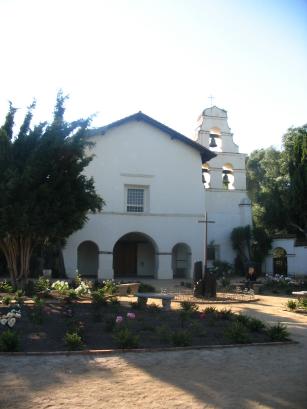
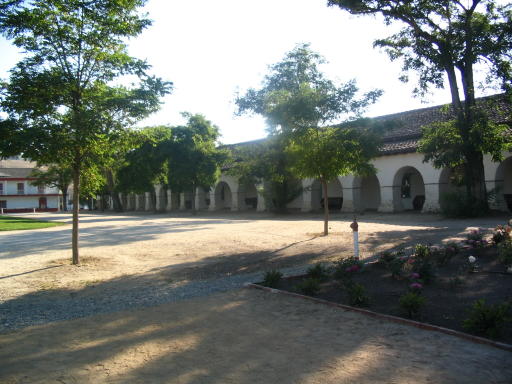
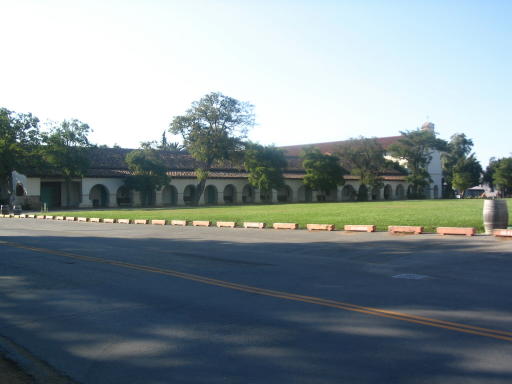
Although I spent the bulk of my recent trip to northern California north of the Bay Area, on my final day I went south, as there was one particular place I wished to visit. This was the town of San Juan Bautista, just inland from Monterrey, and in particular I wished to visit the historic Mission San Juan Bautista, whose bell tower from which Kim Novak falls to her death around halfway through Alfred Hitchcock’s Vertigo (1958), and then again at the very end of the movie.
This particular movie is a favourite of many film nerds, although it was not a box office success when it was released. Possibly it is the theme of the film – it isn’t really a thriller but is more a study of the descent into madness of the character played by James Stewart, as his obsession with Kim Novak becomes more and more weird and destructive. This is perhaps the movie in which Hitchcock’s various obsessions came closest to the surface, and is perhaps about a kind of obsessiveness that those of us who spend a lot of time watching movies in dark rooms understand. I certainly do. It is perhaps my favourite movie.
Or perhaps it is just the beautiful way that Hitchcock used his locations. San Francisco may have been shot better in other movies, but it has seldom been shot in a way that captures the feel of the city as much as does this one. You wander round the various locations in the city, you feel the steepness of the hills, and the coldness of San Francisco Bay and you feel, even today, that Jimmy Stewart and Kim Novak might walk down the corner. It’s a slightly less genteel city than those on the east coast. You can tell it is the city of gold rushes, and the characters in the movie, who in some instances have great wealth or work for people who do, but who none the less act from rather depraved motives, seem to belong there.
Hitchcock was famously disdainful of actors – once referring to them as “cattle”, but he was none the less brilliant at getting great performances out of stars. None of these were better than those he got out of Jimmy Stewart in this movie and in Rear Window. In both cases, Hitchcock created characters who were almost the classic James Stewart everyman, and which certainly drew on this aspect of his stardom, but cracks appeared in the persona as the movie went on, as the characters became warped and twisted. (Oddly, Hitchcock’s use of Stewart in a third movie, Rope is in my mind a failure. In that case the character is clearly required to be warped and twisted (and gay) in the script, but Stewart plays the character far too clean cut). Kim Novak was not Hitchcock’s first choice for the role of Madeleine/Judy in Vertigo, Vera Miles having had to pull out because she was pregnant, and Hitchcock apparently was unable to hide his displeasure about the fact that he was directing his second choice, but Kim Novak plays fragile, scheming, vulnerable, caught up in the consequences of her own machinations, and does so beautifully. I personally cannot imagine anyone else in the role.
In any event, I had visited the San Francisco locations of Vertigo on previous trips to the cities. I wanted to visit the location where the climactic events take place at the end. Watching the movie, I have always got a sense of the church in which the finals events occur being in a place of isolation, and almost unworldly place, but when you get there, you realise it is not so.
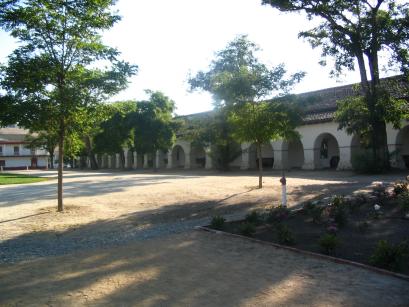
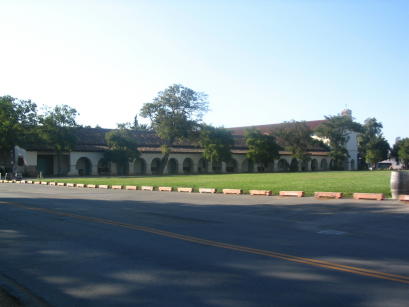
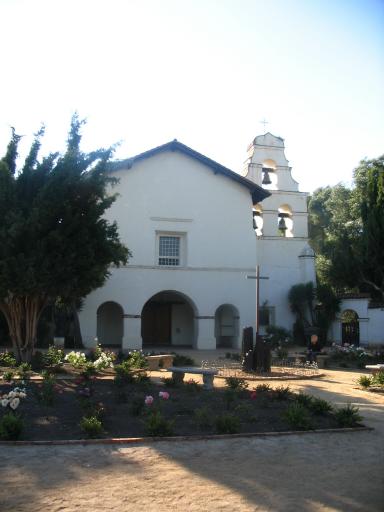
This is the one place in the movie which does not feel it has been shot as itself, which is intriguing given that the setting is clearly indicated as being the real place. (Jimmy Stewart and Kim Novak turn down a road down which a sign points to “San Juan Bautista” on their way to the final scene of the film). Rather than being isolated, the church is in the middle of the town. Watching the DVD of the movie again, Hitchcock makes no attempt to hide the fact that the church is in the middle of a town, and yet somehow I never got that sense until visiting the location. And the bell tower: the bell tower which looks enormous and looms over everything is in fact in reality quite small. The real church tower is shown in the film, but it is shot in such a way as to hide its true lack of size. One suspects that if Kim Novak fell off it in reality she might perhaps hurt herself, but she would have to be unlucky to die. And of course, there is the small matter that the inside of the tower seen in the film is clearly a set. The characters go round and round a seemingly endless spiral staircase, and there is no possible way that this would fit inside the exterior of that particular bell tower.
But it doesn’t matter. And it doesn’t matter for a very particular and clever reason. Jimmy Stewart’s character has suffered from vertigo ever since watching his police partner fall to his death from a high building in the first scenes of the movies. A lot of the film is seen through his eyes, and Hitchcock shows his vertigo through doing interesting things with the camera. He simultaneously moves the camera forwards and zooms out, causing the relative positions of objects to appear to change.(Hitchcock is often given credit for inventing this shot. That may be true, and if it isn’t he is certainly the person who brought it into mainstream movies. It has been used endlessly since). Objects such as the bell tower are very distorted, and we just see this as part of the mental state of the character. The fact that the location makes no sense in reality is largely lost on us. And Hitchcock understood that this would be so when he made the movie.
But when you visit the location, this is immediately obvious.
(I have actually written about Vertigo before, in the context of Terry Gilliam’s film 12 Monkeys, which is sort of a simultaneous science fiction remake of Vertigo and Chris Marker’s La Jetee all crossed with James Tiptree Jr’s The Last Flight of Dr Ain. People who were interested in this post might also find that one interesting).
Here is an interesting contrast between the UK and the US.
The Boston Globe, a Democrat newspaper in a Democrat town, is attacking President Bush’s Supreme Court nominee, John Roberts. Nothing particularly exciting or shocking about that. You might not agree with them, but it’s legitimate, and that is how things are done there.
What intrigues me is the manner of the most recent attack:
Roberts, as Reagan aide, backed national ID card, yells the headline.
It is plainly the Globe’s assumption that its readers will take this is a sign of a fundamentally illiberal personality, not fit to be entrusted on the bench with the defence of American liberties. British popular assumptions, even in the liberal press, have a long way to go. It is still not appreciated much here that state control of personal identity is a big deal, never mind that its fans are poisionous advocates of evil.
While I am inclined to think that flat taxes are not as easy in practice as they are cracked up to be, and I would in any case prefer to scrap personal income tax altogether, a radically simplified tax system would benefit everyone but tax-collectors and accountants. (Even the holy skoolznospitles, and the policemen doing £80,000 of overtime a year, would approve of more net revenue from the same tax burden.)
However, Revenue officials in Britain are trying to censor even the discussion of flat tax:
According to yesterday’s account in the Daily Telegraph
The original version of secret work by officials posted on the Treasury website – after freedom of information request – pooh-poohed the claims of flat tax advocates as “misleading”.
But large parts of the work had been removed. The complete version reveals that most, but not all, of the elements which were blacked out present compelling arguments in favour of the flat tax.
Some ‘freedom of information’!
The Telegraph concluded that since such political excisions must have been at the orders of the Chancellor, Gordon Brown MP, but today this is officially denied in a letter from the permanent civil servant who heads HM Treasury:
The Chancellor had never seen any version of the released documents and no minister had any involvement in the decisions regarding their release. To suggest otherwise is completely false.
Should we conclude that the elected Government is being kept in the dark about its policy options too?
Next time someone tells me that Tony Blair does not run the country, Gordon Brown does, I reserve the right to be skeptical. Government by officials, for officials, subject to no law but Parkinson’s, is nearer the mark.
A very nice line up on Instapundit of the blogosphere’s reactions to MSN journos putting their foot in it again…
Bill Quick on reading an article in Philadelphia Inquirer (registration required):
Sorry, but for me, this entire article was a joyous exercise of schadenfruede on my part. The agony evidenced on the part of the writer that MSM is no longer the gatekeeper, portal, and arbiter of what is news is delicious.
The brain terminal on Paul Krugman’s cavalier attitude to the truth:
Good thing all those editors at the Times provide the layers of rigorous fact-checking that blogs lack!
Annoying gadfly blogswarms indeed.
…is Kenneth Clarke to defy the odds and end up the head honcho of the Conservative Party. Why? Because appointing a Europhile statist would be the absolute best way to split the party so irretrievably that it writes the party off once and for all.
Then maybe we can work on getting a proper opposition party that actually has a coherent ideological position, well, at least as coherent as a main stream party can even be. Hell, it can even call itself the ‘Conservative Party’ for all I care.
There is a gap that is rarely acknowledged between the nominal powers of officialdom and their actual powers in practice. Unless we are vigilant, and the rules are tightly drawn powers will be (not may be, will be) used for broader purposes than those for which they are granted. What’s more ways will be found to use the leverage of one power to enhance another. New police powers do not merely add to the force of those that already exist, they multiply and magnify them.
Last night an example of systematic police intimidation was proudly displayed as PR for the police on the most popular British TV channel (ITV1, not the BBC).
The program (“Inside Crime”) was one of those encouraging people to assist with current investigations and appealing for witnesses to various murders and robberies. Fine. I don’t think I have a problem with that: seems like a genuine public service. But of a 25 minute programme something like a fifteen minute segment was devoted to cameras accompanying police in Dartford as they “cracked down” on drugs and illegal working on one evening.
A sergeant swaggered around in a head mic proudly demonstrating how new technology allows the detection of traces of cocaine in pub lavatories. It was then revealed that “with the cooperation of landlords and managers” that night everybody wishing to enter a pub or club in the centre of Dartford had to submit to police swabbing their hands for drugs as a condition of entry. Those who tested postive were then formally searched under “reasonable suspicion”.
The swabbing itself didn’t count as a search because it was “voluntary”. Thus is the law perverted by those who are supposed to uphold it. The programme was silent on what happened to those who got as far as the entrance to a bar but refused the entry procedure. I’d be interested to know.
→ Continue reading: The power wedge
Please explain to me why there is even any question regarding the facts surrounding the death of Jean Charles de Menezes? I would be amazed if almost every inch of his final journey was not caught on the omnipresent CCTV cameras that disfigure London’s streets. Was anything we were told born out by the evidence? It should be quite easy to check.
Clearly the Metropolitan Police is in the midst of a massive crisis in which the most fundamental question needs to be asked: “Can the police be trusted not to recklessly slaughter people who are just going about their lawful business?”
Only complete transparency over the process and the facts leading up to the shooting can even begin repair the damage to Metropolitan Police credibility. As things stand, a rational observer would have to conclude the Metropolitan Police is run by incompetents and liars. Was being in charge of the ‘Diversity Directorate’ the proper background for Cressida Dick to be put in charge of such work?
And then when John Wadham, the chairman of the Independent Police Complaints Commission says “The Metropolitan Police Service initially resisted us taking on the investigation, but we overcame that”, but Sir Ian Blair, the head of the Metropolitan Police replies that is untrue, well someone is lying then. Is it the head of the Met or the Head of the IPCC? At this point the credibility of the British Establishment is approaching the credibility levels of a ZANU-PF press release.
Release all CCTV footage showing the fatal journey of Jean Charles de Menezes as clearly the words of the police as to what happened are now worthless. If this is not done, one could be forgiven for thinking the reason the state so loves CCTV is only to detect crimes which are not committed by agents of the state. One law for them and another for us?
Release the footage because the ‘official line’ is now as credible as a Comical Ali war report from Iraq.
It could always be worse!
It is hard for someone like me to tell how serious this plan for a completely silent aircraft is. This in particular made me dubious:
Environmental campaigners and people living on flight paths have already welcomed the campaign to build the jet.
“Campaign”? That makes me think that this design is as much politics as technology, a suspicion that is confirmed when I look at the website of the Silent Aircraft Initiative, which is the organisation that is promoting this scheme.
The initiative aims to improve competitiveness in the UK aerospace sector by changing the way research is undertaken, through extensive collaboration with a much wider franchise of stakeholders than ever before. By embracing this larger community, the Silent Aircraft Initiative seeks to produce a truly optimised concept design that contributes to the prosperity of the UK in an environmentally sustainable way.
Well, I suppose it could work. But it all smells to me a bit like a rerun of Concorde, in its very early stage, the stage when they were hustling up public money and political support. There is the same obsessive pursuit of one popular variable, in this case silence, to replace Concorde’s equally narrow focus – with insufficient subsequent regard for either economy or cacophony – on speed. The thing even looks rather like Concorde.
I can find no mention of how extremely inconvenient maintaining this new contraption would surely be, what with the engines being on the top.
Comments anyone? Is this a serious scheme, or just kite flying? Or is it serious, but only at a very early stage? And is that BBC report wrong only in implying that the thing is nearly ready to be built?
Do all generic aircraft designs in their early stages have to be political, one way or another – either paid for wholly by a government or by governments in secret, or else “campaigned” for, out there in the public realm?
What do you do when you have driven your economy off a cliff? Why, you raise taxes.
Zimbabwe’s finance minister has imposed a string of tax rises to bridge a huge spending shortfall and the effects of drought and slum clearances.
A tax on drinks and cigarettes has been increased by 50% and mobile phone airtime will also be subjected to a 22.5% tax, Herbert Murerwa said.
Zimbabwe is beset with shortages of food, fuel and foreign currency, and rampant unemployment and inflation.
An opposition MP said the extra budget showed that the government was “broke”.
The title is a forgivable slur on King Canute who recognised the natural limits of kingship. With reference to ZANU-PF, it is perhaps more acceptable to use the diminutive of his name, which is, of course, Cnut.
|
Who Are We? The Samizdata people are a bunch of sinister and heavily armed globalist illuminati who seek to infect the entire world with the values of personal liberty and several property. Amongst our many crimes is a sense of humour and the intermittent use of British spelling.
We are also a varied group made up of social individualists, classical liberals, whigs, libertarians, extropians, futurists, ‘Porcupines’, Karl Popper fetishists, recovering neo-conservatives, crazed Ayn Rand worshipers, over-caffeinated Virginia Postrel devotees, witty Frédéric Bastiat wannabes, cypherpunks, minarchists, kritarchists and wild-eyed anarcho-capitalists from Britain, North America, Australia and Europe.
|





Recent Comments