We are developing the social individualist meta-context for the future. From the very serious to the extremely frivolous... lets see what is on the mind of the Samizdata people.
Samizdata, derived from Samizdat /n. - a system of clandestine publication of banned literature in the USSR [Russ.,= self-publishing house]
|
Just as newspapers around Europe and beyond are coming to the support of Jyllands-Posten in Denmark, US State Department spokesman Kurtis Cooper has said that freedom of expression in a European country is “not acceptable”.
Firstly, who the hell asked the US State Department to opine on something in a newspaper in Denmark? Secondly, if they are going to take a side here, are religious extremists so deeply entrenched in the US political establishment that they cannot understand the importance maintaining secular rights to free expression in the face of attempts at religious censorship and overt intimidation?
Land of the free, home of the brave, eh? Not in Washington DC it seems. Rather than face down the intolerant face of radical Islam, the US State Department is pandering to it. This is a national disgrace and I hope some US newspapers will show how they feel by supporting their colleagues in Denmark and publishing the damn cartoons themselves and telling Kurtis Cooper where he can stick his political master’s craven opinions.
The (Free) French Resistance has cause for joy because The Scarlet Pimpernel of the Blogosphere is back!
Let’s hear it for The Dissident Frogman!

cliquez ici Soon he will be back blogging regularly. I feel like I am in the final scene of Casablanca when I say “Welcome back to the fight”.
The two acronyms that we hear concerning the twenty-first century are GRIN (Genetics Robotics Information Nanotech) to describe the wave of new technologies and BRIC (Brazil Russia India and China) to identify the new heavyweights. In foreign policy, media commentary has focused upon China, the earliest power to emerge an cast its influence across the globe.
Not far behind is India. With its longer demographic growth, this country is considered as the most powerful power in the longer term, since it will not have to deal with a rapidly aging population. Yet, because some of the people speak English, play cricket and vote, they are not considered to be a potential enemy, with whom we may come to blows. We forget at our peril that democracies can marshall the power of the majority and there is no guarantee that India will be on the side of the Enlightenment. Hindu chauvinism is a powerful counterweight to the Anglosphere. According to Immanuel Wallerstein, India has played on these assumptions to its advantage:
Was then the new Indo-U.S. joint statement a victory for U.S. diplomacy? In it, the U.S. for the very first time legitimated India’s role as a nuclear power, by promising India that it “will work to achieve full civil nuclear energy cooperation with India as it realizes its goals of promoting nuclear power and achieving energy security.” This of course undermined enormously the already weak position of the U.S. in opposing Iranian nuclear ambitions, since what India has received from the U.S. is precisely what Iran has been claiming is its right, “full civil nuclear energy.”
And in return, what did the U.S. get? – a promise “to combat terrorism relentlessly.” Since India was already doing this, it wasn’t very much. Meanwhile, India is maintaining its close relations with Iran and Russia, and even (on paper) a strategic alliance with China. More importantly, India is proceeding with Project Seabird, aimed at turning it into the major military power in the Indian Ocean. This does not make the Chinese too happy, to be sure, but it shouldn’t make the U.S. too happy either, since at the moment, it is the U.S. that is the major military power in the Indian Ocean.
Let us remember that India will, rightly, consider her own interests paramount. They may not coincide with ours.
Here is a photo taken of the march by Muslims protesting against Jyllands-Poster and the ‘Satanic Cartoons’ saga in London earlier today.
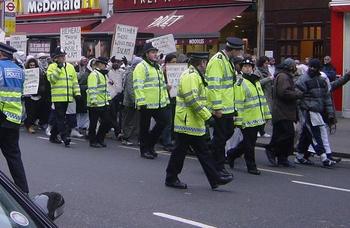
click for larger image The placards read Behead those who insult Islam & Butcher those who mock Islam & Slay those who disrespect Islam etc. etc.
Freedom of expression is quite literally intolerable to them. And we cannot and must not tolerate that. It makes no logical sense to tolerate intolerance.
With thanks to H for the picture
And for those of you who say “It’s just a protest”…
And so as Palestinian gunmen surround the EU mission in Palestine…
Tonight at Samizdata.net HQ, dinner will include…
A trivial thing for sure but it is the thought that counts. The UK newspapers may be too craven to republish them but we always have the internet… and here are the offending cartoons again.
We have a free press and this freedom of expression is a vital and indispensable part of our democracy and this is the reason why I cannot control what is published in the media
– Danish Prime Minister Anders Fogh Rasmussen
Robin Koerner of Watching America thinks that the whole ‘Satanic Cartoon’ issue needs to be resolved with the straightforward notion that people must agree to disagree
Gulliver’s Travels is a satirical story about two factions that face over how to eat boiled eggs. The first maintains that boiled eggs should be cracked at the smaller end. Their opponents maintain that they should be cracked at the larger end: and they are all set to go to war over it.
With the ‘offensive’ Danish cartoons, we have the modern equivalent: the large-enders (Western apologists) are apologizing to the small-enders (offended Muslims) for making a joke out of small-ending!
This entire furor is premised on the assumption that we can not dignify people by giving them responsibility for the way they choose to react to the things in their world – and especially things that they do not like. Just as I have the responsibility not to choose to get angry at all every Muslim when a few damaged individuals commit such evil acts as beheading of innocents.
No one can insult me or offend me unless I choose to be insulted or offended. In denying that, I deny my own power over myself. I understand that people may not have arrived at that understanding, but since I have it, I cannot in good conscience withdraw my own free expression when no hurt was intended.
Did all these politicians and pundits not learn this very basic lesson when they were five and got upset at a hurtful remark in the playground, and their teachers told them, “Sticks and stones may break my bones, but names will never hurt me”…?
While I am the first to expound openness to those who see things differently from me I also expound my own need to be who I am. We have a right to do our truth as individuals, and as a culture, just as do all Muslims and the culture of Islam. While I will always respect the right of someone to disagree with me, and respect the equal humanity even of those who disagree with me violently, I never have to deny my own truth.
Voltaire’s famous line, “I disapprove of what you say, but I will defend to the death your right to say it” will only make for a better world if we add to it, “You disapprove of what I say, but I will defend to the death my right to say it.”…
In the instance of the ‘offensive’ cartoon, no one needs to defend anything to the death. We need only politely apologize for causing unintended upset; politely explain that we do not require that the cartoon be read by anyone who is in any way upset by it, and that we respectfully disagree that our culture is worse for protecting freedom of expression where it is not imposed and does no physical harm.
Then let it drop and let the fire burn itself out. It is called “agreeing to disagree” and is the very manifestation of treating everyone with equal respect.
To impose some perspective: it would take 58 terrorist attacks with the mortality rate of the 7/7 attacks for the toll to reach 3221, which is the number of Britons killed on the roads in 2004. It would take many more terrorist attacks to approach the number killed in the Blitz.
Our jitters about boarding underground trains may obscure, but they do not remove, the fact that the ‘war on terrorism’ is for us a very low casualty operation when compared to, say, the great wars of the twentieth century. If 7/7 evoked the Blitz spirit, it did so with an ounce of the Blitz threat. Our leaders and parts of the media, then, proffer a fear of death that is far removed from the chances of us dying. If we understand that the enjoyment of life in a democratic society comes from our liberties, we should see any reduction in our rights not as a sacrifice to security but as a give-away to those obsessed with death.
— Ben Walford on Spiked.
How many 7/7s make a Blitz? Roughly 775.
Totting up the figures given by the Israeli Foreign Ministry, gives us the total murders achieved by the most sustained bombing campaign directed against any liberal state. Deaths since September 1993 (not counting the bombers): 855. Real wars kill more in a single air-raid. Israel has over 500 deaths in road accidents every year. Even there, you are in more danger from your car than a suicide bomber.
Me, I am taking the tube.
The contributors and most of the commenters to this site actively defend the free speech rights of fanatics, bigots, blasphemers and pornographers. Where the shield wall falters, that is where we go to fight. I think we have the right to be proud of that.
But I wonder if even we do not still have our sacred cows – sacred cows that need to be slaughtered.
I am fully aware that the disclosure I am about to make may cause outrage even among people who think of themselves as absolutists when it comes to free speech. I must apologise in advance to Perry and the others who have extended me the hospitality of this site for what may seem to be an abuse of it. I realise that there are some people who may think that, having said in public what I am about to say, they can never associate with me again. Forgive me. I feel I have to say this. → Continue reading: The limits of free speech
Not only is the state not your friend; it does not live in the same country you do. Failing to keep proper books and records in a business is likely to end in your going to jail, if you do not go broke first. So almost all businesses do manage it.
What would happen to the board of directors of a corporation with a turnover of £10 Billion and 61,000 employees, if it were discovered it did not even reconcile its bank statements during their tenure? Something like this, perhaps? In most corporate scandals the accusation is not defective or absent bookkeeping, but that it was too clever.
Here is the National Audit Office on 31st January 2005:
Sir John Bourn, head of the National Audit Office, reported to Parliament today that the Home Office had not maintained proper financial books and records for the financial year ending 31 March 2005. Sir John therefore concluded that, because the Home Office failed to deliver its accounts for audit by the statutory timetable and because of the fundamental nature of the problems encountered, he could not reach an opinion on the truth and fairness of the Home Office’s accounts.
[…]
Because of the difficulties in implementing the new accounting system, the Home Office was unable to reconcile its cash position during 2004-05, i.e. match its own records of cash payments and receipts with those shown on its bank statements. This is a key control for the prevention and detection of fraud. Following significant work by the Home Office to investigate a £3.035 million discrepancy, it had to make adjustments of £946 million to reconcile its cash position. However the Home Office found no evidence of fraud following this work.
The report points out that the poor quality of the financial statements and the delay to their production reflected a lack of skills within the accounts branch compounded by late recognition by management of the serious problems being encountered. Management procedures to ensure the quality of the financial information produced were also inadequate.
I particularly like, “the Home Office found no evidence of fraud”. Did nobody think to call in the Serious Fraud Office just so that they could say there’d been an independent check?
This is government, you see, and the rules for government are different. I confidently predict that there will be no consequences whatsoever for anyone but the taxpayer, who will stump up for yet another incompetent systems review. No minister will be censured, no official will lose his job, and no-one will go to gaol.
Which is just as well, considering how badly the prisons are run — by the Home Office.
The Home Office is an organisation that is currently preening itself before setting out up to become the Master Department, ruling them all through the largest and most complicated IT system ever, anywhere. It is currently asking suppliers what it should do and how much they think that should cost, while telling parliament it will not reveal any cost estimates (See: Lords Hansard 16 Jan 2006 : Column 428) in case it damages the bargain to be got from those same suppliers.
Though I have other reasons for thinking that the Home Office should not be permitted to seize from the Treasury the role of colossus over the rest of Whitehall, this NAO report at least ought to give any sane administration pause. I cannot see any whelk stalls or breweries taking the risk of offering their facilities for the necessary in-house training.
In order to show some solidarity with Denmark, who are facing remarkable pressure over the Jyllands-Posten ‘Satanic Cartoons’ incident, I for one will be stocking up with Danish products at every opportunity. I find it offensive that they are being threatened by Islamist thugs and pissant Muslim governments for daring to be a tolerant western nation.
So, what recipes can liberty lovers think up that use Lurpak butter, Danish bacon (lots of yummy Danish bacon), Havarti cheese, Carlsberg & Tuborg beer and smoked herring?
And as every campaign needs a ‘face’…
One of the advantages of having a comments section is providing me with new ideas to write about, even when the comment in question is so flat-out wrong that it makes me gape with amazement at the screen. In my recent post about the economic fallacies surrounding immigration, a commenter opined that Indian immigrants into the UK were leeching money out of this country by not re-investing it in new businesses but merely writing cheques to “inactive” folks back in the old homeland.
It is a lousy argument on a number of levels, and I am not even going to dwell long on the obvious dangers of inciting distrust and hostility towards economically successful immigrant groups and accusing them of not being sufficiently “patriotic” by not spending all their profits in Britain. The argument also fails because it ignores the subjectivity of economic value. If a businessman earns a million pounds in profit from a drycleaning business in Birmingham and sends the odd cheque back to his aged relatives in Bombay, then how is economic value being destroyed? In the eyes of the businessman, helping his loved ones is worth more to him than investing that money in something else, even though other people might disagree with that decision and think him to be deluded. It is none of my business to force a change in that decision.
Also, that businessman is doing something that supporters of a liberal civil society have traditionally supported: philanthropy. How can it be wrong for a man to steer a portion of his wealth to his dependants, educate them, feed and house them? Who gives any entity the right, least of all the State, the power to say yay or nay to that decision? The argument that such transfers are wrong is an echo of the old Bethamite notion that the State is entitled to seize wealth if that maximises the “greatest happiness of the greatest number”.
A final point. No doubt large sums of money are paid by immigrants and migrant workers back to the points of origin all the time. This has happened for centuries. These transfer often sustained people in great hardship.
I have come across some dubious economic arguments in my time, but the idea that immigrants paying money to their folks is some sort of parasitical waste has to be one of the weakest.
|
Who Are We? The Samizdata people are a bunch of sinister and heavily armed globalist illuminati who seek to infect the entire world with the values of personal liberty and several property. Amongst our many crimes is a sense of humour and the intermittent use of British spelling.
We are also a varied group made up of social individualists, classical liberals, whigs, libertarians, extropians, futurists, ‘Porcupines’, Karl Popper fetishists, recovering neo-conservatives, crazed Ayn Rand worshipers, over-caffeinated Virginia Postrel devotees, witty Frédéric Bastiat wannabes, cypherpunks, minarchists, kritarchists and wild-eyed anarcho-capitalists from Britain, North America, Australia and Europe.
|










Recent Comments