We are developing the social individualist meta-context for the future. From the very serious to the extremely frivolous... lets see what is on the mind of the Samizdata people.
Samizdata, derived from Samizdat /n. - a system of clandestine publication of banned literature in the USSR [Russ.,= self-publishing house]
|
With a natural catastrophe of this proportion, it is clear that the whole region will be picking up the pieces for the foreseeable future. Death toll is now 10,000 and rising, depending upon your news site, and the emergency situation has been publicised for ten hours
The Foreign Secretary sent out the message of condolences and said “stand by for action“. However, there are no links or help on the Foreign and Commonwealth Office website for families to telephone or leave messages for family members or friends, holidaying in the tropics. Nothing on the State Department for US citizens either, although such aid may be dealt with at a local level. Australia is far better prepared with a hotline. The BBC, agitprop wing of the government, wishes to hear your experiences of the tsunami, but does not provide you with a number if you wish to let your loved ones know that you are still alive.
Especially as it is the holiday period, such emergencies are the time when government departments should place themselves at the service of their citizens. Should, but do not.
UPDATE: The FCO emergency telephone number is 0207 008 0000. However, if you wish to obtain more direct information on each country, you have to visit the ‘Travel Advice by Country’ pages on the FCO website. These will give you direct numbers for the embassies in individual countries: India, Indonesia, Thailand, Maldives, Bangladesh, Sri Lanka, and Malaysia.
If you were to visit the frontispiece of the FCO website, there is still no indication where such information is held. The BBC does not hold this information on its indepth webpage concerning the disaster. Both the BBC and Skynews tuck the number away at the bottom of their webpages reporting the deaths of Britons.
Tory MP Patrick Mercer has tabled legislation to ‘rebalance’ the right to defend life, limb and property in favour of the victims of crime.
And how exactly will that make a lone 60 year old woman safer if someone breaks into her house? Please remember that it was a Tory government which decided she will have no right whatsoever to have effective means to defend herself by restricting firearms.
The Mercer Bill is welcome but all it does is make Britain a little bit safer for houses containing one or more adult males from their late teens to their late sixties who are actually capable of picking up a blunt instrument and taking on an intruder with a reasonable chance of success. The unpalatable truth is that most people are not able to effectively defend themselves against your typical house intruder (one or more young men between 16 and 35) unless they have an effective weapon. And that means a gun.
“God made man but Colonel Colt made them equal”
And here (just in case you missed the comments on the previous posting) is yet another circumstance where an armed populace would have really helped:
One man has died and five other people are in a critical condition after being attacked by a man with a knife.
Scotland Yard said a man drove around the areas between Enfield and Haringey in north London in a red Hyundai stabbing people on Thursday morning.
Officers are investigating if there is a link between the attacks and the murder of shopkeeper Mahmut Fahri.
A man, who police say has a history of mental illness, is being held in connection with the attacks.
“History of mental illness” is today’s euphemism for maniac, it would seem.
Personally I believe that people would not even think of behaving like this if they knew that everywhere they went on such rampages they would be confronted by the armed and the respectable. And I further believe (although I would welcome intelligent contradition about this) that this includes maniacs, who (and I believe there have been quite sophisticated experiments about this) are actually quite responsive and rational about altering how they conduct themselves, when faced with predictably different rewards and predictably different punishments. What maniacs lack is not rationality; it is merely any semblance of good manners.
See also: Hungerford Massacre. This slaughter was caused by gun control. It was not only caused by gun control, but it could not possibly have occurred in the way that it did without gun control. The police had to get guns from London. And it all happened at the precise historical moment when, for the first time since cheap firearms were invented, a country town like Hungerford no longer contained any. Simultaneously, crime throughout the British countryside was rocketing. The response to Hungerford was to tighten the screw that had illegalised self-defence in the first place.
This good woman has already been linked to from here today, but there cannot be too many such links out here in Blogland, I say.
I know that, for some, the way we here at Samizdata.net keep banging on, so to speak, about gun control (iniquity and fatuity of) is a bit dreary and predictable. But there is actually a bit of a buzz in Britain now about this issue, and any decade now this country might see some big changes in the right direction. Provided we keep buzzing and banging on.
Home Office minister for race equality, Fiona Mactaggart refuses to condemn the fact Sikhs have used intimidation and violence to force the closure of a play they find offensive because…
In my experience, very often the consequence of that [violent protests] is that the ideas of the play gain a wider audience than they would have had, had there not been such protests. That people feel this passionately about theatres is a good sign for our cultural life. It is a sign of a lively flourishing cultural life.
So British culture is better off because rioters have forced the closure of a play they disagreed with? Britain is clearly governed by people who are either immoral or demented or both.
But I am curious… would the ‘minister for race equality’ have thought it an equally healthy sign that British theatre is alive and well if a mob of angry white Scotsmen has stormed the theatre, smashed windows and forced the plays to close because they found something in the works of a Sikh playwright offensive?
Well given that Fiona Mactaggart is the ‘minister for race equality’, I guess she would take the view that all races are equally permitted to use violence to prevent freedom of expression, right? Right?
I mean, the races would hardly be equal if only when Sikhs riot is was “a sign of a lively flourishing cultural life”.
Although I knew this day was coming, it is profoundly depressing nevertheless. It is now the law that ID cards will be imposed by force in Britain, with the support of the Leaders of the Conservative Party and the Labour Party. They have won and as far as I am concerned, the guttering flame of the culture of liberty in Britain just blew out.
I do not expect a truly repressive state to be implemented for many years yet (hopefully), but the infrastructure of tyranny is now well and truly in place, all of which came to pass with a soundtrack of a faint bleating sound of an indifferent public in the background. You might as well flip a coin to figure out which party will usher it in but a authoritarian panoptic state is coming. If this is what the majority of British people want, then may they get exactly what they deserve, but I am out of here. For those of you who will be happy to see me go, trust me, the feeling is mutual.
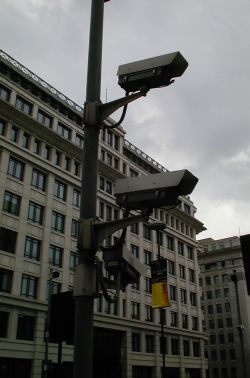
I realise most people will just shrug their ovine shoulders and find my worries inexplicable, crazy even, as it is not like Blair and Howard are setting up Gulags, right? No, of course not. Who needs those when there is a camera on every corner and your every purchase and phone call will eventually be logged on a central government database? As far as I concerned, the war is over and my side lost.
I have to try and speed up my business ventures and get out as soon as I can afford to do so. I shall try to be out of Britain and have my primary residence in the USA by 2007 at the latest to avoid being forced to submit to this intolerable imposition… and I shall be taking my wealth generating assets with me. I cannot say I am looking forward to winters in New Hampshire but I do not really see that I have much choice anymore. I do not see the United States as a paragon of civil liberties (to put it mildly), but at least it is a place in which the battle can be fought within the last bastion of the Anglosphere’s culture of liberty.
Damn it.
The Sikhs who used violence to prevent free speech in Birmingham yesterday and truly the children of the Politically Correct generation. They see that force, be it of law or of the flying milk bottle, is the accepted way to respond if your feelings are hurt and thus have forced a play that they find offensive to close.
Tolerance for dissenting views would appear to be a thing of the past and obviously the state is not the solution. If it was, it would have responded to this affront by the rioters against the basic right to express yourself by meeting force with force. The correct ‘dialogue’ with the rioters would be to crack a number turbaned heads open in the same manner those people are expressing themselves.
Mohan Singh, from the Guru Nanak Gurdwara in south Birmingham, said: “It’s a very good thing that they (the Rep) have seen common sense on the issue.
And so Mohan Singh demonstrates he opposes a pluralist civil society. Presumably when some people decide they find something he values ‘offensive’ and elect to start throwing bricks to prevent it from happening (for example, say some militant atheists, or more probably militant Muslims, find his religious services offensive to their sensibilities), or perhaps it is decide, as in France, that turbans will not be permitted in school under force of law, Mr. Singh will just shrug his shoulders and accept that being forced not to do things other people dislike is just the way of things. And if he does not accept that, why should he expect anyone else to care about what he wants?
Yes, I am glad a few people in the Conservative party have the backbone to stand against Michael Howard and refuse to back the imposition of mandatory ID cards. Yet the truth is than they are outnumbered both by those in the party’s authoritarian faction and in the others who say they opposed ID cards, such as possible future leader David Davies, but place their political careers above both their principles and what they presumably think would be best for the nation. Still, I suppose we should thank Michael Howard for making it clear to all but the most blinkered that they offer no alternative to Labour in any substantive way over an issue that offers much downside and no clearly explained upside.
If you ever want to see an effective opposition in this country, vote for the one party who can deliver that by destroying the Conservative party once and for all by making it permanently unelectable, thereby showing the true cost of Conservative ‘moderation’ on the EU and civil liberties. Only once the last bitter hope that the Tories might ever form a new government has been removed by 10 to 15% of their vote defecting for the foreseeable future can something better emerge from their ashes. Vote UKIP.
Hard to believe! That Tory leader Michael Howard, the second most repressive Home Secretary in living memory, should support mandatory ID cards is hardly a revelation, but that up to 40 Tory MP’s, including some on the front bench, might vote against or abstain regardless of the demands of the whips, well that is quite a pleasant surprise.
Mr Howard has come down in favour of the Government scheme because he was preparing to introduce an ID card Bill himself when he was Home Secretary in 1997 and fears charges of hypocrisy if he does not support it now. Some MPs complained that he has been heavy handed in whipping the issue. One said: “I think it is disgraceful. I don’t know where our leadership is heading.”
I know exactly where it is heading…
Democracy is a remarkable thing. It gives an illusion of a state being governed ‘by the people and for the people’ whilst at the same time entrenching a ‘public service’ class (with ‘service’ being very much used in the farming sense of the word) that operates almost entirely for its own benefit. That this can go on in nation after nation in much the same manner is a testament to the dementing and infantilising effect that democratic politics has on a large proportion of the population of the planet.
And so when we get an article in The Times called Purge of e-mails will deny the right to know (people outside the UK may not be able to access this link due to the idiotic policy of the Times), which alerts us that it just so happens that 11 days before freedom of information laws come into force, millions of e-mails will be deleted from government servers, it should be clear to all but the most wilfully blind that the state will always place its institutional interests before those who are comically led to believe ‘own’ the state: that mythical thing called ‘the people’.
The Cabinet Office, which supports the Prime Minister and co-ordinates policy across government, has ruled that e-mails more than three months old must be deleted from December 20, The Times has learnt.
[…]
It will be up to the individual which e-mails are printed, with no monitoring from heads of department. Many officials, who receive about 100 e-mails a day, will have at least 3,000 items in their mailboxes. These include officials in the Prime Minister’s Strategy Unit, the Delivery Unit, and the offices of Alan Milburn and Sir Andrew Turnbull, the Cabinet Secretary. Although the deleted e-mails will be stored on back-up systems, these have been declared off limits to freedom of information requests because of the cost of accessing them.
[…]
Constitutional experts called the introduction of an “opt-in” system, where civil servants are proactive in preserving information, a blatant contradiction of the Act’s “presumption of disclosure”.
And that is why it cannot be pointed out too often that the state is not your friend.
The Evening Standard published a letter to the editor by me today in the print version of the newspaper (in slightly edited form). Here is the full text:
The resignation of David Blunkett may give some holiday cheers to those with the wits to see that this man has presided over the greatest abridgements of civil liberties in Britain within living memory… and given that we had the dreadful example of Michael Howard’s tenure in that office to compare him to, that is quite an achievement.
Yet before too many people start popping Champaign corks at the downfall of a truly repressive Home Secretary, I hope they will realise that nothing that Blunkett did was without the support of Tony Blair and his cabinet. Do not be so caught up with the individual personalities that you are blinded to the fact that the real threat, in fact the gravest threat to the liberty of British people since World War II, comes from both the authoritarian mindset that is alive and well at Number 10 Downing Street and the acquiescence to most of Blunkett’s excesses by the inept Tory party.
Perry de Havilland
Samizdata.net
The Tory Party in Britain has been beyond a joke for a while now, but having now come out in support of ID cards, the Conservatives have well and truly screwed the pooch. Apart from the Democrats in the United States, never has a political party been so clueless and thoroughly unfit to govern. Let’s get this bursting at the seams.
Link via Patrick Crozier
Home Secretary David Blunkett has resigned, which is probably a euphemism for “has been sacked”, over allegations that he used his power as Home Secretary to speed up visa applications of his mistress’ nanny and various other dubious things. (Sadly, he has not been sacked for his fairly successful attempts at abolishing the common law). David Carr will undoubtedly post a comment saying that things will be as bad or worse under a new Home Secretary / future Conservative Government / blah blah blah. He is probably right, but none the less, I salute the demise of this vile man.
|
Who Are We? The Samizdata people are a bunch of sinister and heavily armed globalist illuminati who seek to infect the entire world with the values of personal liberty and several property. Amongst our many crimes is a sense of humour and the intermittent use of British spelling.
We are also a varied group made up of social individualists, classical liberals, whigs, libertarians, extropians, futurists, ‘Porcupines’, Karl Popper fetishists, recovering neo-conservatives, crazed Ayn Rand worshipers, over-caffeinated Virginia Postrel devotees, witty Frédéric Bastiat wannabes, cypherpunks, minarchists, kritarchists and wild-eyed anarcho-capitalists from Britain, North America, Australia and Europe.
|