We are developing the social individualist meta-context for the future. From the very serious to the extremely frivolous... lets see what is on the mind of the Samizdata people.
Samizdata, derived from Samizdat /n. - a system of clandestine publication of banned literature in the USSR [Russ.,= self-publishing house]
|
A half brick. That’s about how musical I am as.
So I’m no judge of an orchestra, but Simon Heffer in the Telegraph seems to think the New Queen’s Hall Orchestra is pretty good. The unusual thing about this orchestra is that it does not receive Arts Council funding.
I have to say that the fact that it gets some of its money from the patronage of the Duchess of Cornwall means that it cannot claim to be entirely independent of the State, since I presume she gets much of her money from the Civil List. But there you go. If one has to have state subsidies for the arts it is much more in the proper style that the dosh should come from the bejewelled hands of the former mistress, now wife, of the Prince of Wales than by filling in a grants form. I rather hope she hands over a velvet bag of gold sovereigns instead of writing a cheque.
I digress right royally. Here is what Simon Heffer writes about the orchestra’s founder, John Boyden:
He has serious convictions about arts funding – in particular, he believes that the market for orchestral music is so distorted by public funding that innovation is almost impossible. Until the Arts Council’s predecessor began funding orchestras just after the war, serious music depended on ticket sales and the patronage of the wealthy. Before the late 1940s, the LSO (a company owned by its players) paid dividends. Now it receives £2,355,836 (in 2010/11) from the Arts Council alone.
Mr Boyden believes that by keeping the price of tickets artificially low, the gap between an orchestra and its audience has become a gulf. He believes that other orchestras use their Arts Council funding to undercut orchestras such as his, taking up residencies in the provinces that are only made possible by the taxpayer’s largesse. The state does not contemplate pulling the plug on these famous institutions and, as a result, everything in the orchestral world is static. Mr Boyden argues, with some justification, that the last piece of new music to seize the public imagination was Britten’s War Requiem 48 years ago – because the music now written for these orchestras is created to satisfy not the musical public, but the taste of a handful of bureaucrats.
I see that former Velvet Underground drummer Moe Tucker was spotted at a Georgia Tea Party protest, telling a local reporter that she is “furious about the way we are being led towards socialism.” Prefix magazine calls this “depressing” news that will “bring you down” before the weekend, because it’s incumbent upon all musicians – especially those in seminal proto-punk bands like VU – to have roughly the same, boring lefty politics.
– Michael C. Moynihan, linked to and already picked out as a nice little nugget by Instapundit, which is where I saw it. I know, I know, who gives a defecation what ex-music-celebs think? Or for that matter current actors. Well, I like it when they talk sense, if only because the people who talk nonsense get so miserable and angry about it.
“I don’t know what organically grown chickens are; I’ve never seen one.”
– Tony Curtis, one of the greats, who died this week.
You never stop learning strange things, do you? For instance, this morning, I was (still am) listening to CD Review, and the presenter Andrew McGregor suddenly starts talking about how, in the year 1612, the heir to the throne, James I’s son Prince Henry, rather foolishly went for a swim in the Thames, caught typhoid, and died. Cue an “outpouring of grief”, which included songs about the death of the young Prince (aged 18), hence the CD angle.
And who became king of England instead? Why, only Charles I, who got himself executed in 1649, in the midst of a ferocious civil war between himself and his severely angered Parliament. That I had heard about. Prince Henry was apparently, and in fascinating contrast to his younger brother, a Protestant:
Henry was quite the Protestant – when his father proposed a French marriage, he answered that he was ‘resolved that two religions should not lie in his bed’.
You can’t help wondering: What If? What if Prince Henry had not gone for that swim, and had become the King instead of Charles I? How might English history have turned out then?
There is a new film out, with a fairly strong, leftie vibe about it, called Made in Dagenham, celebrating the campaign by women factory workers in the late 1960s to get the same pay as their male counterparts. It sounds such a self-evidently just cause that no doubt any film-goers will come out of the cinema nodding to themselves about the rightness of the cause and the evil of the chauvinist, exploiter bastards who presided over the previous, unjust state of affairs. Throw in lots of period costumes and some nice background music and this is a sort of feelgood movie, in a way.
The trouble is, as I suspect readers will tell, is that the situation is not quite as simple as all that. As Tim Worstall occasionally likes to point out, a lot of the supposed injustice involved in lower pay for women for doing the same jobs as men has a perfectly rational basis, however politically unpalatable it might be to say so. Here is another one of his articles over in the Guardian (brave man, is Tim).
In part, it is worth remembering that in the far more unionised labour market of Britain in the 1950s and 1960s, a lot of the resistence to women entering the workforce to do the same work as men came from male trade union members, not from the firms. And companies, realising that many women are as talented, if not a damn sight more so, than the men, obviously realised that they could attract such workers willing to work for a slightly lower wage than their male counterparts. Outside unionised businesses, such a difference was likely to be even more marked. It reminds me of the fact that the labour movement, with such features like the closed shop, has often been at odds with the Left’s alleged concerns for things such as equality between the sexes and races. I would be interested to know if this aspect of the labour movement comes out in the film.
I suspect that, absent labour market restrictions such as closed shops and other deliberate barriers to entry, women’s pay would have approached that of the men much faster than it did, but for reasons adduced by the likes of Tim Worstall, there will remain gaps which cannot be blamed on the free market.
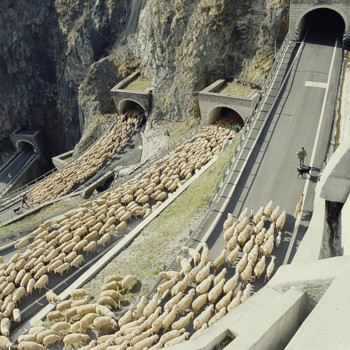
Here, via the Flickr blog, is this charming photo (click on that to see it as big as you want), which combines an ancient agricultural procedure with some much more modern civil engineering, somewhere near Treviso, in north east Italy:
Ideal circumstances, all here will surely agree, for a James Bond car chase. Goldeneye, which was shown on ITV2 last night and is on ITV2 again tonight, has a car chase early on, on just such a road. No sheep are involved, but there are cyclists. Bond didn’t drive into them, like this, but he did drive past them and they all fell over.
Sadly, I think that the above road is probably too narrow for cars, and is actually a bespoke sheep track. I guess that sheep, in Italy, are objects of political worship, much as cyclists are here.
The UK Film Council has been scrapped. I am not sure why it was needed. According to a Guardian article, its inclusion in the quango scrappage scheme is a catastrophe. Presumably that is luvvie hyperbole for a bad outcome. Yet, who has come to this conclusion. Tony Hayward, Chief Executive of the UK Film Council. Not an impartial view then. More a biased testament of UK Film Council puffery helped by the Quango Support Group at the Guardian.
One must remember that any industry will gladly accept other people’s money if it is doled out to them. It seems that the UK Film Council was indispensable, as a middleman, broking films to ministers:
History tells us that governments do not understand cultural industries: they are too complex, with too many moving parts and too many competing factions. When there was trouble in the film world, the UK Film Council acted as a translator to government and a critical friend to the industry: that function saved the film sector’s bacon more than once. But no more – so in that respect, too, it’s back to the dark ages.
Words missing from this epitaph include audience, profit, success, blockbuster, and popular. Another example of redistributing taxes to fund elite culture (unwatchable films) under cover of some utilitarian rationale for supporting an ‘industry’. One less public sector vacancy to fill.
Germane to Michael Jennings’ post below pertaining to Prince’s declaration that the “Internet is completely over”, I had a brief conversation with a decidedly winsome 20-something young lady, elegant yet edgy (she was a cut glass accented thoroughbred Sloane Ranger wearing ‘All Saints’). She was sitting in a sandwich shop in a well-heeled part of town… expensive Apple laptop open as she availed herself of the free WiFi whilst having luncheon…
The following really happened, serious, not joking.
Samizdata Illuminatus “Did you read that Prince thinks the ‘Internet is completely over”? He refuses to release any of his music on it at all”
20-Something-Young-Lady “Really? Umm… I did not even know he was a musician.”
SI “Well, yes…he is. He is one of the great guitarists of our time.”
20-S-Y-L “Hah, that’s funny! I cannot picture that old foggy playing a guitar! I thought he just spent his time playing polo, messing with architects and hugging trees…”
SI “No, no, no, not Prince Charles… ”
20-S-Y-L “Prince William? No, I am sure you must mean Harry! Oooo! Yummy Harry with a guitar!”
SI “No, the American musician called ‘Prince’.”
20-S-Y-L “Oh, I see. And this chap calls himself ‘Prince’? That’s hilarious!”
SI “He used to call himself ‘Squiggle’.”
20-S-Y-L “I’m sure I’ve never heard of him.”
SI “I suddenly feel very… old’.”
20-S-Y-L “I’ll download something of his off Bit Torrent and see if he’s any good.”
I do not believe she immediately grasped the sheer transcendent irony of the moment.
Now I am usually harsh in my criticism of the National Health Service and indeed I wish to see it abolished entirely… but credit where credit is due. This was a very, er, uplifting example of ‘Enterprise Thinking’ by the NHS.
Carry on, Doctor!
I am addicted to the Jack Reacher novels of Lee Child (I have read practically all of them). On Child’s website is a nifty collection of the cover art for his novels, taken from all around the world. Cover art is a much under-rated aspect of design, in my opinion.
A few weeks ago, I got my hands on an old Ian Fleming hardback – You Only Live Twice. It is a US first edition that I bought for £25, which I reckon is a serious result. It was printed in the early 60s, and its cover is deceptively simple. (Here is a collection of all the hardback covers of that novel.) The first edition Bond novels that were released first in the UK often go for a bloody fortune. The first edition of Casino Royale will cost tens of thousands. The cover art on those novels is great.
And SF cover art is often excellent. Here are some ones I like on this link.
Over at Counting Cats, NickM uses suitably salty language to say what he thinks of the actor Jeremy Irons for coming out with “there are too many humans on the planet” sort of comments.
I am not going to add to the post in question – I am pretty certain that we have trodden this ground fairly well already – but I wanted to ask the question as to why is it, that folk in the acting profession, or at least most of them, seem to hold such statist/Greenie views? Maybe it is an impression not based on a lot of hard statistics, but I’d guess that the acting trade is disproportionately full of folk who hold these kinds of opinions. Of course, there are actors who are a bit of a break from the trend – think Michael Caine, Clint Eastwood and the playwriter, Tom Stoppard, but they are often notable for being exceptions to the rule.
Maybe it is because, as actors, they view business, and people with cash, as somehow alien. Or maybe it is because, as actors, they often take on a generally adversarial view to the prevailing culture, and for many, being adversarial is still to be left-wing, to champion things such population control, government aid to Africa, or whatever.
Or maybe it goes right back to when they were at school. They probably were not on the same wavelength, emotionally or socially, with the kind of people who excelled at hard science, or who showed a flair for business and sport. Some may even have been quite badly bullied or put upon by the school “toughs” and took a sort of view that they’d take their revenge on society by the kind of plays/films they would get involved in, or the causes they would espouse.
Like I say, this is all very impressionistic. But the weakness for certain celebrities in the acting business for such causes deserves to have a sort of Phd thesis. I wonder if one has ever been written.
My old friend, Andrew Ian Dodge, now residing in the chilly US northeastern state of Maine, has a book out, And Glory, which is set in a near future where the EU superstate is in full power (not that far off, then, Ed). He mashes up a a bit of political speculation, SciFi and good rollocking drama to make an interesting read. (As if my reading list was not long enough, aaagrrrh).
I have been thinking about who else has written books where the EU is treated as a sort of malign feature of a novel. One that springs to mind is Andrew Roberts’ novel, written a few years ago, called The Aachen Memorandum. I am a fan of Roberts the historian, so this hopefully would be a good read. Sometimes the EU crops up in the science fiction books of Ken Macleod, as in Cosmonaut Keep. And I recall that Peter Hamilton made some glancing, and unflattering references, to the EU in this recent novel, which was quite enjoyable, albeit with a rather unpleasant central character.
Of course, writing any speculative novel about the European Union carries the risk that reality keeps overtaking the story line. I mean, I wonder if either the two Andrews mentioned here or Ken would have envisaged the idea of a German politician suggesting that Greece flog off some of its islands to pay down its debt?
And as an aside, Henry Porter, the British journalist and scourge of this government over its dreadful civil liberties record, also had a novel out recently that I can recommend for mixing a powerful message and a cracking good storyline.
If commenters can think of other novels where there is an EU angle, let me know.
|
Who Are We? The Samizdata people are a bunch of sinister and heavily armed globalist illuminati who seek to infect the entire world with the values of personal liberty and several property. Amongst our many crimes is a sense of humour and the intermittent use of British spelling.
We are also a varied group made up of social individualists, classical liberals, whigs, libertarians, extropians, futurists, ‘Porcupines’, Karl Popper fetishists, recovering neo-conservatives, crazed Ayn Rand worshipers, over-caffeinated Virginia Postrel devotees, witty Frédéric Bastiat wannabes, cypherpunks, minarchists, kritarchists and wild-eyed anarcho-capitalists from Britain, North America, Australia and Europe.
|






Recent Comments