We are developing the social individualist meta-context for the future. From the very serious to the extremely frivolous... lets see what is on the mind of the Samizdata people.
Samizdata, derived from Samizdat /n. - a system of clandestine publication of banned literature in the USSR [Russ.,= self-publishing house]
|
semiquaver
pentacle
octodecimo twice
X times Gemini plus Gemini plus III
Who am I?
Patrick Crozier of UK Transport looks at Britain and realises we have seen it all before.
It is an essential service. It has been starved of funds. It is in desparate need of modernisation. Of course, this will require some money but the politicians promise us that after they’ve got the new technology working everything will be as right as rain. Is this the National Health Service (NHS) we’re talking about? No, British Rail in the 1950s.
The railway was clapped out just like the NHS. It had been the pride of the nation – just like the NHS It had faced years of re-organisation coupled with fare control, followed by Depression, followed by War, followed by nationalisation. In an age of diesel and electricity, British trains were powered by steam and the industry was losing money fast. So, they called for a Modernisation Plan and a stack of cash was produced. And in the late 1950s British Rail spent it – just like the NHS is about to. And, boy, did they spend it. They spent it on diesel locomotives, electric locomotives, steam locomotives (would you believe it), marshalling yards, DMUs, EMUs, electrification projects. They commissioned something like 20 different types of locomotive – some of which actually worked. Some of which are rattling around the network to this very day.
But by the early 1960s things were looking bleak. British Rail was still shipping cash even though it was supposed to be breaking even. It seems that people had found alternatives to one-size-fits-all railways. They had bought themselves flexible, go-anywhere-anytime cars and lorries and didn’t need boring old trains anymore. Cue Doctor Beeching. Cue the closure of half the network.
As with the railways, so (up to a point) with the NHS. They will spend the money. Some of their IT projects will work. There will be some nice new hospitals. And in 5 years’ time there will be little else to show for it.
The big difference is customers. British Rail wanted customers. The NHS doesn’t. British Rail didn’t get what it wanted and neither will the NHS. British Rail lost out because there was an alternative. The NHS will lose out because there isn’t. The NHS is going to gouge out the private sector for doctors, nurses and beds. In doing so it will force even more people to suffer its tender mercies. And in 5 years’ time a new Doctor Beeching will have to sort out the mess.
Patrick Crozier
Dr. Tim Evans welcomes ‘Red Ken’ to the world of capitalist rationality… sort of
I have long been an advocate of private roads and road pricing. State ownership of public space and its attendant services such as police beat patrols is madness. Indeed, I have long believed that London and all other geographic areas will only get decent integrated roads and transport systems through genuine private ownership and good old free market price signaling.
What I did not expect was that that doyen of the British left and now Mayor of London, Ken Livingstone, would be the man to instigate the transition to such an approach. Let me be clear, Livingstone is planning to introduce road pricing into the capital city early next year. However imperfect his plans will be (and my God, they have some glaring holes at present) and however he seeks to dress this move up with all the usual environmental waffle, the long term affect of his policy of “congestion charging” is going to lead to the commodification of public space. By pricing roads, encouraging an income stream down them and therefore deriving revenue, Livingstone will slowly become addicted to the money.
As he becomes addicted and the approach spreads – already Durham, Cheshire, Milton Keynes, Surrey, Warwickshire, Isle of Wight, Cumbria, South Gloucestershire, Leeds, Hampshire, Derby and at least twenty other areas are already talking to the Department of Transport about introducing road pricing – the incentive for a supply side revolution in roads and public space will mount. For as money pours into the coffers and drivers slip into the psychology of becoming consumers of road space, so there will be ever more pressure to find new ways of generating more income and therefore getting the supply side of public space to meet people’s demands: that is – some semblance of a market approach.
It is with this in mind that the utopian ideas so long espoused by the Libertarian Alliance in such glorious pamphlets as:
LA Economic Notes No. 49, Brian Micklethwait, The Private Ownership of Public Space: The New Age of Rationally Priced Road Use, 1993 *
LA Economic Notes No. 57, Martin Ball, Liberate the Roads! The Benefits that will come from road privatisation, 1994 *
LA Political Notes No. 17, Max More, Private Police and the Free Rider Problem, 1983 *
LA Political Notes No. 40 Chris R. Tame, On the Side of the Angels: A View of Private Policing, 1989 *
LA Political Notes No. 58, Sean Gabb, The Case for Privatising the Police, 1991 *
…will begin to become relevant to everyday experience and discourse. And that in turn could well mean fantastic new private roads and even maintenance work being undertaken with the customer in mind and not the producer interest.
Sure, these new roads might be built underground by private sector companies who put in the latest air purification technology. And yes, the owners of X road might well want to contract with a private security company to breath test one in every 10,000 drivers for excessive alcohol. But hell, that is capitalism. The owners of X road will want to tell customers that this road is the cleanest and safest way to travel.
None of this will happen in the short term. But slowly, step by step, the incentives to engage a market in road provision are mounting. Sod the Queen’s nationalised highway. I want it owned by capitalists. As a driver, I want roads to be appropriately priced and to be served as a customer.
Come to think of it, perhaps that is why those most hard-line privatisers at the Adam Smith Institute had Ken Livingstone visit their offices three times over the last year on the subject of roads?
Come on comrade Ken, scatter those libertarian seeds and take us to the supply side!
Dr. Tim Evans
*= (links requires Adobe Acrobat Reader (or similar pdf reader) which can be downloaded for free)
Dale Felber writes in and tell us that he has seen the future.
I smoke. Some years ago the government decided that smoking was bad for me, so they began to tax cigarettes. Law suites began against tobacco companies. Warnings were placed on cigarette packs.
Now the government says that the number one health hazard is obesity! I saw on the news today that California will start taxing soda to fight obesity. Can taxing hamburgers and french fries be far behind? Law suits against McDonalds?– “I didn’t know a BigMac was bad for me… McDonalds owes me $100,000,000!”
The number of products to tax and the companies open to law suites are almost endless. Watch your investments in “Junk Food”. If you don’t believe me keep an eye on OverLawyered.com and remember what happened to big tobacco.
Everyone looked down on me and the other 25% of the population who smokes. Now it’s their turn… the government will divide and tax.
Dale Felber
http://www.businessbay.com
Paul Staines finds himself moved by a display of profoundly national sentiment
Have just finished listening to “The Falklands Play”. Looking out from my study, across the Thames over the House of Lords the Union flag is fluttering at half mast in an English spring breeze against a blue sky. A queue of thousands snakes from Westminster hall to pay their respects to the late Queen Mother.
Sometimes even a cynical rational Libertarian-republican-internationalist can cry.
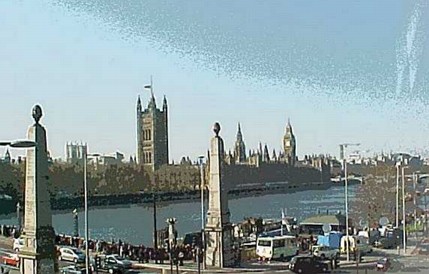 The queue of mourners can seen backed up across Lambeth bridge and around further along the Thames Embankment
Paul Staines
Lagwolf does not think much of the ideology underpinning the EU.
The EU has decided in all its brilliance in order to make sure to avoid facism in Europe it has to be have like the Nazis in the 1930s. It yet another gross breach of liberty and individual rights the EU is trying to bring in legislation to ban “racism and xenophobia”. Neither is illegal in the UK. To add to this outrage, it will be possible to be prosecuted by other EU countries for offences committed in another EU country.
So some nosy German know-it-all (yes, I know that is a tautology) (mis)hears me making some derogatory comment or joke about the Germans. He then goes home and reports me to his local black shirt (er, sorry, policeman). This policeman can then issue a warrant for my arrest in the UK and I can be dragged to Germany for a trial. This law could pretty much cause the arrest of every comedian in Britain as well as most of my friends.
I am sure we can expect the French to use this to prosecute any Briton who dares question French behaviour towards the Jews during Vichy. There are also worries that this will be used to quiet criticism of the EU in Britain. For years there have been attempts made to paint any Eurosceptic/Realist/Phobe as a racist and a xenophobe.
In short, this law is outrage on everything that is right and true in the Anglosphere. One hopes, this is yet another nail in the coffin of Britain’s membership is the 4th Reich/2nd Holy Roman Empire/EU.
Lagwolf
 Thanks to Natalija for the use of her ‘interesting’ graphic
Allen Thorpe also sees demonstrations as a largely pointless exercise
Demonstrations have lost their point. It used to be that oppressed people, like American blacks under Jim Crow, could demonstrate and draw national attention to the injustices of the way they were treated. Then it meant something.
Today it’s just a substitute for thinking and reasoned argument. Causes are inflated to the point where fat people demonstrate because they’re not considered beautiful. Who cares? And if we do care, what can anybody do about the situation?
Demonstrating, picketing and marching is now so common that the media hardly notices anymore, so the demonstrators try to get attention through numbers (The Million [Insert name here] March), violence (anti-globalist demonstrators), or commit terrorist acts such as those of the ELF (Environmental Liberation Front) in the U.S.
The more it goes on, however, the more pointless it all seems. The Palestinians could probably win more sympathy by non-violent means than by what they’re doing now. The problem is that they want more than simply a state of their own. They want to destroy Israel, to accomplish what all the wars with Israel were unable to accomplish. By teaching their young people that martyrdom is the gate to a better life and earns a perpetual income for their families, they have made themselves appear irrational and abominable to the rest of us. It is difficult to see where this will end. How can Arafat stop this? And if he can’t, why should anyone negotiate with him or anyone else from the Palestinian side?
What’s next, everyone in Gaza and the West Bank to go on a hunger strike? How about mass suicide? Everybody will be sorry then, right?
In essence demonstrations have become tantrums, not the simple, civil refusals that Ghandi and King used. These worked because they brought attention both to the powerlessness of the demonstrators and the injustice of their treatment by those in power. Once they start using violence, the demonstrators lose that appeal and become mere lawbreakers.
Allen S. Thorpe
Lagwolf is also not too keen on demonstrations
It seems that every time I try to take the bus to Oxford Street here in London, some bunch of Islamo-fascist lovers is having another demo. The police were more prepared this time, so things did not come to a complete halt. I am sure it is deliberate that the degenerates (who don’t seem to know what a shower is) are holding this event during Passover. No doubt there was anti-semitic bile frothing from the mouths of all those on hand. Why is it that the left can so anti-semitic and get no flak, while anyone on the right criticises Israel is lynched? I wonder if any sympathy was uttered for those poor Israelis who have been killed by suicide bombers? They want the US/UK/Israel to stop the war, how about getting the Palestinian militants, so of whom were represented at this event, to stop killing civilians.
The amusing thing to me is that each time I see a protest of the sort my support for Israel goes up, not down as they intend. Any group that has that lot against them is good by me. I am sure that the Voice of Palestine (BBC) will have a report on it. There were fewer people there than last time, this time however there was a sit-down protest outside Downing Street.
Lagwolf
Lagwolf witnesses the Sith Parliament at work abridging civil liberties
I was involved in the pro-hunt protest outside of the Houses of Parliament today. It was a well behaved and good humoured protest which occupied the road outside the building. At 3pm sharp the protestors left the road and gathered in the protest area on Parliament Square or the nearest pub. Alas our efforts were rather less than effective and the parliamentarians voted to ban hunting. It is now up to the Lords to protect this quintessential English freedom.
The fact there are Conservative MPs who voted for the full ban is most distressing and deserve all the derision decent people can muster. That Ann Widdecombe MP voted to ban is telling of how the Tory party has members who do not believe is anyone else’s freedom besides their own. Her own dubious sexuality makes this more offensive. Her “do as I say not as I do,” mentality is most galling. I hope that any Tory MP who voted for this ban is deselected at the earliest opportunity. You either believe in freedom or your don’t. Anyone who voted for a ban on fox-hunting does not believe in freedom…full stop.
Lagwolf
Neel Krishnaswami points out that we all hate it… or do we?
It’s true. Everybody hates utilitarianism. The Left hates it(1), The Right hates it(2), Libertarians hate it(3), and Adriana Cronin(4) hates it.
And we all hate it for good reason, too. It sounds so reasonable –“maximize the total happiness of society”. But it leads to such stupid conclusions. That small-town America is justified in banning Lady Chatterley’s Lover, because it offends more Baptists than turns on smut-addicted book-lovers.(5). Oops; there goes freedom of speech. That proper social policy involves enslaving 5% of the population to grow opium to keep the other 95% in a drug-induced delirium. Utility must be maximized. And finally, in a mathematical coup de grace, economists armed with the Generalized Axiom of Revealed Preference have shown that individual utility functions are not commensurable. This means we can’t even define “total happiness” in a sensible fashion, because one individual’s utility function is not on the same scale as anyone else’s.
But. (You knew that a “but” was coming, didn’t you?)
Utilitarian arguments are the only arguments I have known to successfully convince anyone across ideological boundaries. No libertarian rights-based argument I have ever constructed has ever convinced my social democrat (and outright socialist) friends of anything at all. Nor have I ever seen a libertarian react to a plea for social justice with anything other than tired sighs. But start wonking out with per-capita GDPs, life expectancies, crime rates, and accident figures, and suddenly bystanders start paying attention.
A concrete example. A couple of years ago, I was talking with a friend of mine about third world poverty. He complained that the government should do something about it. I pointed out that indeed the government did do something about poverty: mainly, it caused it. He regarded my objections to large-scale government intervention as the usual quixotic libertarianism until I offered the example of microcredit programs as an example of how to bootstrap a market and improve the lot of the poor(6). At this point my friend got really excited, because now he had a concrete charity to try and send money to.
It wasn’t a rights-based argument about why government intervention is harmful that energized him: it was a concrete, utilitarian example (and an avenue for positive action). What he cared about was people not going hungry. He also knew that in political debate, people tend to use abstractions to paper over the difficulties in their program(7). Most notorious are various leftists’ use of euphemism to justify things like the Cultural Revolution, but it’s a universal sin. He, like anyone with healthy political antibodies, narrows his eyes when vague slogans — whether “worker’s paradise”, “but it’s for the children” or even “spontaneous order” — enter the discussion. So any attempt to convince my friend had to get past his suspicion that the political jargon was just bafflegab aimed at preserving the status quo.
This is why utilitarian arguments are so useful. Focusing single-mindedly on making actual individuals better off enables one to avoid getting (correctly) killed by the “that’s ideological bullshit” reaction. A political philosophy beyond utilitarianism is essential to avoid absurdity, but concrete utilitarian arguments are essential both to convince others and to keep ourselves honest.
(1)= Rawls, John. A Theory of Justice. The best attempt ever to offer a solid theoretical grounding for the social democratic program. Amartya Sen smashed it with a brief, elegant article that identified a critical algebra error in the setup. Oops.
(2)= Kass, Leon R. The Ethics of Human Cloning. Yes, this Luddite idiot is the chair of the US Bioethics Commission. It is to weep.
(3)= Nozick, Robert. Anarchy, State, and Utopia. Of course you know about this.
(4)= Cronin, Adriana.“EU and e-commerce, or does Bad plus Good equal a greater Good?”, Samizdata.net March 14, 2002
(5)= Sen, Amartya. “On the Impossibility of a Paretian Liberal”. This man is depressingly smart.
(6)= see http://www.villagebanking.org/home.php3
(7)= Orwell, George. “Politics and the English Language“. Yeah, he’s every conservative’s favorite socialist and every socialist’s favorite conservative, but what can you do?
A followup posting by Michael Wells:
Two weeks after my previous post on North Korean defections, 25 defectors have stormed the Spanish embassy in Beijing and demanded asylum, threatening to commit suicide if they were sent back. China still doesn’t want to acknowledge defectors as refugees, but that position’s becoming harder to maintain as the situation becomes more visible. Pressure from South Korea and (one hopes) the US should help a lot.
I’ll be watching for soldiers defecting along the Chinese and Russian borders. The military is all that keeps Kim Jong Il’s regime in power. If they start going, it’s all over for the DPRK.
Kevin Marks has a rather different ‘take’ on the matter of reputation in the modern world. So is ‘Google envy’ the new snobbery, Kevin?
Neel Krishnaswami is taking a very centralised view of reputation that smells of a synoptic delusion to me. The real revolution in online reputation is happening from the ground up, with Google being the prime example.
Google ranks webpages on how many pages link to them. It then repeats this process, weighting the links from highly linked-to pages higher. In effect, some pages have a higher reputation than others through an emergent mechanism created by all those individual links.
One can argue whether this is elitist or democratic endlessly, but it is certainly based on a Hayekian spontaneous order.
For example, I posted Two Kinds of Order by John Marks on March 11th, and mentioned this to some colleagues who might be interested. I linked to it from a Weblog or two, and Doc Searls did too.
Today it is number 1 on a search for ‘two kinds of order’ out of over 2 million, and a search for John Marks shows it in the top ten, despite there being lots of other John Marks’s on the net.
Have I piggybacked on Doc’s reputation? Yes, but only because he thinks what I and my father wrote is worth reading. If his readers disagree, they’ll stop linking to him, and his reputation will go down.
Cory explains this in more detail, and how a centralised effort can never match this.
|
Who Are We? The Samizdata people are a bunch of sinister and heavily armed globalist illuminati who seek to infect the entire world with the values of personal liberty and several property. Amongst our many crimes is a sense of humour and the intermittent use of British spelling.
We are also a varied group made up of social individualists, classical liberals, whigs, libertarians, extropians, futurists, ‘Porcupines’, Karl Popper fetishists, recovering neo-conservatives, crazed Ayn Rand worshipers, over-caffeinated Virginia Postrel devotees, witty Frédéric Bastiat wannabes, cypherpunks, minarchists, kritarchists and wild-eyed anarcho-capitalists from Britain, North America, Australia and Europe.
|

