Etiam pulvinar consectetur dolor sed malesuada. Ut convallis
euismod dolor nec pretium. Nunc ut tristique massa.
Nam sodales mi vitae dolor ullamcorper et vulputate enim accumsan.
Morbi orci magna, tincidunt vitae molestie nec, molestie at mi. Nulla nulla lorem,
suscipit in posuere in, interdum non magna.
Even when Karl Marx was a child (in the 1820s) economists such as Richard Whately and Samuel Bailey had refuted the Labour Theory of Value – and it was not just British economists who refuted the theory (traces of which can be seen in Adam Smith, perhaps an outgrowth of the labour theory of property to be found in John Locke, but which was really fleshed by David Ricardo) – it was also rightly exposed as false by economists such as Rau and Gossen in Germany, Ferrara in Italy and-so-on.
Tragically the Labour Theory of Value made a comeback later – under the influence of John Stuart Mill (who followed his father James Mill and family friend David Ricardo – yes the person who really developed the Labour Theory of Value) – specifically in his “Principles of Political Economy” (1848).
Mill did not argue against the refutations of the Labour Theory of Value – he ignored the refutations (he was very much aware of them – but he kept silent about them in his main work on economics) – this is an effective method in intellectual warfare, if an opponent has arguments that are too strong for you, just pretend the opponent (and their argument) does not exist.
J.S. Mill also said that “everyone agreed” that local government should do XYZ – again he was aware that this was NOT literally true (there were many people who opposed the expansion of local government spending on various things) – what he meant was “everyone – who matters to me” which is not quite the same thing as “everyone”.
But to get back to the Labour Theory of Value…..
It was finally refuted by Carl Menger (and others – such as Jevons and Walras) at the start of the 1870s – anyone who trots it out now is either honestly ignorant (and some people are honestly ignorant), or is engaged in deception.
This is important as the Labour Theory of Value is the “scientific” basis for the “exploitation and oppression” claims of the socialists – and for their claim (for example made in the infamous “Clause Four” of the Labour Party Constitution of 1918, printed on every Labour Party membership card till only a few years ago) that to secure the full fruits of labour for those who work “by hand or brain” the taking over of the “means of production, distribution and exchange” is required.
In short socialism has no scientific basis – it is false.
David Ricardo’s theory of LAND is also false – as shown by Frank Fetter and others.
And this is important – because Ricardo’s theory, which influenced the Westminster Review group and the general “Philosophical Radicals” (including James and John Stuart Mill) was the basis of both the later land nationalization movement, and of the later “Single Tax” movement of Henry George and others.
In spite of his good work on international trade (the law of comparative advantage) and his good work on money (attacking Credit Money and upholding the truth that money should be a physical commodity that people choose to value before-and-apart-from its use as money), there is a good reason to suggest that by his Labour Theory of Value and his theory on LAND, David Ricardo did more harm than any other economist.
The LTV was, in an earlier form, even supported by the early classical economists, such as Adam Smith – we are marking the 250th anniversary of the Wealth of Nations this year, of course – but by the mid-19th century, enough economists, such as Carl Menger of the Austrian school, and others in the so-called “marginalist” school, had debunked it.
Kevin MacFarlane, an old friend and writer for the now-defunct Libertarian Alliance, wrote this brilliant paper that takes much of the socialist project, and the LTV base of it, apart.
Robert Nozick’s Anarchy, State and Utopia has a section that takes LTV apart and by extension, the whole edifice of Marxian economics. For instance, he points out that in the LTV school, there’s no real place for entrepreneurial risk-taking, or the point that people have different tolerances for risk-taking, which is why some prefer to work for a steady salary and others are more at ease with oscillating incomes. Socialists assume we are all the former.
Johnathan Pearce – as I pointed out, there are traces of the Labour Theory of Value in Adam Smith (perhaps due to the influence of John Locke’s Labour Theory of Property – the false idea that Locke had, drawn from his MISreading of the Book of Genesis – in the Bible, that private ownership of land had to be “justified”) – but the Labour Theory of Value is really the baby of David Ricardo – who really pushed it.
By the way the younger Adam Smith understood there is no “paradox of value” as one does not, for example, value all water against all diamonds – one values a specific diamond against a specific amount of water in the circumstances of a specific time and place – but as Adam Smith got older he seemed to get confused on such matters.
Yes indeed the great Dutch legal thinker Hugo Grotius read the Bible correctly – and understood that the world was not given to humanity in-common (but, rather, land was made, by God, to be claimable by individual persons who occupied it) and, therefore, that private ownership of land did not need to be “justified” by labour, and “as much and as good” land (or some form of financial payment – as in a Lockean Poor Law justification) did NOT have to be provided, by force, for others.
Grotius also showed (following both Roman Law and Germanic Common Law) that the taking of land by force by some distant ancestor – does NOT invalidate peaceful landownership based on people living there over so many years, so (for example) the absurd rituals one now sees in North America and Australia (about “we live on stolen land”) are false – as well as hypocritical (hypocritical because if people and institutions really thought the land was “stolen” they would seek out the rightful owner and give the land to that person).
Pope Gregory XIII (famous for his calendar reform) played this dishonest game in the Papal States – declaring that every land owner should prove their “just title” to land over all the generations – of course this was not possible, so it was disguised land nationalization (plundering) which helped reduce the Papal States to a condition of terrible poverty and banditry.
Even the peaceful farmers of Appenzell who have governed themselves with their annual meeting for so many centuries (freeing themselves from church and other external taxes by the Appenzell Wars of some 600 years ago) did not always live where they are now – their forefathers were Germanic tribesmen who overwhelmed the Roman authorities in the area some one and half thousand years ago (the Romans have conquered the area some five centuries before that).
To claim that this some-how invalidates their ownership of the land, or that they should pay taxes to give money to people who do not own land, is the height of intellectual dishonesty.
For the uninitiated could someone explain how the existence of OnlyFans (which strikes me as just a more successful Substack) refutes the Labour Theory of Value?
@Molly Millions If ever there was a case of “subjective value”, it’s porn
Right but to increase the price does involved work, whether making extra videos, or marketing your channel, or going to the gym. There is even capital investment involved, such as buying better camera equipment or getting a boob job.
I’m sure the reality of doing that job is nasty, probably requiring a lotta drugs to dull your senses, but in some ways I kind of admire it. It seems very much a pure free market thing aside from the hosting platform which no doubt takes fees that would make a pimp blush. I really like the idea of individual women (and I suppose some men) being liberated from the big porn companies, leveraging what their mamma gave them to satisfy a need, and taking advantage of society’s weird attitudes about sex to their advantage. And doing so on their terms rather than the terms and demands that porn places on women.
Johnathan Pearce – I am trying to remember a book title that would cover Grontius on property rights – contrast him with Pufendorf and Locke- but my memory is drawing a blank, I did look into these matters in some depth – but some time ago (1980s and 1990s). The name “Karen Vaughn” is appearing in my Swiss Cheese like semi senile brain – but no title of a book or article.
I do remember that Karen Vaughn write about Locke’s idea (expressed in a work that started with the letter “V”) that a sea captain who decided not to sell his cargo of food in a port where there was a famine (because he could get a better price elsewhere) was “guilty of murder” – and how traditional legal thinkers (such as Grotius) would consider Locke’s view insane. It is insane – as there is always hunger to be found anywhere (port or not) so this would bid down the price of food (and everything else) to zero – but it is more than economics, not-helping-people is NOT the same murdering them, it is a failure of charity (mercy) not justice (not to each his own), Locke does not even mention any contract the sea captain has at the first port – his grasp of law (both criminal and civil) is just wrong. The sea captain is NOT “guilty of murder” – he is not guilty of any crime at all.
Basically there was no real dispute on the matter in either the Roman Law or the Common Law tradition – the problem came from Book of Genesis. Writers such as John Locke, and (I seem to remember) Samuel Pufendorf held that God gave land to humanity in-common so private ownership of land had to be “justified” (in Locke by work – labour) and either “as much and as good” (Locke again) left for others – or some form of financial payment from landowners to people with nothing – the English Poor Law system (which went back to Tudor times).
Hugo Grontius, and others, held that God gave land – to-be-claimed, that no “justification” or financial payment to non landowners was needed. This was the traditional view of both Roman and Common Law – it was Locke and others who were (de facto) dissenting from the traditional legal view.
John Locke did some odd things at times – I remember going through his “fundamental constitutions of the Carolinas” – where Locke reinvents serfdom (which had died out in England) as “leet men and leet women – for all generations” and writes other crazy things – but I am not sure whether he was serious, or making some sort of joke (recognizing humour has never been a strength of mine).
Gough (Oriel Oxford) back in his 1940s book on Locke noted that even in the “Two Treatises” Locke slips (in a rather sly manner) from individual consent to majority consent – ignoring the distinction that had been well known for centuries.
Making liberty about majority (rather than individual) consent, has devastating consequences for private property rights.
Right but to increase the price does involved work, whether making extra videos, or marketing your channel, or going to the gym. There is even capital investment involved, such as buying better camera equipment or getting a boob job.
If internet porn has taught us anything it is the infinite variety of niche (oh. err. missus!) things people get off on. It is not all gym-toned Baywatch Babes with tits till Tuesday professionally photographed with a Nikon. Some of it is utter mingers doing things that the Holy texts didn’t even think to condemn. Some of it hideous. That’s a large part of Only Fans.
I think we have to take the rough with the smooth here… Social interaction via the internet has allowed me to discuss and find out about really niche things. I didn’t even know what a “libertarian” was until I found this here site! I certainly wouldn’t be in a position to easily discuss (which I found myself getting into several times, somewhat to my surprise) the role of Catholic theology in the works of Tolkien without the likes of Quora. Or inquire into suitable NACA airfoil sections for an A-Frame model aircraft… The idea that the internet is isolating is a great lie. The net has enabled people with recherché interests to interact. That those range from the most erudite and noble to the basest and mean and all stations inbetween (via “Just Weird”) is, I think utterly wonderful. That we all differ on our classifications here is inevitable. As they say, YMMV.
N(L,R)G.
There is audio porn as well you know… I also beg to differ about gold. It doesn’t just look pretty. It has many other uses than that due to it’s physical and chemical properties. It also lasts like few other things making it an ideal store of wealth.
Right but to increase the price does involved work
Not relevant. That work only produces value to people who want to see babe pix, it has none to those who don’t. No amount of work gives an OnlyFans channel *intrinsic* value to a punter rather than subjective value.
@Molly Millions Not relevant. That work only produces value to people who want to see babe pix, it has none to those who don’t. No amount of work gives an OnlyFans channel *intrinsic* value to a punter rather than subjective value.
I have no idea what that means. All value is subjective, what does “intrinsic value” even mean? for most people a bar of gold is worth more than a gallon of water. But if you are alone in the middle of the desert the subjective value is obviously reversed. Some people pay millions of dollars for a painting that I wouldn’t hang in my house for free.
The value of anything comes not from its composition but from its utility, and how useful something is depends entirely on who is using it. So if our model makes pictures that are useful to some user then she has clearly created value. It might not be valuable to you or to me, and the “use” the guy is putting it too might offend some, but you probably value things that the aforementioned punter would toss[*] in the trash.
I mean to be clear, I think the labor value of value is completely wrong, but that doesn’t mean that labor can’t create value. It most certainly can when appropriately directed.
(FWIW, a bit OT, but it is why I think the idea of gold as a currency because of its “intrinsic” value is just plain wrong. Gold backed money is better than what we have, but it has lots of weaknesses. Just ask the Spanish Empire in the 17th century.)
Surely the fact that some footballers get paid millions for running around for 90mins (plus stoppage time naturally), and others have to pay for the privilege of doing exactly the same thing has already long provided a less salacious example of why the labour theory of value is b*llocks?
I think Fraser’s summary is somewhat oversimplified. One part of the utility of an item is the utility of,er, actual use. But another possible use is as an item to exchange. Thus even if I have no use, personally, for bag of walnuts, I may nevertheless be able to exchange it for a chocolate bar, with someone who values nuts more and chocolate less, than I do.
Thus my subjective valuation is the higher of {the item’s in use value to me} or {the item’s value in exchange} which will be determined by other people’s subjective valuations of the item, and what they are willing to exchange it for.
None of this gets us to an intrinsic value but it does get us into a complex realm of lots of people’s subjective value.
Personally I have no use for the vast majority of modern art junk. But if I found a Picasso in the attic it would still be worth quite a lot to me. Because it would be worth quite a lot to someone else.
It must not be assumed that believing that the people should control the government depends on a Labour Theory of Property – let alone a Labour Theory of Value.
For example, long before John Locke – James Buchanan in Scotland was arguing that the people of a nation (the people are the nation – the national group) had the right to remove a government that was undermining them – even a monarchy that had lasted for centuries.
There is no Labour Theory of Property, let alone a Labour Theory of Value, in this.
And most of Scotland did not have a Poor Law Tax till 1845.
France did not have such things till well into the 20th century.
For the uninitiated could someone explain how the existence of OnlyFans (which strikes me as just a more successful Substack) refutes the Labour Theory of Value?
It doesn’t; the LTV wasn’t intended as a catch-all for every single variety of “work” or “payment”; it’s typically more a description of why commodity goods tend (in the mathematical sense) towards their cost value in the long-run absent countervailing factors, including but not limited to scarcity, demand, monopoly, state intervention etc. At any given time, you have the cost of the good on one hand, and the countervailing factors (marginalism largely covers these) on the other. The two interact, and determine the spot price.
There’s loads of exceptions – pop-stars, football players, Veblen goods etc – which simply sit outside the LTV and have nothing to do with it.
Labour Theory of Value pretends one of the costs of production magically imbues the product with “value” because that is politically convenient to imagine. Every justification is pure handwaving.
Labour Theory of Value pretends one of the costs of production magically imbues the product with “value”
As with most of these types of discussion, it depends what you mean by LTV. Smith’s version was markedly different from the more “classical economics” version of Ricardo et al, for instance, in that he viewed it as the amount of labour the purchaser was willing to perform (eg. Was I willing to enough paper-rounds to save up enough to buy a BMX?) – it leans more towards Subjective Theory of Value.
Some people – incorrectly, in my view – believe that it means that pricing “should” be somehow capped at cost.
In it’s simplest form, it means that the “cost” of a product is just the aggregate value of all the labour that went into producing it, from the initial labour expended to dig the raw materials out of the ground or whatever, through to the final stage before it is sold (including all of the labour that goes into building the machines involved at all the various stages of production, transportation and so on). It’s one of those things that is “technically” correct, but far too abstract to be useful, IMO.
Phrasing it as “The Cost Theory Of Value” makes more intuitive sense, I suspect.
Anyway, the important bit about it is that it describes half of the formation of natural pricing of commodities over the long-run; the other half being the factors I mentioned above (supply and demand etc etc). Probably important to note that even if the more, uh, artificial factors like state-supported monopolies, subsidies etc were removed, spot pricing will still fluctuate around the “cost” price (above AND below), just due to natural scarcity, changes in demand and so on; but pricing should, in a freed market, at least come down to something “approaching” cost price in the long-run.
It’s just a descriptive thing.
I know some people want to use it as a “law” or something for how much people should be “allowed” to charge, but that’s – again, in my ever so humble opinion – a misunderstanding or misapplication of the theory itself.
In it’s simplest form, it means that the “cost” of a product is just the aggregate value of all the labour that went into producing it, from the initial labour expended to dig the raw materials out of the ground or whatever, through to the final stage before it is sold (including all of the labour that goes into building the machines involved at all the various stages of production, transportation and so on). It’s one of those things that is “technically” correct, but far too abstract to be useful, IMO.
Eh ? This is barmy. It’s not “technically” correct, it’s “technically” barmy. Because there are other inputs to production besides labor. Like, er, raw materials. Like land. Like sunshine.
If one patch of land happens to contain useful raw materials, another wild strawberries, and another huntable antelope, the values of the output generated from the application of labor on that land will vary according to both the quantity and quality of the labor applied, but ALSO according to the nature of the land.
It is true of course that labor can “improve” the land, but that is a detail. Labor cannot improve any land to any use. And improving some land to agricultural use requires much greater labor than improving other land. Land with its own natural water supply does not require an irrigation system. Doh !
A sower went out to sow his seed: and as he sowed, some fell by the way side; and it was trodden down, and the fowls of the air devoured it. And some fell upon a rock; and as soon as it was sprung up, it withered away, because it lacked moisture. And some fell among thorns; and the thorns sprang up with it, and choked it. And other fell on good ground, and sprang up, and bare fruit an hundredfold.
Like, er, raw materials. Like land. Like sunshine.
These things don’t have an exchange value until they’re “worked on” in some fashion. It’s easy to understand in the case of things like your wild strawberries – you can’t sell them at market until you’ve worked to pick them and carry them to market. It becomes more abstract, especially as more commodities are produced with the use of automation, but essentially everything is the product of someone working on something; even if that thing is, say, the machine used to extract oil. In the case of land itself that contains valuable raw materials, the cost might very well include the labour involved in putting up a fence and then policing it. None of the things are worth anything (economically speaking – you may indeed think a field of wild strawberries is very pretty to look at, and has value in that sense, but that’s nothing to do with LTV) until they are laboured on. But, as I’ve been saying, whilst it’s “technically” correct, it’s rather abstract.
Note that for each seed, the labor is identical.
Sure, but LTV doesn’t state that all labour is valuable (mud-pies being the classic silly strawman here). Three of the four sets of seeds have no value at all, so the fruits of your labour – literally, here – cannot be exchanged, and LTV has no relevance to those.
All value is created by labour, but not all labour creates value.
A lot of the “LTV has been refuted” arguments seem to come from a misunderstanding of what it was meant to be applied to; a good analogy I’ve seen is that it’s like trying to refute Darwin by noting that rocks don’t naturally evolve into houses in the wild.
Marginalism, subjective theory of value, and others add to the LTV, but they don’t refute it (LTV on it’s own is and was incomplete as a “total” description of commodity pricing and exchange, to be very clear).
No. If you own the land, you can sell the right to pick this year’s strawberries, before anyone has expended any labor on picking the strawberries – for a price P = S-L, where S is the exchange value of the strawberries when picked, and L is the value of the labor to be expended. The mere fact that S-L is positive demonstrates that the exchange value of the right to pick the strawberries, pre any expenditure of labor, is not zero. And so, likewise, the value of the land is not zero either, as the purchase of it confers the rights to use it for strawberry picking, or any other purpose, in perpetuity. Governments permitting.
Three of the four sets of seeds have no value at all, so the fruits of your labour – literally, here – cannot be exchanged, and LTV has no relevance to those.
I agree that the wasted seeds are worthless. But the parable is not telling us that the sower is foolishly sowing seeds in silly places, it is telling us that in the nature of things, some seed will fall on good ground and produce fruit, and some will not. By chance. The labor to produce the fruit includes all of the sower’s labor, for in order to have a chance of seeds landing on good ground he had to scatter the seed widely. The fruit could not have been obtained without the failure also. The exchange value of the fruit differs from the exchange value of the seeds fallen on stony ground etc solely because of the nature of the ground. If you wish to hang your hat on the fact that the bad ground produces nothing and has no exchange value, then just alter the parable*, and allow some seed to fall on poor ground, so that it produces a much smaller crop than the bumper crop from the good ground. That poor crop is plainly worth less than the bumper crop but it has had exactly the same labor expended on it.
I vaguely recall that Marx, or maybe Engels, tried to wriggle out of this problem by arguing that labor meant maximally efficient labor so that if producing a bag of coal from three days labor was sub par, and it could be produced with a day’s labor, then the “wasted” two days didn’t count. But this is obviously cheating and retreating into “the thing” is worth what it’s worth, and we’ll call that “labor value” by inventing a notional quantity of maximally efficient labor which could have produced it, which happens to be precisely proportional to, er , what it’s worth.
But even this dodge doesn’t get round the problem that the sower’s labor is NOT inefficient. It’s the maximally efficient way to sow, in the technology of the day. It’s just that the crop depends on another factor of production. The quality of the land on which the seed falls.
* in fact you don’t even need to alter the parable as it allows for varying production – “some an hundredfold, some sixtyfold, some thirtyfold.”
And so, likewise, the value of the land is not zero either, as the purchase of it confers the rights to use it for strawberry picking
Yes, absolutely – I agree. But where does the value in the land come from? Sticking with the strawberry field example (if that’s cool with you?), then the value you offer as the landowner comes down to what? I’m going to suggest keeping the land in good order so strawberries can grow, erecting and maintaining fences around it, keeping it clear of vermin, and loads that I haven’t thought of. All of which come from human labour (some, like the fences, will be “one-off” purchases, as such, but will depreciate over time). And because of the value that I, the landowner, offer, I get to be recompensed for that. No argument here. As long as I am actually offering that value..
One of the initial driving forces behind the development of any of the various “theories of value” was to understand why, out of selling price P, X goes the worker, Y goes to the capitalist, and Z goes to the landlord (bearing in mind how much more relevant agriculture was at the time). So, yes, there’s nothing in your first paragraph that I disagree with. But it doesn’t change the concept that until the strawberries are picked and taken to market – ie. worked on – they have no exchange-value, in economic sense, except in potentiality.
And, yes – if I’m understanding you correctly (please say if not), you’re pointing out that, well, in the real world prices are significantly higher than the labour cost that has gone into producing something, sooo, LTV falls over; but we don’t live in a real freed market economic system, and even if we did, natural countervailing forces will always affect prices in the short-term. LTV is a starting theory (I mentioned that I find it incomplete), which starts by saying “the only thing that creates value is the work done on a material” and then carries on from there to attempt to explain prices.
I vaguely recall that Marx, or maybe Engels, tried to wriggle out of this problem by arguing that labor meant maximally efficient labor
Your “vague recall” isn’t far off at all!
I think it was Marx, but either way – that’s what “Socially Necessary Labour Time” means.
Aside – this is, unfortunately, another one of those concepts that has been butchered over time. Colloquially, it’s often misunderstood, and people think they meant “producing stuff that is valued by society”; one can then – correctly, under that definition – say that this actually means subjective value. I believe that this is largely a good faith misunderstanding – it’s a horribly awkward phrase – but it is still a misunderstanding.
What SNLT actually means is the average amount of time, using average quality tools, under average conditions, that it takes to produce X commodity. It’s not “maximum” (that’s the only bit your recall failed you on), but the average.
It was designed to head off the inevitable “but someone who takes three times longer to pick the same amount of strawberries deserves three times as much money? lol gotcha I am very smart” argument. I think they wasted too much energy and verbiage on this, when a simple “Obviously not, behave yourself” would have done, but then they were not exactly known for being concise *shrugs*
So, yes, it is efficient, on it’s own terms. I happen to grow a lot of my own stuff, so I recognise this one, and there are lots of ways to be “efficient” – soaking seeds overnight, putting them in my dark garage and seeing which ones sprout, and a million others. I do very few of these; I just whack them all in and cross my fingers (I’m exaggerating for effect, I do a few things, but overall, I’m not sitting here for hours with a £1.14 packet of seed and separating them out).
Our sower, here, he’s only being paid for the seeds that produce – which is totally fair; it’s incumbent on him to work out whether it’s valuable spending time on checking where he’s sowing is likely to work or not. At the same time, if some of the seeds sown, in all expectation of success, still failed, then one would expect that to be factored in so that the final price of the “successes” cover the “failures” as well. The LTV doesn’t insist that people should – necessarily – be paid for failures; it’s not relevant to it’s point.
That’s still labour; he’s hopefully made a calculation that checking pH levels, soil type, sunlight hours and so on is or isn’t worth it, and allowed for “some” failure rate. That’s just standard practice, and one would hope that payment would cover those; but without the labour expended on sowing, nothing would have been produced.
Some people, certainly, have used this to say that “all expended labour time is equal” – see various experiments with labour vouchers etc; I can understand why, and I believe they’re in good faith, but I’m not one of them. It’s not the necessary logical conclusion of a proper understanding of LTV, IMO.
So we have gone from neonsnake defending Ricardo’s theory of land (rejecting Frank Fetter’s refutation of it), to neonsnake defending the Labour Theory of Value itself.
Well at least the Gentleman is consistent on this matter. Richard Whately, Samuel Bailey (and others) refuted this doctrine two centuries ago – back in the 1820s.
Although it should be noted that both David Ricardo and Karl Marx rejected Credit Money (the idea of the Monetary Cranks that increasing the amount of money made the economy better by “increasing effective demand”) – they were not wrong on that matter.
The difficulty with your theory of strawberries is that you imagine that labor must be deployed on the land such that it can bear strawberries. But that is not how wild strawberries work. They just grow. Maybe you are fortunate enough to have land on which wild strawberries grow. Maybe you are unfortunate and nothing useful grows.
Back to the sower. Imagine he labors at sowing for others. Four landowners hire him to sow his seeds on their equally sized plots. So he does and gets paid the same by each landowner. And the four landowners get, as a result, ten, thirty, sixty and a hundred pieces of fruit. Is the exchange value of each landowners crop the same ? Obviously not.
But we must factor in the cost of collection, which, say, is proportional to the size of the crop (which btw it won’t be as there will be some economies of scale).
But however you slice it each patch of land produces a different amount of fruit per unit of labor expended. The exchange value of that fruit is different and the reason is simply the productivity of the land.
On which the landowner has expended no labor. The labor is God’s. He made the soil, the moisture, the exposure to sun.
This is even more obvious with say land with iron ore on it. Sure there is labor to dig out the ore. But how much ore can be extracted and what its exchange value is, depends on the quality and quantity of the ore. Which has nothing to do with labor. Except God’s.
The difficulty with your theory of strawberries is that you imagine that labor must be deployed on the land such that it can bear strawberries. But that is not how wild strawberries work. They just grow. Maybe you are fortunate enough to have land on which wild strawberries grow
Sure – lets assume that one has a patch of land that one expends no effort on maintaining, but wild strawberries grow on it. Now we’re talking about factors of production, which is a different thing; but until they’re picked and taken to market, they still can’t be exchanged. I have an apple tree, myself, in my garden; I make a (very small!) amount of money from it, by making jams and jellies and whatnot. Even if all I did was pick the apples and sell them whole, I still have to pick them. And, trivially enough, the jams and jellies sell for more because they require more of my time and energy and that is recognised in the market price.
It’s still the labour that gives them an exchange value. The land has value in and of itself – a source of current or perhaps future revenue, but it’s not the same thing as commodity production, and sits outside of the LTV (same for the iron ore example, fwiw)
Is the exchange value of each landowners crop the same ? Obviously not.
I’m not totally sure I understand where you’re going with this, so my genuine apologies if I’m answering a point that you haven’t made (very happy to be corrected if I do so!).
LTV doesn’t state that every “hour” spent on labouring is “worth” an identical amount. If, say, I spend hours on making apple jelly and then spill it at the last moment, clearly enough, that was a complete waste. However, that would be factored in – that’s what “Socially Necessary Labour Time” means; if one assumes that across 100 jars of apple jelly, that 2 of them get spilled, or spoil, or I forget them and they thicken up too much, or otherwise just “don’t work” in whatever way, that doesn’t affect it. Remember, it’s the average, not any individual instance, that counts.
In the case of our sower, it’s not the exchange value of the individual landowners’ crops that the LTV intends to address, but the average commodity price; it absolutely takes into account bad crops, bad seasons, and so on.
However, let me know if that wasn’t the point you were making, and I’ll reformulate my response accordingly!
Further, just in case there’s been a misunderstanding of what *I* mean when I’m talking about the LTV.
I mentioned this upthread, but historically, The Labour Theory Of Value has had a few different meanings. All of them start from the idea that the ultimate source of value is people working on the gifts that Nature, God, Gaia or Mother Earth has granted us, which I do not believe to be a controversial statement.
Broadly, there are two main conceptions of it –
The first is that it’s an empirical model, used to describe why pricing of commodities “approaches” cost in the long-run, absent countervailing forces. The idea, very broadly speaking, is that in a world of perfect competition, pricing comes down as competition increases. We’re all, as free-market advocates, pretty familiar with this idea and I’d be very surprised to find someone who disagrees with that, on a libertarian blog.
It doesn’t mean that on any given day, final pricing = cost, because there are always countervailing forces, natural or unnatural.
The second is that it’s a normative model (I’ve seen this referred to as “utopian”); that pricing should be set at no more than the labour that went into producing them, and that labourers should be recompensed accordingly, by various contrivances like labour-hour-vouchers and the like. You’d then exchange “two hours of your labour” for a product that takes “two hours of someone else’s labour”. I know of a few experiments along those lines – I think the most famous are Josiah Warren’s and Robert Owen’s, but I’m familiar with them only in a passing sense, I’m afraid.
I fall into the first category – I treat it as an empirical model, not a normative one. Interestingly, so did Marx, although I suspect that many people think otherwise. Again, another misconception.
Within the first category, it breaks down at least a bit further – Marx considered that “surplus value” or “exploitation” was just a given in any market system. I, as a free-market type, do not agree with Marx, and I believe that “exploitation” is generally a result of state interference and privileges, and that if that interference and privileges were removed, then pricing would drop to something “approaching” cost, given that competition would no longer be penalised.
(I’m sure there’s other variants that I’ve failed to mention, but this comment is already quite long – apologies for broad brushing, but I can’t possibly encapsulate everything)
For those who do not know – the economic value of something (a good or service) is determined by how much someone wants it, it is subjective (based on that person’s opinion – their desire), economic value is NOT determined by how much work is put into a good or service.
Working for pay is not “exploitation” – and there is no “surplus value” (as the Labour Theory of Value is false).
Nor is paying rent for land or other property “exploitation” – and land nationalization, or the taxing away of the value of land or other property is not good – it is evil.
However, there are people who think otherwise – in the end one is killed by such leftists, or one kills them.
When I was a young man I would (and did) spend a long time painstakingly going through the arguments – and trying to convince people on the other side.
That is before I got it through my thick head that the people on the other side do not want to be convinced – and are not interested in the truth (on this – or other matters).
They want to destroy, and they want to kill.
So one either becomes their victim – or one does not.
And there is only one way, in the end, to avoid being destroyed by them – and that is to destroy them.
However, there are people who think otherwise – in the end one is killed by such leftists, or one kills them.
Perry.
I presume that you’re going to moderate my last couple of comments away into oblivion, but.
Paul has now made a couple of pretty direct threats towards me.
I use a pseudonym to protect me, for various reasons, but I also assume that it won’t be enormously difficult to work out who I really am. If nothing else, I have to put an email address in when making comments. Paul appears to be genuinely making threats against me, at this point – whilst I have certain doubts about his ability to carry them out, that’s still somewhat…a bit much.
I’m not going to take this any further, but I would very much appreciate it if you rein him in, please.
We can disagree on stuff like this – to my mind, I’m having a good faith discussion with Lee right now – but I really do not appreciate literal threats like “or one kills them”, or “they want to kill” with the added thing of “”there is only one way, in the end, to avoid being destroyed by them – and that is to destroy them.” (I can only think that that means that Paul wishes to kill me)
I assume (?) that you have my email address, because I have to enter it when making a comment, and am happy to discuss in private, if needed.
In conceding that land and raw materials have value in themselves, your LTV seems to have shrunk into the proposition that – that part of the exchange value of something which reflects labor input, is reflective of labor input.
Which sounds obvious even tautologous if it were to be accepted that input determines the value of output. It’s true empirically that the value of labor input usually enhances the value of output, but there are so many exceptions and variations that it becomes meaningless.
So far as I can see what you are insisting on most enthusiastically is that the things always require some input of labor to bring it to the final consumer. Even if true this walks straight past the obvious fact that stuff has an exchange value and can be exchanged before it is ready for final consumption. It does not demonstrated that labor is the only input contributing to value. But as others have mentioned value and cost are quite different ideas.
We’ll conclude with art. Mr A paints a beautiful painting in 250 hours of expert labor. It sells for £10,000. Mr B paints a different painting, equally expertly, but it sells for only £1,000. Art lovers just love the subject and style of Mr A’s painting more than Mr B’s. But then there is a change in tastes and Mr B’s painting is resold for £125,000, while MrA’s languishes at a meagre £29,000.
Then there is a war and portable wealth like paintings shoots up in value, and the A painting sells for £1 million, and the B for £3 million. After the war demand for these paintings remains high, but tastes change again, and the A painting overtakes the B painting once more. How do we explain any of these changes in the exchange values of the paintings by reference to the labor input ?
Just to shoot an unwashed dumb opinion into the mix:
I always thought that the “Labor Theory of Value” was speaking to a definition of value that differs greatly from price or cost.
To a socialist system, that definition of value is going to indicate how much human labor is associated with something, and if your system is predicated upon human labor as the highest of moral values, a product that incorporates a LOT of human labor is by definition going to contain a lot of that same valuableness. Not expensiveness – something less tangible but more ideological.
bobby To a socialist system, that definition of value is going to indicate how much human labor is associated with something, and if your system is predicated upon human labor as the highest of moral values, a product that incorporates a LOT of human labor is by definition going to contain a lot of that same valuableness. Not expensiveness – something less tangible but more ideological.
The idea that occupying 100 men for a month in digging a ditch in the rain and sleet is more valuable, somehow, than occupying 5 men for a week, surely sounds like socialism to me. It certainly explains the White Sea Canal.
No neonsnake – it is a statement that I will defend myself, and others, against the supporters of the Labour Theory of Value (and the Ricardian theory of land).
Why should I make it easy for you to kill me? Not that I particularly want to live – but frustrating your designs is worth doing, at least as regards other people (who do wish to live).
And it is not me who is inventing the idea that you support evil – you have made that clear, repeatedly, by your own words. The supporters of the Labour Theory of Value (and the Ricardiian view on land) have murdered over 100 million people in the last century.
So this is not a theoretical matter – your side has made its agenda of mass murder quite clear, as the supporters of the Labour Theory of Value (and the Ricardian theory of land) have already murdered over 100 million people.
See The Black Book of Communism – and the works of Robert Conquest on the Soviet Union and Frank Dikotter on Mao’s China.
neonsnake has reminded me of someone who recently said I was being “unfair” to Dr Sean Gabb (who now calls himself “Alan Brinkley”) over his de facto support, in the present war, for the Islamic Republic of Iran tyranny that has murdered vast numbers of Iranians – and many other people (around the world), in its “Death to….” policy over the last 47 years, and seeks nuclear weapons to USE in order to “hasten” the supposed return of the 12th or Hidden Imam.
Supposedly the problem is me using harsh language – not Dr Gabb, in post after post (multiple posts – not one or two) on the London Liberty Facebook group (and so on) – in which he (and his glove puppets) repeat, as truth, the propaganda of the Islamic Republic of Iran tyranny against the United States – in much the same terms that the Morning Star Communist newspaper does.
Perhaps I am “threatening the life” of Dr Gabb – by pointing out that he (and his glove puppets) are supporting a regime that wants to kill me – and would also (and here is the irony) kill or enslave Dr Gabb and his family (and associates) themselves.
Just to shoot an unwashed dumb opinion into the mix:
No, it’s not dumb at all. The confusion arises because people have different conceptions of what it means.
Even in it’s most “formal” conceptions, I know of at least two; see one of my comments above, but essentially there’s a “it’s an empirical model which describes why, in situations of perfect competition, price approaches cost” model (which is the one I’m talking about), and a normative model which says that “so prices should, morally, be set at cost” (a view I disagree with mightily).
On top of the difference in the formal conceptions, there’s a LOAD of misconceptions that lead to us talking past each other. In the empirical model, it can only be applied to products/services where competition can exist because the “good” is fungible – ie. commodities.
It can’t apply to things like art, pop singers, or ladies getting their thru’penny bits out on the internet, because they’re not fungible goods (I’m sure there’s a pun to be made somewhere here) – and was never meant to. It also has zero relevance to things like the “mud pie” example, because there’s no exchange-value there (ie. you can’t bring it to market, because no-one will buy it). Lee is 100% correct to note that it doesn’t apply to art, but I fear we’re talking past each other here (in good faith on his part, I’m not having a dig; it’s probably my fault for not explaining it well enough).
I think the other thing is: in Adam Smith’s day, it was relatively easy to understand that nothing has an exchange-value until it’s “worked on” because people were much “closer” to their product. It’s also easier if you contain yourself to manual labour (I think?), but white-collar work is still labour, formally speaking.
Like, it’s really easy to understand that strawberries in a field don’t have an exchange-value until they’re picked, packaged, and taken to market, which takes labour. They are raw materials, or formally “subjects of labour” in that they need human labour applied to them before they can be exchanged. They don’t magically go and sell themselves, and God/Mother Nature/Gaia etc don’t get paid.
Further, it’s relatively easy in that case to conceive that any machinery involved (the automated strawberry picking machine provided by your employer) is also, itself, the product of labour, because one can easily imagine that someone built it. In that instance, it’s still labour but it becomes “abstract labour”, and is captured in the cost of the good (in any P&L capital goods are accounted for, yeah?)
In today’s world, that’s quite a lot harder, I think because we’re so much more abstracted from our product, and we use so many products that we, in turn, are abstracted from. So we capture that “human labour” in cost, as a useful abstraction. Take the keyboard I’m currently typing on – I’ve little concept of the details, but before it reached me, someone had to design it (labour), put it together (labour), mine the materials used to make it (labour) or design and manufacture the machine that put it together or extracted the raw materials (labour) – all the way back, it’s all labour. It’s hard to measure that, objectively, so we abstract it and call it “cost price”, which is sensible. I said this a way upthread, that I prefer to use “Cost Theory Of Value”, because it’s more intuitive, but I got sidetracked while chatting with Lee.
None of the above is an argument against subjective value or spot-pricing, or so on. It simply notes that in a world of perfect competition (“imagine a spherical cow”), pricing will approach cost, which is objectively true and verifiable. Again, it doesn’t apply to goods/services/products that aren’t fungible, because they by definition cannot be “competed” with; it’s not that people are making “exceptions”, as such, just that it never applied in the first place, nor was it meant to.
Like, it’s really easy to understand that strawberries in a field don’t have an exchange-value until they’re picked, packaged, and taken to market, which takes labour.
But this is incorrect, as I have mentioned already. They can be exchanged before they are picked and packaged. The owner of the patch of land on which the strawberries grow can sell them to the picker, without lifting a finger to pick them. The picker buys them, applies some labor, and then resells them at a profit. Perhaps to a wholesaler, who applies a bit more labor, and possibly some machinery, and then sells them at a profit to a retailer, who applies yet more labor etc, and in turn sells them to a restaurant, who applies more labor etc, and sells them to the diners. All along the way the strawberries are being exchanged, for money, and all along the way the inputs include lumps of labor and lumps of other stuff*.
They are raw materials, or formally “subjects of labour” in that they need human labour applied to them before they can be exchanged.
As mentioned above, they can be exchanged before any human labor ia applied. But there is obviously some definitional sh!t going on here. The “raw materials” and the “labor” are both necessary inputs to create the “ready for sale to the punter strawberries.” If the “raw materials” are to be seen as “subjects of labor” then the “labor” can just as easily be seen as “subjects of raw materials.” The labor input is not logically favored above the non labor input. They are all inputs alike, which are mixed together to create the output. If you mix labor with clay, you will not get a strawberry picking machine. You need a spot of iron ore. Clay is different from iron ore. The difference is not related to human labor.
Further, it’s relatively easy in that case to conceive that any machinery involved (the automated strawberry picking machine provided by your employer) is also, itself, the product of labour, because one can easily imagine that someone built it. In that instance, it’s still labour but it becomes “abstract labour”, and is captured in the cost of the good (in any P&L capital goods are accounted for, yeah?)
It may be easy so to conceive, but it is incorrect. For the machinery is just as much a “product of raw materials” and a “product of land” as it is a “product of labor.” Its not “abstract labor” it’s “abstract ALL the inputs.”
So far as I recall you acknowledged that land and raw materials are real inputs which are not labor. Labor is applied to these other inputs (or land and raw materials are applied to labor, however you want to slice it) – but the output is composed from a mixture of inputs of which labor is only one. Why, when you consider the machinery’s role in producing a product, would you forget about the non labor inputs which were necessary to create the machinery, and only remember the labor?
* I should asd that there is a lot more going on here than just labor and raw materials. The exchange value of the strawberries in the restaurant is considerably higher than the exchange value at earlier stages because the restaurant is taking on a RISK that no one will buy the strawberries and they will go bad. This has nothing to do with labor, but plenty to do with the realities of economics.
They can be exchanged before they are picked and packaged. The owner of the patch of land on which the strawberries grow can sell them to the picker, without lifting a finger to pick them.
Land isn’t (in the economic sense) a commodity, so the LTV doesn’t apply.
Recall: the LTV only applies to commodities, in the strict economic sense of it needs to be fungible. Land isn’t fungible.
But there is obviously some definitional sh!t going on here.
Yeah, there is, and I think it’s why we’re talking past each other. I think there’s a bunch of stuff where you’re thinking “hang on, obviously not because X?” and I’m thinking “X has nothing to do with it, though?”
🙂
Most likely, it’s because I’m attempting to collapse a LOT of thought into short-ish posts (and some of them are already too long), and skipping past some concepts which seem “axiomatic” to me, but might not be to others. Also, I’m probably mixing “formal definitions” with something less formal, and therefore not explaining myself well. I think I’ve been a bit woolly on the definition of value, to be very fair to everyone. I’ve been meaning “added value”, or “new value”, but I suspect I’ve not been clear on that (one of those things that, in my career as a buyer, I take for granted, but then I’m operating under possibly different paradigms to others)
I’m happy to carry on, but might be worth getting some definitions sorted first, if you like? A lot of your “definitions”, I will likely agree with, in the context that you’re using them – but I suspect I’m using them in slightly different contexts.
For clarity, Lee: it’s very hard to get “tone of voice” across in posts like this, but I haven’t been taking you as “combative” and I hope you haven’t been taking my responses to you as “combative” either. When I say I’m happy to carry on, it’s because I’ve been viewing our discussion in the spirit of a “chat”, not an “argument”, if that makes sense?
For further clarity, and to counter a point made against me by…someone else…I’m a rabid proponent of free-markets. I’m not a socialist of the “government should own the means of production” variety, in any way whatsoever; my post history will back this up. Any argument I make in favour of the “Labour Theory Of Value” or “Cost Theory Of Value” leads *me* to the conclusion that we should have freer markets, not more government intervention.
No neonsnake – it is a statement that I will defend myself, and others, against the supporters of the Labour Theory of Value (and the Ricardian theory of land).
However, there are people who think otherwise – in the end one is killed by such leftists, or one kills them.
Yeah, alright, sunshine. Are you now saying that “or one kills them” doesn’t mean “or one kills them”?
I can accept an amount of hyperbole – “Death to the Labour Party” or whatever is meaningless to me – it clearly doesn’t mean murdering their members. But you’re talking about individuals here, and your desire to literally kill them.
I’m sure you have the capacity to do so (“You’re a big man” but “out of shape”, as the saying goes), but I rather suspect that given a chance, you would act on those desires.
Perhaps you could explain what you mean by “commodity” and “fungible” ? In my strawberry example, the strawberries appear in many guises. On the bushes, in the pickers baskets, at the pickers store, in the wholesalers truck, in the wholesalers warehouse, in the retailers shop, in the restaurants kitchen, on the diners plate. Even if each strawberry were identical the stage at which it is at carries a different value. When does it become a commodity / fungible ? On the bushes? On the plate ?
And in any event strawberries are never fungible. Some are large, some are not quite ripe yet, some are squishy or on the turn.
I think if you are going to posit a whole scale of value which doesn’t apply to non commodities we need to understand what one is. Before we move on and examine why we shouldn’t just carry on using the same valuation mechanism that we use for non commodities.
Just for the avoidance of doubt I am not positing that the landowner sells the land on which the strawberries are growing – just the strawberries that are growing on it. The object of sale is the strawberries themselves, it is just that while on the bushes their value derived from the land, the rain and the sunshine, not from any human labor.
Some initial points: as much as possible, I’m going to try to confine myself to generally accepted “formal” definitions, as in, those in use over the past 100 years or so, and I’ll indicate these by using italics. If I forget, that’s my fault, but while we’re doing “definitions”, I’ll try to keep it “strict and formal”, rather than adding in my opinion. If I do so, I’ll try to to make that clear.
Secondly, a lot of my first-hand experience with this kind of stuff comes from my profession. For basically all my working life, I’ve been in “sales” of some description; be that literal shopfloor salesman in an electronics store when I was young; through to being a Buying Manager for various products for very, very large companies. Some of those products have been commodities, some haven’t. That experience may bleed into what I say, as it’s “hands-on”, as it were, rather than “theory”. I haven’t, though, ever been involved in FMCG buying (including groceries), so I might get some assumptions wrong here – please extend me some grace on that one.
Also, there may be instances where I just don’t have the knowledge of a product to immediately tell if it’s fungible or not – I was idly googling “pizza” earlier to check if it was fungible or not, with regard to your point about “on the plate”. My kneejerk would have been to say that a Dominoes peperoni pizza WAS fungible, but apparently not. I would expect an two “artisan” pizzas from two independently owned restaurants not to be, sure, but I expected a pizza from a chain would be. Hey-ho.
———-
Ok, so strictly speaking, a fungible good is one where one it is interchangeable with another good of the same grade and type, because it is either fully or substantially identical (substantially here meaning “in it’s substance”, not something like “it’s 80% the same”)
In general, this will mean two goods of exactly the same type. Two tins of Heinz Baked Beans, for example, are fungible. A tin of Heinz Baked Beans and a tin of Jolly Green Giant Sweetcorn, are not. Some standard examples are gold, currency, corn, bonds, stocks, oil (trying to give a wide spread of examples). There’s some nuances – an easy one is that “2 $5 bills are fungible with 1 $10 bill”, even though they’re not literally the same thing, but because they’re substantially the same thing.
Not all fungible goods are commodities (stocks themselves are not considered commodities in standard economincs), but all commodities are fungible.
Other than it being fungible, a commodity is tangible and physical, of standardised quality (this is kind of the same thing as fungible, but it’s helpful to bear it in mind)and typically traded in bulk. Examples would be corn, and oil from my list above, as well as things like lumber (lumber is sold to certain standards), tins of beans, and punnets of strawberries. Note: I’ve seen “electricity” classed as a commodity. I’m not a physicist or whatever so that one always makes me wrinkle my brow in confusion a little.
Cool so far?
————
So, to our friend who owns the wild strawberry patch and sell them to market. I’m gonna have to make some assumptions here, because I’m not a farmer, and (per above) I’ve never been involved in this kind of product; but I did have a quick look when I went to the shop this morning.
My local supermarket sells two “grades” of strawberries – labelled as “hand picked strawberries” and “pick of the crop”. Both are 227g, but the second has a higher price tag. Each punnet has an expiry date, country of origin, variety, and a bunch of numbers/letters that mean two parts of bugger-all to me personally (batch number, I guess?). The strawberries in each punnet are all of tolerable equivalence in size, and the difference between various punnets is negligible.
At this point – I’m going to confidently say that it’s a commodity and therefore fungible – not between the two grades, but within the same grade. If I have “strawberries” on my shopping list, and I’m happy enough with the cheaper variety, I have a reasonable expectation that any punnet that I pick up will be of comparable quantity and quality. Basically, I should expect to be able pick any punnet whatsoever that has the same expiry date, from the “hand picked strawberries” shelf, tick off “strawberries”, and that any punnet I pick has the quality as any other.
Fruit and veg are not individually fungible, for sure. As you say, some are large, some small, some squishy. So, they’re graded. I knew previously that corn was graded into “types 1 and 2” because I’d come across it before, but it turns out (and I absolutely only knew this when I googled it today, although I could have guessed) strawberries are graded into “types 1 and 2” in the US, and into “Extra class” and “Class 1” in the UK (size, shape, colour etc). Seems that anything below those grades are then used for jams etc.
So: I would say the following with reasonable confidence:
On the supermarket shelf, and in the supermarket’s central warehouse – commodity
At the supplier who sells it to the supermarket, after grading and separating into “boxes” of standard and equal grades – commodity
Prior to that, I’d say not? Especially as we’re talking about wild strawberries here, so I’m guessing quality might vary. Maaaaaybe, if a purchaser bought job lots and could be reasonably certain of an “average” level of quality, they could be treated “practically” as a commodity, but I’m far less certain here.
In the other direction – in the restaurant’s kitchen? I don’t think so. He’s not intending on selling them on “as is”, so I think it transforms into a raw material. Note: I’m not positive that “transforms” is the correct “formal” term here – it is a “formal” term, I’m just not sure it’s the correct one- but I’m drawing a blank on what is the right term in standard economics. It’s the same as, say, a tin of white paint is obviously a commodity when it’s on the shelf in B&Q, but for the tradesman who is a painter and decorator, it’s part of the material needed for the job.
On the plate? No, I’m going to say not, because a strawberry sorbet and an Eton mess are two substantially different types of plate.
Thank you. All sounds plausible-ish. So long as that is not taken as my acceptance that you have identified any “qualitative” distinction. Thus, as it happens, all punnetts (if that is the right term for plastic containers) of raspberries (which I prefer to strawberries) which I find in the supermarket, are NOT alike for me. I peer very carefully at the contents to try to identify whether they’re already on the turn, and I select my punnett (or three) very carefully.
In the same way, a battleship can also be regarded as a commodity in a similar sense since it functions in a battleshippy sort of way. It is not exactly like all other battleships, so it is not interchangeable with any other battleship, but that is not qualitatively different from my raspberries. I distinguish between raspberries in a similar way to how battleship buyers distinguish between battleships. They’re mostly similar to each other, but not quite the same. Just like girlfriends. Or boyfriends. Or dogs.
There are indeed some things which no buyer distinguishes – such as notes of money (though Mrs Moore does distinguish between new ones and dirty ones.) And electricty is sold in units, and all units are alike. Until they come from wind or solar power and fail to arrive.
Anyway, I am quite happy to accept that in a broad brushy sort of way – there are some things that are fairly fungible and most buyers don’t distinguish between them, most of the time. So long as we don’t focus too hard on the matter of distribution. Like the can of beans in the small nearby supermarket is more expensive than the identical can of beans in the bigger but more distant supermarket, on the basis that it is not – by virtue of its position – in fact fungible with the can in the big distant supermarket. And it’s probably also closer to, or even beyond, its sell by date.
I hear you, nevertheless, when you say there’s stuff that is kinda fungible. I await education on why I should be interested in fungibility, and why fungible items are to be valued on a basis different from non fungible ones.
Thus, as it happens, all punnetts (if that is the right term for plastic containers) of raspberries (which I prefer to strawberries) which I find in the supermarket, are NOT alike for me.
In economic terms, this doesn’t matter – an economist still defines them, formally, as fungible, as long the punnets you’re comparing are of the same type. If, say, they have different expiry dates, then no, they wouldn’t be fungible, since expiry date would be a fundamental property. If they’re of the same type (I dunno, “everyday raspberries”), of the same variety, same expiry date, and whatever other legal or consumer standards apply that, then they’re all fungible. One box is as good as any other, economically speaking. It’s not whether I personally have identified any qualitative distinction, this is purely how economists categorise things. This is all standard stuff.
I absolutely get where you’re coming from – I too am absolutely of the “check the individual lemons before putting them in the trolley” persuasion – but in the formal sense, they’ve fulfilled everything needed to be classed as a fungible good (I’m still using “formal” terms used in standard, not my own, here). I guess one can argue about whether the standards are strict enough, but that’s another topic.
(I know nothing about battleships beyond very, very basics, but I’ve a vague idea they can be classed by how many guns they have? If so, a battleship with 10 guns is absolutely not “fungible” with one that has 48. I suppose two battleships of the same class are technically fungible. I wouldn’t *think* they’re commodities (in the economic sense), but my experience with buying and selling product doesn’t include battleships 😉 so I’ll take the correction if I’m wrong)
Regarding to the can of beans that has a different selling price depending on where it’s bought from – it’s still fungible, absolutely 100%. A tin of Heinz Baked Beans is still a tin of Heinz Baked Beans (assuming expiry date is the same – this would be important in this case) and is therefore fungible – fungibility, economically speaking, is not defined by its selling price, but whether it fulfils the same purpose (Heinz vs Own-brand wouldn’t be, though)
Again, I can understand where you’re coming from, totally – I suspect you’re going “yeah, but, hang on…?” – but in a very strict “how it is defined in standard economics” sense, they’re still fungible. These aren’t my definitions, btw, these are standard economic definitions.
I fear I’m still not explaining myself well; maybe this link might help (it’s investopedia)?
I’m paraphrasing (as you can probably imagine, I’ve been googling many things to check my wordings, definitions etc, and I don’t have an eidetic memory), but I’ve seen it described as “a fungible good is one which discharges the obligation, no matter where it came from, and irrespective of price”. Like, if you say “Neonsnake, I need a tin of beans for dinner” – it’s irrelevant where that tin of beans comes from. Any tin of beans meets that obligation.
The obvious corollary to this is that you need to be specific – do you mean baked beans or green beans? If you mean baked beans, do you mean Heinz, or will any brand do? How important is expiry date? All of this will be written into a contract if we’re talking at that level, but is really important for “avoidance of doubt” in any legal sense.
—————-
As to why its important to understand, if one is going to posit any theory of value, then it’s important to make sure people are talking about the same thing. Physical goods (and services as well) fall under many different categories, because the real world is messy and rich and complex; theories of value are used to understand “why” goods that, on the surface are similar, might sell for different values. An original Picasso (or Jack Vettriano) might sell for much more than a print that one buys at Athena or The Range. Why? I mean, they look the same and that print of “Dance Me To Of Love” has all the same properties, regardless. Some of these reasons are obvious, and some aren’t.
When it comes to mass-produced and fungible goods, it’s important, because a basic assumption around “free markets” is that they drive pricing down on fungible goods, as newer, scrappier, competitors enter the market, willing to take lower profits; or develop more efficient technologies, improve the product (fungibility isn’t necessarily desirable), or a whole host of other reasons.
But it’s also important so that one can legitimately attack or question theories of value on the terms that they apply to. The LTV (or, as I’ve said, my preference is to use Cost Theory of Value) is incomplete, and I’ve said that many times.
But the original meme (only fans Achilles heel) is a complete strawman, and betrays such an enormous lack of understanding of the LTV, to the point that it undermines any serious discussion of it’s flaws or incompleteness, by those who would use it.
Ergo – me trying to explain what it actually means, so that we can genuinely look at where it works, and where it has holes (As it were, pun not intended wrt onlyfans)
And in an attempt to keep the mood light – if you think the accidental “holes” onlyfans pun was bad, I wrote and then deleted a whole reply to bobby b noting that Adam Smith’s original example was that if it takes twice as long to hunt 1 beaver than 1 deer, then surely 2 deer should exchange for 1 beaver (obviously doesn’t make sense, which is why he was pondering it) in which I earnestly wrote the whole-arse sentence “I mean, I’ve never eaten beaver” and then collapsed in teenage-style giggles until it timed out and I deleted it.
OK I read your link from which I absorbed the notion that an item is fungible if it is sufficiently interchangeable and indistinguishable from à like item to be traded on a commodity exchange.
That makes perfect sense – the commodity exchange cannot function of one can of beans is not accepted as good delivery on the “can’o beans” contract.
One can deduce from this that all cans of beans which meet the commodity exchange’s requirements must be exchangeable at the same price, at least when exchanged on the exchange.
But I’m not seeing how any of this leads me to believe that this price has any logical connection to how much labor, or indeed any other input, went into it. Sure there’s usually a vague relation- if you constantly sell below cost you’re destined to be toast. And if you consistently sell way above cost, competitors / substitute goods will be attracted. How quickly this affects the price depends on thd details.
But I’m sitting on a rock still happily convinced that the buyers demand has something to do with it. Maybe people go off beans. Maybe there’s a climate disaster in the bean fields. And so on. The commodity exchangers adjusts accordingly.
One can deduce from this that all cans of beans which meet the commodity exchange’s requirements must be exchangeable at the same price, at least when exchanged on the exchange.
Cool! Glad we agree (I should probably use links more often).
But I’m not seeing how any of this leads me to believe that this price has any logical connection to how much labor, or indeed any other input, went into it. Sure there’s usually a vague relation- if you constantly sell below cost you’re destined to be toast. And if you consistently sell way above cost, competitors / substitute goods will be attracted. How quickly this affects the price depends on thd details.
Yes, you’re bang on the money. I’m on the rock with you (scooch over a bit, will you?) buying you a beverage of your choice. I totally agree that demand has something to do with it. A lot, in fact!
In the short-term supply and demand are the primary factors determining price. I can think of loads of examples from just the past few years – the EverGiven doing a handbrake turn in the Suez Canal, Russia invading Ukraine, and most recently the Strait Of Hormuz (and etc and etc) have all had material effects on cost pricing, which of course then get passed on to the customer.
This is why I’ve been trying to note that I personally view the Labour Theory of Value as incomplete; as much as it probably looks like I’m defending it to the death, I actually think it’s but one part of the equation. It describes, in pretty abstract and slippery terms, the relationship between commodities, but doesn’t do a good job of describing the end pricing. Exchange-value is NOT the same as price, which is a concept that I’ll be the first to admit is very slippery indeed.
(Smith, Ricardo, Marx etc – they weren’t at all blind to the idea of utility and scarcity, but they sort of ignored it. I understand why (essentially, it was because they were focussed on something different), but I personally feel that it leaves them open to criticism, in more-or-less the same way as I’m criticising people who don’t understand the LTV.)
In a marginalist conception – utility and scarcity are primary drivers of pricing (and they conflate that with value). In less formal terms, that’s broadly the same as supply and demand (near enough for you and me, anyway).
This is – well, its just obviously and empirically true. You don’t need any formal grounding at all in economic theory to understand that if a high-demand product is in short supply, then the price goes up. Conversely, if demand is low and supply is high, pricing goes down (sometimes to below cost) to clear out excess inventory. Hardly a groundbreaking insight, those last two sentences, right?
What the Labour Theory of Value does, though, is provide the fixed point around which those prices fluctuate.
You said it above – you can’t constantly sell below cost. And if you consistently sell way above cost, competitors/substitute goods will be attracted – with the long-run effect of lowering the price to a point where it approaches the cost. The reason I’m hammering “commodities” is that this clearly isn’t true with, say, original paintings.
We know this is true, because we can see it in products that are very, very highly competitive and hugely commoditised. I suspect that our “can of beans” is one such example, but I’m not 100% sure (FMCG not being something I have experience in), but I can say with absolute certainty that it’s the case with, say, tins of white paint. The long-run profit on these is utterly negligible because of how competitive the market is, even if on any given day the pricing varies wildly and profits, also, vary wildly.
As to why it’s important (you asked earlier why you should be interested)?
Well, depending on how you view it, it leads to some…interesting…political implications.
At some point, you’re going to look at my statement “pricing roughly equates to cost in the long-run” and think “That’s obviously not always true, though, is it? Even with your much-vaunted definitions of fungibility and commodities that you’ve been wanging on about.”
And you’d be right.
So the next step is to understand when product pricing does not obey what feels like a pretty fundamental rule for all of us free-marketeers; some of them are kind of “natural” (climate disaster in the bean-fields, for instance), but some are not – I’m going to group the “unnatural” ones under government-imposed “barriers to entry for competitors”. I’m sure you can think of examples.
I’ll leave it there for now, but let me know if we’re still on the same page?
(Actually, one last thing: whilst I’ve spent some time defending – on the face of it, at least – Marx’s LTV, I feel the need to point out that I disagree in absolutely massive terms with where he went with it next. I can expand on exactly what and why, but that’s one for later, probably)
A discussion of the Labour Theory of Value that ignores the fact that it is nonsense – and was exposed as nonsense in the 19th century (indeed long before the 1870s by Carl Menger and others – it was exposed as nonsense as far back as the 1820s by Richard Whately, Samuel Bailey and others), is a waste of time.
No one really believes in the Labour Theory of Value – it is an excuse for the taking of property, it is an excuse for the lust-for-power.
The people who murdered over 100 million people in the 20th century did not really believe in the Labour Theory of Value (or Ricardo’s theory on land) – it was an excuse for what they wanted to do anyway.
Paul, I don’t believe that you understand the LTV or the arguments against it, in any sense whatsoever.
You’ve not provided any substantial arguments other than “Person X said it wasn’t true in 1820!”, which cuts no ice with me. Whately’s arguments against it are, at best, very silly indeed.
Pearls? Jesus Christ and all his fisherman friends, that kind of “good” and how it fits in to theories of value have been covered endlessly. It’s not a gotcha unless you’re 14 years old.
(same for land – “Fetter said it wasn’t so!” isn’t an argument; I’ve asked several times for you to summarise his main argument, and you’ve not done so. I can only conclude that you’ve not actually read the argument, because if you had, you’d know the particular point that it hinges on, and why that’s massively up for grabs)
As for your current attempt to use the “Black Book Of Communism” against me, I don’t know what to say to that; you’re attempting to equate my propensity for properly free markets with state-communism, which doesn’t hold up.
I know why you’re doing it – you yourself don’t personally like free markets because a free market would put more power into the hands of the currently poorer classes, which, bewilderingly because you keep saying that you’re poor, to the point of being questionable about your wage, offends you – but that “conflation” that you’re attempting is a total lie, and you know it is. You are significantly closer to Stalinism than I am.
I see that price tending towards cost (always assuming we don’t forget the cost of capital) in the long run tells us that, so long as everything remains entirely stable, the cost of inputs will determine the price.
The difficulty is that things don’t remain stable and can’t. Indeed one of the main benefits of the price mechanism is to advise consumers and suppliers of changes in conditions that require changes of inputs, buying choices, und so weiter.
So what can be deduced about a permafrost economy tells us very little about what happens in the real world. Consumer tastes change, old people are replaced by new people, new energy sources and raw materials are discovered, new know how is discovered, The Lord’s wrath sends typhoons and pestilence.
As von Mises explained neatly a century ago, the Socialist Commonwealth has no mechanism to respond to change. The economy is not permafrost and in order to understand prices we need to appreciate the many things that are always causing them to depart from merely being the static sum of the inputs.
I see that price tending towards cost (always assuming we don’t forget the cost of capital) in the long run tells us that, so long as everything remains entirely stable, the cost of inputs will determine the price.
Yep, and costs of distribution and wages and whatnot. Undoubtedly a few others as well.
But it has the interesting and obvious side-effect that as selling prices fall, so do the rates of profit. Great for consumers, crap for the individual producer. If everything else is also falling in cost, then a reduction in profit might well be okay, since their lowered renumeration still purchases the same basket of goods. Your bean-maker might be making less money, but he’s spending less money on strawberries, so it all works out okay. But when some products fall in price, reducing profits, and others don’t, then we run into problems – cost of living goes up.
Prices only fall under conditions of competition (largely – overproduction and other factors can effect them, of course); if I have a monopoly, then I can charge whatever the market will bear (not the same as “whatever I want”, obviously), and if we’re talking essential goods, then that price can be pretty high indeed.
As a producer, or as someone who makes their living based on the profits from a factory or farm, or whatever, then it’s clearly in my interest to form a monopoly or a cartel, and to discourage competition by raising the barrier to entry. It doesn’t need to be impossible to enter a market, or to compete – it just needs to be hard enough to discourage people and make it bloody difficult. And I don’t need a full, 100% monopoly, just a big enough share that I’m not likely to get undermined by some scrappy young upstart.
What I don’t want, as a producer/owner, is my pricing to be forced down to cost. I want everything else (other products) to be forced down in price, so that my money goes further – I mean, naturally enough, for sure.
And this, in fact, what has been happening. The cost of a bucket of “Trade White Matt Emulsion” is pretty low compared to it’s final cost, but people can’t afford a house to paint with it! The last time I bought a new telly, it was less than my monthly groceries. Great that the cost of TVs has plummeted, but my groceries are 40-50% (ish) higher than they were 6 years ago. I mean, I like my new telly, but I like eating food more.
This is where Marx, who up until this point had been broadly heading in the right direction with his analysis, jumps the tracks and gets it massively wrong; this then leads to his utterly wrong-headed conclusion on what, politically, needs to be done. He concluded that this disparity, and the ability to charge monopoly pricing, was just an inherent feature in markets – therefore, markets need to be abolished so that everyone can be housed and fed.
Others concluded that the biggest causes* of monopolies were government-granted privileges which created “unfree” markets, and limited competition enough to allow for monopoly or cartel formation. Therefore – markets need to be free-er, so that everyone can be housed and fed. I fall into this category, and advocate for the removal of such state-privileges that create barriers to entry.
What we (or most people) want, is obviously a higher abundance of goods at lower prices. To achieve that, we want free competition. We want people willing to take a lower profit – or we want technological innovation that reduces input costs, or results in better products. We don’t actually want static, permafrost economies, we want that dynamism that competition encourages – because if so, everyone gets a better quality of life, rather than a select few who take all the profits, but actively don’t want to reinvest those profits on improved products or methods of production (leading to stagnation in products and rises in costs of living).
*no-one ignored that there were obviously some natural advantages that some people/places had, but those were likely to be a small part, relatively speaking.
Not entirely sure why you assume price tending towards costs must betoken falling profits. Price may be tending towards cost from below.
Secondly, as cost includes the cost of capital, a business can survive and feed the employer simply by covering its costs.
Third, the rate of profit is not what business would like to make larger. That would be profits in toto. Selling more stuff at a lower rate of profit is entirely acceptable so long as the total profits go up.
And while we’re on the”rate of profit” as a Marxian concept including the cost of capital, a falling rate of profit for capitalists generally is not a crisis of capitalism it’s – a GOOD THING.
As with anything else a larger supply of capital tends to reduce its price. More capital, lower cost of capital. Capital is essentially a fancy word for wealth. So a falling cost of capital aka a falling Marxian rate of profit betokens à society suffering from a scary and accelerating glut ….. of wealth.
Which describes the economies of the West, and happily now more widely that that, for the last few hundred years.
I agree of course that Adam Smith was right that businessmen are always conniving to raise prices by restricting competition, but they are famously bad at it unless they use the power of government to do it. Mostly they are forced to do workaday things like improving the product, finding ways to cut costs etc.
I confess I don’t know exactly why grocery prices have been rising. I’m sure government and its nutty regs have something to do with it (aside from printing money.) But you’d expect the inflationary effects of wild money printing to show up more in basic goods where profit margins are already low, than in high tech goods where improvements are coming thick and fast.
I for one am very happy to pay more for pre prepared vegetables. I just mention that as I happen to be in rural NZ at present whither that idea seems not yet to have percolated.
The central principle of the “Land Value Tax” which makes it different from normal Property Taxes, is that it would be on the land only – so, for example, someone who kept land as a nature reserve, would pay the same tax as someone who built a factory on the land.
In the United Kingdom, since 1929, farmland has not been subject to Property Tax (called “Rates” here – a form of taxation that goes all the way back to Tudor times, first introduced to fund the Poor Law – most of Scotland did not have such a system till 1845, France did not have Poor Law style benefits till well into the 20th century), farmers, if they owned the land, would have to pay the Land Value Tax – thus turning farmers into tenants of the state. Although, of course, much would depend on how high the tax is – what really matters about taxation is not the exact form of it, but how high it is. There is no such thing as a “good tax” – all taxation is harmful, but how harmful taxation will be is determined by how heavy the burden of taxation is.
For example, property taxes in Alabama do much less harm than property taxes in New Jersey – but this is NOT because property taxes are structured fundamentally differently in New Jersey than they are in Alabama – it is just that they are much HIGHER in New Jersey, and, therefore, do more harm.
That is why, for example, the present obsession of the Tax Foundation with the exact way taxes are designed, rather than with the overall burden of taxation in American States (there has not been a State and Local Tax Burden report from the Tax Foundation since April 9th 2022) and European countries, is so disheartening – the Tax Foundation seems to have lost its way and is no longer really doing what it was created to do.
That discussion with supporters of the Land Value Tax is pointless can be seen from the Wikipedia article on the matter – the article is almost entirely a “puff piece” (any real criticism is quickly edited out – so much for “anyone can edit”) of both the Land Value Tax and the economic (the false economics of David Ricardo and others), philosophical, and even theological, theories behind it.
In the West one example of the theological thinking behind the Land Value Tax is the idea, to be found in John Locke and others, that God gave the world to humanity in-common and that, therefore, private ownership has to be justified – either by “as much and as good left for others” or by some form of financial payment (to be collected by the state – for some reason).
Logically a supporter of the idea should be against population increase, for example against immigration, as the more people who came into an area – the more landless people there will be, so the less money each landless person would get (in various benefits and services) from the Land Value Tax.
Henry George reflected this – with his opposition to people going to California, even opposing the building of railways as this would make it less difficult for people to go to California. Even the “Christian Socialist” John Rawls (once very popular in academia) seems to have rejected the idea of a world tax – holding that American taxes should go to Americans in terms of welfare state programs – of course if one “imports the Third World” (the policy of many in the Democratic Party since 1965 – especially during the Biden Administration of 2021 to 2025) then government spending does go on the poor of the world – as they have come to the nation (the same is true in Britain and other nations). Claims, by the CATO Institute and others, that Third World immigrants are “net taxpayers” (that they provide more in taxes than they take in benefits and services) are false. Ideologically motivated deceptions.
For those people who reject the theological basis of the Land Value Tax (and its real basis is theological, see above, rather than in the false economics of David Ricardo and others), the matter is of little interest – if one holds, with Hugo Grotius and others, that God did NOT give all land to humanity in-common – then no “justification” of private ownership is needed, either by “as much and as good left for others” or by some form of financial payment.
That competition can drive down prices (compared to what the prices otherwise would be) is true – and this is why people try and find better ways to do things, in order to reduce their costs – and/or produce better quality goods and services, or (indeed) new goods and services that have not been thought of before.
This may mean technological improvement, but normally it means just organizing things better (normally it does not mean actual technological invention – although it can mean that). People think of how they could produce goods and services better – either to drive down their costs, or to produce better goods and services (which customers will prefer – even if they cost more), less expensive goods and services, and/or better quality goods and services. Or, again, new goods and services that have not been thought of before.
This is in no way a “crises of capitalism” – and no one (today) really believes it is a “crises of capitalism” – like the Labour Theory of Value, and Ricardo’s false view on land economics, people (today) use such things as agitprop (agitation propaganda) for the stealing they wish to do anyway. Although this may (may – perhaps) not have been true in the 19th century.
What should one do to such people? If they are peaceful – NOTHING AT ALL, one should ignore them.
But if they are violent, if they seek to impose their Collectivism by robbery and murder, on a vast scale, then one should hang them.
Not entirely sure why you assume price tending towards costs must betoken falling profits. Price may be tending towards cost from below.
I don’t think I did assume that, did I? I said that as pricing falls, so does profit. If that wasn’t clear, then my mistake. I don’t disagree with you at all that pricing may be tending upwards.
Secondly, as cost includes the cost of capital, a business can survive and feed the employer simply by covering its costs.
Yes; however, I’ve never been in a business that simply aspires to cover it’s costs. I’m know they exist, but every business I’ve ever worked for has always had an aspiration in it’s yearly budget to increase YoY profits, in order to satisfy it’s shareholders and investors. In non-capitalist businesses, though, yes, I agree. I strongly suspect that in a proper freed market, we’d see more of those type of businesses.
On your point 3 (total £/$ profit vs % profit) – yeah, good point; agreed, 100%.
On Marx’s “crisis of capitalism” – my confidence in my interpretation here is MUCH lower than in that of his LTV, so take this all with a large grain of salt, and offer me some grace if I get anything wrong 😉
I believe that what he refers to here hinges on “over-production”, whereby so much of a given good or basket of goods is produced that they can no longer be sold profitably; leading to factory closures, workers being laid off, reduction in wages as more workers compete for fewer jobs, and so on; the “boom and bust” cycle. He appeared to view this is an inevitably that will eventually destroy capitalism as these cycles become more frequent (I think)
I’m a bit twitchy about my understanding of it, because it doesn’t, at first blush, appear to be “inevitable” at all. My kneejerk reaction is “just seems like poor inventory management and buying practice to me?”
I’ve certainly seen my fair share of that kind of thing, don’t get me wrong, but it doesn’t appear to be inevitable, and certainly doesn’t seem to be something inherent only to capitalism. I mean, trivially obviously, the USSR and Maoist China are fricking notorious for “poor inventory management” (a term which feels awful to use in those contexts, given that people literally starved to death).
Again, though – I’m really not confident in my understanding on that particular aspect.
I agree with everything else you said in that comment (interesting note about inflation showing up more in basic goods – that feels very likely now that you mention it). And regarding nutty regs, I’m totally with you. Whilst I don’t think it can explain all of the increase in pricing (for me in the UK, there’s loads of other factors, and I’m sure there’s loads for you as well), it’s still something that can be changed. Might not fix the whole problem, for sure – but it’s a step in the right direction.
—–
Side note: pre-prepped veggies are brilliant. I love to cook, but over the last couple of years I’ve developed osteoarthritis in my neck, which filters down into a bit of a loss of motor function in my hands. It’s only “slight” at the moment – I can still chop 4 or 5 onions, but a whole bag would be hard – and I may well get to the stage where I need to buy those packs of pre-chopped veggies.
Anyone who tries to tell me that they’re for lazy people can fuck right off. If my choice is “I can still cook, just using some pre-prepped stuff” vs “I can’t cook at all so I’m resigned to readymeals”, then the first option is clearly less “lazy”, you know? And also, people get to make that choice – who cares if it’s so-called lazy? Maybe they’ve got better things to do with their time.
I’ve never been in a business that simply aspires to cover it’s costs.
Me neither – but that is because I am exceptionally lazy and I prefer to work somewhere where somebody else handles the admin grind. And for that you need something at least moderately big. But I would venture that the vast majority of businesses, by number, are of the type which simply provide the sole proprietor, or family, with a living until such time as it collapses as a result of competition, changing tastes, death, whatev. The corner grocery store, the local plumbing business. They are doing no more than just about recouping their cost of capital.
As for “overproduction” yes it’s likely to result in some retrenchment, and people losing their jobs … jobs that as it turns out are not supportable by demand. Life is like that. Business folk get their hopes up, and their hopes are dashed, roughly half the time. The desire to eliminate the swings of up and down is an understandable one, just like the desire for free beer. But it does not translate into anything connected to reality. Free markets correct errors quicker than central planning – that is one of their many benefits. But they do not prevent errors being made. That is what second sight is for. And on average free markets shuffle money towards people who are a tiny bit better at guessing what it would be sensible to do, than the average Joe. Having lumps of capital held, somewhat disproportionately by those who are better than average at using it is a feature, not a bug.
Paul, that’s basically the only thing I take seriously about you, that you think people who disagree with you should be killed.
Your arguments against Land Tax are spurious at best, mostly irrelevant, and rely on you bringing things like France, Scotland, Alabama, New Jersey, wikipedia, theology and God etc in, because you feel the need to consistently make your own points on other people’s posts, as has been noted elsewhere.
I’m not going to fisk all of those points, because frankly, none of them answer my original question and you’re not being a serious person with them; I do not take you seriously with them as a debate partner.
I do, however, take your threats of violence seriously. It’s very unlikely that I would ever find myself in a room with you, but if I ever did by accident, I would leave immediately; I at this point believe that you would take violent action.
But it does not translate into anything connected to reality. Free markets correct errors quicker than central planning – that is one of their many benefits. But they do not prevent errors being made.
100%.
You okay if we call it a day, here?
I feel like now that we’ve defined terms, we’re largely in agreement (me agreeing with your terms as much as you with mine!); more though, I’ve appreciated the conversation and it’s tone, it’s been a genuine pleasure, and I’ve treated it as such. I’d enjoy a beer with you, I think, even if we don’t agree on everything.
(Paul’s constant interruption comments about wanting to kill me are sort of winding me up, and I have better things to do with my life right now – not your fault, for sure, but I’m just not in the mood)
All content on this website (including text, photographs, audio files, and any other original works), unless otherwise noted, is licensed under a Creative Commons License. Powered by WordPress & Atahualpa
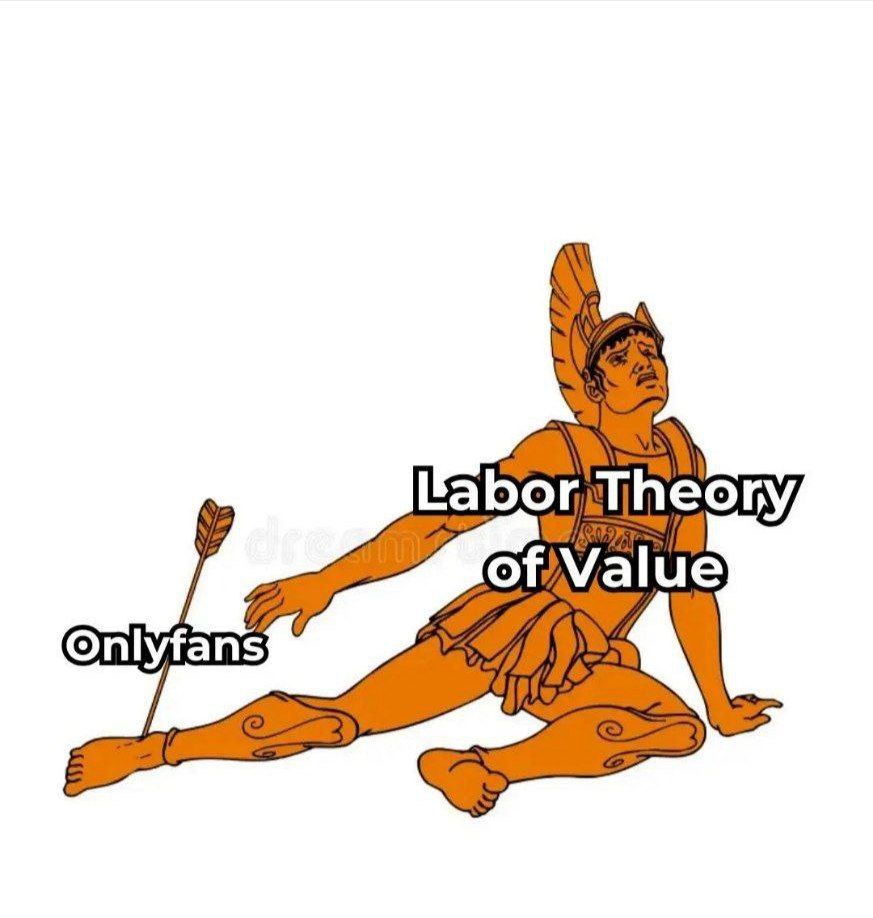


Even when Karl Marx was a child (in the 1820s) economists such as Richard Whately and Samuel Bailey had refuted the Labour Theory of Value – and it was not just British economists who refuted the theory (traces of which can be seen in Adam Smith, perhaps an outgrowth of the labour theory of property to be found in John Locke, but which was really fleshed by David Ricardo) – it was also rightly exposed as false by economists such as Rau and Gossen in Germany, Ferrara in Italy and-so-on.
Tragically the Labour Theory of Value made a comeback later – under the influence of John Stuart Mill (who followed his father James Mill and family friend David Ricardo – yes the person who really developed the Labour Theory of Value) – specifically in his “Principles of Political Economy” (1848).
Mill did not argue against the refutations of the Labour Theory of Value – he ignored the refutations (he was very much aware of them – but he kept silent about them in his main work on economics) – this is an effective method in intellectual warfare, if an opponent has arguments that are too strong for you, just pretend the opponent (and their argument) does not exist.
J.S. Mill also said that “everyone agreed” that local government should do XYZ – again he was aware that this was NOT literally true (there were many people who opposed the expansion of local government spending on various things) – what he meant was “everyone – who matters to me” which is not quite the same thing as “everyone”.
But to get back to the Labour Theory of Value…..
It was finally refuted by Carl Menger (and others – such as Jevons and Walras) at the start of the 1870s – anyone who trots it out now is either honestly ignorant (and some people are honestly ignorant), or is engaged in deception.
This is important as the Labour Theory of Value is the “scientific” basis for the “exploitation and oppression” claims of the socialists – and for their claim (for example made in the infamous “Clause Four” of the Labour Party Constitution of 1918, printed on every Labour Party membership card till only a few years ago) that to secure the full fruits of labour for those who work “by hand or brain” the taking over of the “means of production, distribution and exchange” is required.
In short socialism has no scientific basis – it is false.
By the way….
David Ricardo’s theory of LAND is also false – as shown by Frank Fetter and others.
And this is important – because Ricardo’s theory, which influenced the Westminster Review group and the general “Philosophical Radicals” (including James and John Stuart Mill) was the basis of both the later land nationalization movement, and of the later “Single Tax” movement of Henry George and others.
In spite of his good work on international trade (the law of comparative advantage) and his good work on money (attacking Credit Money and upholding the truth that money should be a physical commodity that people choose to value before-and-apart-from its use as money), there is a good reason to suggest that by his Labour Theory of Value and his theory on LAND, David Ricardo did more harm than any other economist.
The LTV was, in an earlier form, even supported by the early classical economists, such as Adam Smith – we are marking the 250th anniversary of the Wealth of Nations this year, of course – but by the mid-19th century, enough economists, such as Carl Menger of the Austrian school, and others in the so-called “marginalist” school, had debunked it.
Kevin MacFarlane, an old friend and writer for the now-defunct Libertarian Alliance, wrote this brilliant paper that takes much of the socialist project, and the LTV base of it, apart.
Robert Nozick’s Anarchy, State and Utopia has a section that takes LTV apart and by extension, the whole edifice of Marxian economics. For instance, he points out that in the LTV school, there’s no real place for entrepreneurial risk-taking, or the point that people have different tolerances for risk-taking, which is why some prefer to work for a steady salary and others are more at ease with oscillating incomes. Socialists assume we are all the former.
Johnathan Pearce – as I pointed out, there are traces of the Labour Theory of Value in Adam Smith (perhaps due to the influence of John Locke’s Labour Theory of Property – the false idea that Locke had, drawn from his MISreading of the Book of Genesis – in the Bible, that private ownership of land had to be “justified”) – but the Labour Theory of Value is really the baby of David Ricardo – who really pushed it.
By the way the younger Adam Smith understood there is no “paradox of value” as one does not, for example, value all water against all diamonds – one values a specific diamond against a specific amount of water in the circumstances of a specific time and place – but as Adam Smith got older he seemed to get confused on such matters.
Before Snorri points it out…..
Yes indeed the great Dutch legal thinker Hugo Grotius read the Bible correctly – and understood that the world was not given to humanity in-common (but, rather, land was made, by God, to be claimable by individual persons who occupied it) and, therefore, that private ownership of land did not need to be “justified” by labour, and “as much and as good” land (or some form of financial payment – as in a Lockean Poor Law justification) did NOT have to be provided, by force, for others.
Grotius also showed (following both Roman Law and Germanic Common Law) that the taking of land by force by some distant ancestor – does NOT invalidate peaceful landownership based on people living there over so many years, so (for example) the absurd rituals one now sees in North America and Australia (about “we live on stolen land”) are false – as well as hypocritical (hypocritical because if people and institutions really thought the land was “stolen” they would seek out the rightful owner and give the land to that person).
Pope Gregory XIII (famous for his calendar reform) played this dishonest game in the Papal States – declaring that every land owner should prove their “just title” to land over all the generations – of course this was not possible, so it was disguised land nationalization (plundering) which helped reduce the Papal States to a condition of terrible poverty and banditry.
Even the peaceful farmers of Appenzell who have governed themselves with their annual meeting for so many centuries (freeing themselves from church and other external taxes by the Appenzell Wars of some 600 years ago) did not always live where they are now – their forefathers were Germanic tribesmen who overwhelmed the Roman authorities in the area some one and half thousand years ago (the Romans have conquered the area some five centuries before that).
To claim that this some-how invalidates their ownership of the land, or that they should pay taxes to give money to people who do not own land, is the height of intellectual dishonesty.
Paul, is there an accessible study about the property rights ideas of Grotius that you are aware of?
Interesting that Grotius had ideas about land derived from the Bible because his native Holland is very much an artificial construct of Man!
For the uninitiated could someone explain how the existence of OnlyFans (which strikes me as just a more successful Substack) refutes the Labour Theory of Value?
If ever there was a case of “subjective value”, it’s porn 😀
Patrick,
I was wondering that too… Oh, I just saw Molly’s response. It all depends upon how much effort you want to put into a wank…
@Molly Millions
If ever there was a case of “subjective value”, it’s porn
Right but to increase the price does involved work, whether making extra videos, or marketing your channel, or going to the gym. There is even capital investment involved, such as buying better camera equipment or getting a boob job.
I’m sure the reality of doing that job is nasty, probably requiring a lotta drugs to dull your senses, but in some ways I kind of admire it. It seems very much a pure free market thing aside from the hosting platform which no doubt takes fees that would make a pimp blush. I really like the idea of individual women (and I suppose some men) being liberated from the big porn companies, leveraging what their mamma gave them to satisfy a need, and taking advantage of society’s weird attitudes about sex to their advantage. And doing so on their terms rather than the terms and demands that porn places on women.
Gold is also subjective. We don’t need it for anything. Try selling gold or porn to a blind person!
Lily Phillips begs to differ.
Johnathan Pearce – I am trying to remember a book title that would cover Grontius on property rights – contrast him with Pufendorf and Locke- but my memory is drawing a blank, I did look into these matters in some depth – but some time ago (1980s and 1990s). The name “Karen Vaughn” is appearing in my Swiss Cheese like semi senile brain – but no title of a book or article.
I do remember that Karen Vaughn write about Locke’s idea (expressed in a work that started with the letter “V”) that a sea captain who decided not to sell his cargo of food in a port where there was a famine (because he could get a better price elsewhere) was “guilty of murder” – and how traditional legal thinkers (such as Grotius) would consider Locke’s view insane. It is insane – as there is always hunger to be found anywhere (port or not) so this would bid down the price of food (and everything else) to zero – but it is more than economics, not-helping-people is NOT the same murdering them, it is a failure of charity (mercy) not justice (not to each his own), Locke does not even mention any contract the sea captain has at the first port – his grasp of law (both criminal and civil) is just wrong. The sea captain is NOT “guilty of murder” – he is not guilty of any crime at all.
Basically there was no real dispute on the matter in either the Roman Law or the Common Law tradition – the problem came from Book of Genesis. Writers such as John Locke, and (I seem to remember) Samuel Pufendorf held that God gave land to humanity in-common so private ownership of land had to be “justified” (in Locke by work – labour) and either “as much and as good” (Locke again) left for others – or some form of financial payment from landowners to people with nothing – the English Poor Law system (which went back to Tudor times).
Hugo Grontius, and others, held that God gave land – to-be-claimed, that no “justification” or financial payment to non landowners was needed. This was the traditional view of both Roman and Common Law – it was Locke and others who were (de facto) dissenting from the traditional legal view.
John Locke did some odd things at times – I remember going through his “fundamental constitutions of the Carolinas” – where Locke reinvents serfdom (which had died out in England) as “leet men and leet women – for all generations” and writes other crazy things – but I am not sure whether he was serious, or making some sort of joke (recognizing humour has never been a strength of mine).
Gough (Oriel Oxford) back in his 1940s book on Locke noted that even in the “Two Treatises” Locke slips (in a rather sly manner) from individual consent to majority consent – ignoring the distinction that had been well known for centuries.
Making liberty about majority (rather than individual) consent, has devastating consequences for private property rights.
Fraser,
If internet porn has taught us anything it is the infinite variety of niche (oh. err. missus!) things people get off on. It is not all gym-toned Baywatch Babes with tits till Tuesday professionally photographed with a Nikon. Some of it is utter mingers doing things that the Holy texts didn’t even think to condemn. Some of it hideous. That’s a large part of Only Fans.
I think we have to take the rough with the smooth here… Social interaction via the internet has allowed me to discuss and find out about really niche things. I didn’t even know what a “libertarian” was until I found this here site! I certainly wouldn’t be in a position to easily discuss (which I found myself getting into several times, somewhat to my surprise) the role of Catholic theology in the works of Tolkien without the likes of Quora. Or inquire into suitable NACA airfoil sections for an A-Frame model aircraft… The idea that the internet is isolating is a great lie. The net has enabled people with recherché interests to interact. That those range from the most erudite and noble to the basest and mean and all stations inbetween (via “Just Weird”) is, I think utterly wonderful. That we all differ on our classifications here is inevitable. As they say, YMMV.
N(L,R)G.
There is audio porn as well you know… I also beg to differ about gold. It doesn’t just look pretty. It has many other uses than that due to it’s physical and chemical properties. It also lasts like few other things making it an ideal store of wealth.
Not relevant. That work only produces value to people who want to see babe pix, it has none to those who don’t. No amount of work gives an OnlyFans channel *intrinsic* value to a punter rather than subjective value.
Intrinsic value? Read Paycheck by Philip K Dick.
@Molly Millions
Not relevant. That work only produces value to people who want to see babe pix, it has none to those who don’t. No amount of work gives an OnlyFans channel *intrinsic* value to a punter rather than subjective value.
I have no idea what that means. All value is subjective, what does “intrinsic value” even mean? for most people a bar of gold is worth more than a gallon of water. But if you are alone in the middle of the desert the subjective value is obviously reversed. Some people pay millions of dollars for a painting that I wouldn’t hang in my house for free.
The value of anything comes not from its composition but from its utility, and how useful something is depends entirely on who is using it. So if our model makes pictures that are useful to some user then she has clearly created value. It might not be valuable to you or to me, and the “use” the guy is putting it too might offend some, but you probably value things that the aforementioned punter would toss[*] in the trash.
I mean to be clear, I think the labor value of value is completely wrong, but that doesn’t mean that labor can’t create value. It most certainly can when appropriately directed.
(FWIW, a bit OT, but it is why I think the idea of gold as a currency because of its “intrinsic” value is just plain wrong. Gold backed money is better than what we have, but it has lots of weaknesses. Just ask the Spanish Empire in the 17th century.)
[*] No pun intended, just a happy coincidence.
No shit, Sherlock. But that’s not what Labour Theory of Value would have us believe.
Surely the fact that some footballers get paid millions for running around for 90mins (plus stoppage time naturally), and others have to pay for the privilege of doing exactly the same thing has already long provided a less salacious example of why the labour theory of value is b*llocks?
I think Fraser’s summary is somewhat oversimplified. One part of the utility of an item is the utility of,er, actual use. But another possible use is as an item to exchange. Thus even if I have no use, personally, for bag of walnuts, I may nevertheless be able to exchange it for a chocolate bar, with someone who values nuts more and chocolate less, than I do.
Thus my subjective valuation is the higher of {the item’s in use value to me} or {the item’s value in exchange} which will be determined by other people’s subjective valuations of the item, and what they are willing to exchange it for.
None of this gets us to an intrinsic value but it does get us into a complex realm of lots of people’s subjective value.
Personally I have no use for the vast majority of modern art junk. But if I found a Picasso in the attic it would still be worth quite a lot to me. Because it would be worth quite a lot to someone else.
It must not be assumed that believing that the people should control the government depends on a Labour Theory of Property – let alone a Labour Theory of Value.
For example, long before John Locke – James Buchanan in Scotland was arguing that the people of a nation (the people are the nation – the national group) had the right to remove a government that was undermining them – even a monarchy that had lasted for centuries.
There is no Labour Theory of Property, let alone a Labour Theory of Value, in this.
And most of Scotland did not have a Poor Law Tax till 1845.
France did not have such things till well into the 20th century.
It doesn’t; the LTV wasn’t intended as a catch-all for every single variety of “work” or “payment”; it’s typically more a description of why commodity goods tend (in the mathematical sense) towards their cost value in the long-run absent countervailing factors, including but not limited to scarcity, demand, monopoly, state intervention etc. At any given time, you have the cost of the good on one hand, and the countervailing factors (marginalism largely covers these) on the other. The two interact, and determine the spot price.
There’s loads of exceptions – pop-stars, football players, Veblen goods etc – which simply sit outside the LTV and have nothing to do with it.
Labour Theory of Value pretends one of the costs of production magically imbues the product with “value” because that is politically convenient to imagine. Every justification is pure handwaving.
As with most of these types of discussion, it depends what you mean by LTV. Smith’s version was markedly different from the more “classical economics” version of Ricardo et al, for instance, in that he viewed it as the amount of labour the purchaser was willing to perform (eg. Was I willing to enough paper-rounds to save up enough to buy a BMX?) – it leans more towards Subjective Theory of Value.
Some people – incorrectly, in my view – believe that it means that pricing “should” be somehow capped at cost.
In it’s simplest form, it means that the “cost” of a product is just the aggregate value of all the labour that went into producing it, from the initial labour expended to dig the raw materials out of the ground or whatever, through to the final stage before it is sold (including all of the labour that goes into building the machines involved at all the various stages of production, transportation and so on). It’s one of those things that is “technically” correct, but far too abstract to be useful, IMO.
Phrasing it as “The Cost Theory Of Value” makes more intuitive sense, I suspect.
Anyway, the important bit about it is that it describes half of the formation of natural pricing of commodities over the long-run; the other half being the factors I mentioned above (supply and demand etc etc). Probably important to note that even if the more, uh, artificial factors like state-supported monopolies, subsidies etc were removed, spot pricing will still fluctuate around the “cost” price (above AND below), just due to natural scarcity, changes in demand and so on; but pricing should, in a freed market, at least come down to something “approaching” cost price in the long-run.
It’s just a descriptive thing.
I know some people want to use it as a “law” or something for how much people should be “allowed” to charge, but that’s – again, in my ever so humble opinion – a misunderstanding or misapplication of the theory itself.
Eh ? This is barmy. It’s not “technically” correct, it’s “technically” barmy. Because there are other inputs to production besides labor. Like, er, raw materials. Like land. Like sunshine.
If one patch of land happens to contain useful raw materials, another wild strawberries, and another huntable antelope, the values of the output generated from the application of labor on that land will vary according to both the quantity and quality of the labor applied, but ALSO according to the nature of the land.
It is true of course that labor can “improve” the land, but that is a detail. Labor cannot improve any land to any use. And improving some land to agricultural use requires much greater labor than improving other land. Land with its own natural water supply does not require an irrigation system. Doh !
Note that for each seed, the labor is identical.
These things don’t have an exchange value until they’re “worked on” in some fashion. It’s easy to understand in the case of things like your wild strawberries – you can’t sell them at market until you’ve worked to pick them and carry them to market. It becomes more abstract, especially as more commodities are produced with the use of automation, but essentially everything is the product of someone working on something; even if that thing is, say, the machine used to extract oil. In the case of land itself that contains valuable raw materials, the cost might very well include the labour involved in putting up a fence and then policing it. None of the things are worth anything (economically speaking – you may indeed think a field of wild strawberries is very pretty to look at, and has value in that sense, but that’s nothing to do with LTV) until they are laboured on. But, as I’ve been saying, whilst it’s “technically” correct, it’s rather abstract.
Sure, but LTV doesn’t state that all labour is valuable (mud-pies being the classic silly strawman here). Three of the four sets of seeds have no value at all, so the fruits of your labour – literally, here – cannot be exchanged, and LTV has no relevance to those.
All value is created by labour, but not all labour creates value.
A lot of the “LTV has been refuted” arguments seem to come from a misunderstanding of what it was meant to be applied to; a good analogy I’ve seen is that it’s like trying to refute Darwin by noting that rocks don’t naturally evolve into houses in the wild.
Marginalism, subjective theory of value, and others add to the LTV, but they don’t refute it (LTV on it’s own is and was incomplete as a “total” description of commodity pricing and exchange, to be very clear).
No. If you own the land, you can sell the right to pick this year’s strawberries, before anyone has expended any labor on picking the strawberries – for a price P = S-L, where S is the exchange value of the strawberries when picked, and L is the value of the labor to be expended. The mere fact that S-L is positive demonstrates that the exchange value of the right to pick the strawberries, pre any expenditure of labor, is not zero. And so, likewise, the value of the land is not zero either, as the purchase of it confers the rights to use it for strawberry picking, or any other purpose, in perpetuity. Governments permitting.
I agree that the wasted seeds are worthless. But the parable is not telling us that the sower is foolishly sowing seeds in silly places, it is telling us that in the nature of things, some seed will fall on good ground and produce fruit, and some will not. By chance. The labor to produce the fruit includes all of the sower’s labor, for in order to have a chance of seeds landing on good ground he had to scatter the seed widely. The fruit could not have been obtained without the failure also. The exchange value of the fruit differs from the exchange value of the seeds fallen on stony ground etc solely because of the nature of the ground. If you wish to hang your hat on the fact that the bad ground produces nothing and has no exchange value, then just alter the parable*, and allow some seed to fall on poor ground, so that it produces a much smaller crop than the bumper crop from the good ground. That poor crop is plainly worth less than the bumper crop but it has had exactly the same labor expended on it.
I vaguely recall that Marx, or maybe Engels, tried to wriggle out of this problem by arguing that labor meant maximally efficient labor so that if producing a bag of coal from three days labor was sub par, and it could be produced with a day’s labor, then the “wasted” two days didn’t count. But this is obviously cheating and retreating into “the thing” is worth what it’s worth, and we’ll call that “labor value” by inventing a notional quantity of maximally efficient labor which could have produced it, which happens to be precisely proportional to, er , what it’s worth.
But even this dodge doesn’t get round the problem that the sower’s labor is NOT inefficient. It’s the maximally efficient way to sow, in the technology of the day. It’s just that the crop depends on another factor of production. The quality of the land on which the seed falls.
* in fact you don’t even need to alter the parable as it allows for varying production – “some an hundredfold, some sixtyfold, some thirtyfold.”
Yes, absolutely – I agree. But where does the value in the land come from? Sticking with the strawberry field example (if that’s cool with you?), then the value you offer as the landowner comes down to what? I’m going to suggest keeping the land in good order so strawberries can grow, erecting and maintaining fences around it, keeping it clear of vermin, and loads that I haven’t thought of. All of which come from human labour (some, like the fences, will be “one-off” purchases, as such, but will depreciate over time). And because of the value that I, the landowner, offer, I get to be recompensed for that. No argument here. As long as I am actually offering that value..
One of the initial driving forces behind the development of any of the various “theories of value” was to understand why, out of selling price P, X goes the worker, Y goes to the capitalist, and Z goes to the landlord (bearing in mind how much more relevant agriculture was at the time). So, yes, there’s nothing in your first paragraph that I disagree with. But it doesn’t change the concept that until the strawberries are picked and taken to market – ie. worked on – they have no exchange-value, in economic sense, except in potentiality.
And, yes – if I’m understanding you correctly (please say if not), you’re pointing out that, well, in the real world prices are significantly higher than the labour cost that has gone into producing something, sooo, LTV falls over; but we don’t live in a real freed market economic system, and even if we did, natural countervailing forces will always affect prices in the short-term. LTV is a starting theory (I mentioned that I find it incomplete), which starts by saying “the only thing that creates value is the work done on a material” and then carries on from there to attempt to explain prices.
Your “vague recall” isn’t far off at all!
I think it was Marx, but either way – that’s what “Socially Necessary Labour Time” means.
Aside – this is, unfortunately, another one of those concepts that has been butchered over time. Colloquially, it’s often misunderstood, and people think they meant “producing stuff that is valued by society”; one can then – correctly, under that definition – say that this actually means subjective value. I believe that this is largely a good faith misunderstanding – it’s a horribly awkward phrase – but it is still a misunderstanding.
What SNLT actually means is the average amount of time, using average quality tools, under average conditions, that it takes to produce X commodity. It’s not “maximum” (that’s the only bit your recall failed you on), but the average.
It was designed to head off the inevitable “but someone who takes three times longer to pick the same amount of strawberries deserves three times as much money? lol gotcha I am very smart” argument. I think they wasted too much energy and verbiage on this, when a simple “Obviously not, behave yourself” would have done, but then they were not exactly known for being concise *shrugs*
So, yes, it is efficient, on it’s own terms. I happen to grow a lot of my own stuff, so I recognise this one, and there are lots of ways to be “efficient” – soaking seeds overnight, putting them in my dark garage and seeing which ones sprout, and a million others. I do very few of these; I just whack them all in and cross my fingers (I’m exaggerating for effect, I do a few things, but overall, I’m not sitting here for hours with a £1.14 packet of seed and separating them out).
Our sower, here, he’s only being paid for the seeds that produce – which is totally fair; it’s incumbent on him to work out whether it’s valuable spending time on checking where he’s sowing is likely to work or not. At the same time, if some of the seeds sown, in all expectation of success, still failed, then one would expect that to be factored in so that the final price of the “successes” cover the “failures” as well. The LTV doesn’t insist that people should – necessarily – be paid for failures; it’s not relevant to it’s point.
That’s still labour; he’s hopefully made a calculation that checking pH levels, soil type, sunlight hours and so on is or isn’t worth it, and allowed for “some” failure rate. That’s just standard practice, and one would hope that payment would cover those; but without the labour expended on sowing, nothing would have been produced.
Some people, certainly, have used this to say that “all expended labour time is equal” – see various experiments with labour vouchers etc; I can understand why, and I believe they’re in good faith, but I’m not one of them. It’s not the necessary logical conclusion of a proper understanding of LTV, IMO.
So we have gone from neonsnake defending Ricardo’s theory of land (rejecting Frank Fetter’s refutation of it), to neonsnake defending the Labour Theory of Value itself.
Well at least the Gentleman is consistent on this matter. Richard Whately, Samuel Bailey (and others) refuted this doctrine two centuries ago – back in the 1820s.
Although it should be noted that both David Ricardo and Karl Marx rejected Credit Money (the idea of the Monetary Cranks that increasing the amount of money made the economy better by “increasing effective demand”) – they were not wrong on that matter.
The difficulty with your theory of strawberries is that you imagine that labor must be deployed on the land such that it can bear strawberries. But that is not how wild strawberries work. They just grow. Maybe you are fortunate enough to have land on which wild strawberries grow. Maybe you are unfortunate and nothing useful grows.
Back to the sower. Imagine he labors at sowing for others. Four landowners hire him to sow his seeds on their equally sized plots. So he does and gets paid the same by each landowner. And the four landowners get, as a result, ten, thirty, sixty and a hundred pieces of fruit. Is the exchange value of each landowners crop the same ? Obviously not.
But we must factor in the cost of collection, which, say, is proportional to the size of the crop (which btw it won’t be as there will be some economies of scale).
But however you slice it each patch of land produces a different amount of fruit per unit of labor expended. The exchange value of that fruit is different and the reason is simply the productivity of the land.
On which the landowner has expended no labor. The labor is God’s. He made the soil, the moisture, the exposure to sun.
This is even more obvious with say land with iron ore on it. Sure there is labor to dig out the ore. But how much ore can be extracted and what its exchange value is, depends on the quality and quantity of the ore. Which has nothing to do with labor. Except God’s.
Sure – lets assume that one has a patch of land that one expends no effort on maintaining, but wild strawberries grow on it. Now we’re talking about factors of production, which is a different thing; but until they’re picked and taken to market, they still can’t be exchanged. I have an apple tree, myself, in my garden; I make a (very small!) amount of money from it, by making jams and jellies and whatnot. Even if all I did was pick the apples and sell them whole, I still have to pick them. And, trivially enough, the jams and jellies sell for more because they require more of my time and energy and that is recognised in the market price.
It’s still the labour that gives them an exchange value. The land has value in and of itself – a source of current or perhaps future revenue, but it’s not the same thing as commodity production, and sits outside of the LTV (same for the iron ore example, fwiw)
I’m not totally sure I understand where you’re going with this, so my genuine apologies if I’m answering a point that you haven’t made (very happy to be corrected if I do so!).
LTV doesn’t state that every “hour” spent on labouring is “worth” an identical amount. If, say, I spend hours on making apple jelly and then spill it at the last moment, clearly enough, that was a complete waste. However, that would be factored in – that’s what “Socially Necessary Labour Time” means; if one assumes that across 100 jars of apple jelly, that 2 of them get spilled, or spoil, or I forget them and they thicken up too much, or otherwise just “don’t work” in whatever way, that doesn’t affect it. Remember, it’s the average, not any individual instance, that counts.
In the case of our sower, it’s not the exchange value of the individual landowners’ crops that the LTV intends to address, but the average commodity price; it absolutely takes into account bad crops, bad seasons, and so on.
However, let me know if that wasn’t the point you were making, and I’ll reformulate my response accordingly!
Further, just in case there’s been a misunderstanding of what *I* mean when I’m talking about the LTV.
I mentioned this upthread, but historically, The Labour Theory Of Value has had a few different meanings. All of them start from the idea that the ultimate source of value is people working on the gifts that Nature, God, Gaia or Mother Earth has granted us, which I do not believe to be a controversial statement.
Broadly, there are two main conceptions of it –
The first is that it’s an empirical model, used to describe why pricing of commodities “approaches” cost in the long-run, absent countervailing forces. The idea, very broadly speaking, is that in a world of perfect competition, pricing comes down as competition increases. We’re all, as free-market advocates, pretty familiar with this idea and I’d be very surprised to find someone who disagrees with that, on a libertarian blog.
It doesn’t mean that on any given day, final pricing = cost, because there are always countervailing forces, natural or unnatural.
The second is that it’s a normative model (I’ve seen this referred to as “utopian”); that pricing should be set at no more than the labour that went into producing them, and that labourers should be recompensed accordingly, by various contrivances like labour-hour-vouchers and the like. You’d then exchange “two hours of your labour” for a product that takes “two hours of someone else’s labour”. I know of a few experiments along those lines – I think the most famous are Josiah Warren’s and Robert Owen’s, but I’m familiar with them only in a passing sense, I’m afraid.
I fall into the first category – I treat it as an empirical model, not a normative one. Interestingly, so did Marx, although I suspect that many people think otherwise. Again, another misconception.
Within the first category, it breaks down at least a bit further – Marx considered that “surplus value” or “exploitation” was just a given in any market system. I, as a free-market type, do not agree with Marx, and I believe that “exploitation” is generally a result of state interference and privileges, and that if that interference and privileges were removed, then pricing would drop to something “approaching” cost, given that competition would no longer be penalised.
(I’m sure there’s other variants that I’ve failed to mention, but this comment is already quite long – apologies for broad brushing, but I can’t possibly encapsulate everything)
Paul – yes, I reject Fetter’s refutation of it. He is wrong. Someone saying “I refute this!!!” is not enough to actually prove it wrong.
Explain to me why I’m wrong to do so, given the very specific argument that his so-called refutation hangs on?
For those who do not know – the economic value of something (a good or service) is determined by how much someone wants it, it is subjective (based on that person’s opinion – their desire), economic value is NOT determined by how much work is put into a good or service.
Indeed Paul, it really is that simple.
Working for pay is not “exploitation” – and there is no “surplus value” (as the Labour Theory of Value is false).
Nor is paying rent for land or other property “exploitation” – and land nationalization, or the taxing away of the value of land or other property is not good – it is evil.
However, there are people who think otherwise – in the end one is killed by such leftists, or one kills them.
Yes Perry – it is that simple.
When I was a young man I would (and did) spend a long time painstakingly going through the arguments – and trying to convince people on the other side.
That is before I got it through my thick head that the people on the other side do not want to be convinced – and are not interested in the truth (on this – or other matters).
They want to destroy, and they want to kill.
So one either becomes their victim – or one does not.
And there is only one way, in the end, to avoid being destroyed by them – and that is to destroy them.
Is that a threat on my life, Paul?
Because it certainly looks like one.
Perry.
I presume that you’re going to moderate my last couple of comments away into oblivion, but.
Paul has now made a couple of pretty direct threats towards me.
I use a pseudonym to protect me, for various reasons, but I also assume that it won’t be enormously difficult to work out who I really am. If nothing else, I have to put an email address in when making comments. Paul appears to be genuinely making threats against me, at this point – whilst I have certain doubts about his ability to carry them out, that’s still somewhat…a bit much.
I’m not going to take this any further, but I would very much appreciate it if you rein him in, please.
We can disagree on stuff like this – to my mind, I’m having a good faith discussion with Lee right now – but I really do not appreciate literal threats like “or one kills them”, or “they want to kill” with the added thing of “”there is only one way, in the end, to avoid being destroyed by them – and that is to destroy them.” (I can only think that that means that Paul wishes to kill me)
I assume (?) that you have my email address, because I have to enter it when making a comment, and am happy to discuss in private, if needed.
In conceding that land and raw materials have value in themselves, your LTV seems to have shrunk into the proposition that – that part of the exchange value of something which reflects labor input, is reflective of labor input.
Which sounds obvious even tautologous if it were to be accepted that input determines the value of output. It’s true empirically that the value of labor input usually enhances the value of output, but there are so many exceptions and variations that it becomes meaningless.
So far as I can see what you are insisting on most enthusiastically is that the things always require some input of labor to bring it to the final consumer. Even if true this walks straight past the obvious fact that stuff has an exchange value and can be exchanged before it is ready for final consumption. It does not demonstrated that labor is the only input contributing to value. But as others have mentioned value and cost are quite different ideas.
We’ll conclude with art. Mr A paints a beautiful painting in 250 hours of expert labor. It sells for £10,000. Mr B paints a different painting, equally expertly, but it sells for only £1,000. Art lovers just love the subject and style of Mr A’s painting more than Mr B’s. But then there is a change in tastes and Mr B’s painting is resold for £125,000, while MrA’s languishes at a meagre £29,000.
Then there is a war and portable wealth like paintings shoots up in value, and the A painting sells for £1 million, and the B for £3 million. After the war demand for these paintings remains high, but tastes change again, and the A painting overtakes the B painting once more. How do we explain any of these changes in the exchange values of the paintings by reference to the labor input ?
It doesn’t look that way to me, just intemperate Paul being Paul. I’d kick/ban if I thought it was a literal direct threat.
Just to shoot an unwashed dumb opinion into the mix:
I always thought that the “Labor Theory of Value” was speaking to a definition of value that differs greatly from price or cost.
To a socialist system, that definition of value is going to indicate how much human labor is associated with something, and if your system is predicated upon human labor as the highest of moral values, a product that incorporates a LOT of human labor is by definition going to contain a lot of that same valuableness. Not expensiveness – something less tangible but more ideological.
Works on the macro level but not the micro?
bobby To a socialist system, that definition of value is going to indicate how much human labor is associated with something, and if your system is predicated upon human labor as the highest of moral values, a product that incorporates a LOT of human labor is by definition going to contain a lot of that same valuableness. Not expensiveness – something less tangible but more ideological.
The idea that occupying 100 men for a month in digging a ditch in the rain and sleet is more valuable, somehow, than occupying 5 men for a week, surely sounds like socialism to me. It certainly explains the White Sea Canal.
No neonsnake – it is a statement that I will defend myself, and others, against the supporters of the Labour Theory of Value (and the Ricardian theory of land).
Why should I make it easy for you to kill me? Not that I particularly want to live – but frustrating your designs is worth doing, at least as regards other people (who do wish to live).
And it is not me who is inventing the idea that you support evil – you have made that clear, repeatedly, by your own words. The supporters of the Labour Theory of Value (and the Ricardiian view on land) have murdered over 100 million people in the last century.
So this is not a theoretical matter – your side has made its agenda of mass murder quite clear, as the supporters of the Labour Theory of Value (and the Ricardian theory of land) have already murdered over 100 million people.
See The Black Book of Communism – and the works of Robert Conquest on the Soviet Union and Frank Dikotter on Mao’s China.
neonsnake has reminded me of someone who recently said I was being “unfair” to Dr Sean Gabb (who now calls himself “Alan Brinkley”) over his de facto support, in the present war, for the Islamic Republic of Iran tyranny that has murdered vast numbers of Iranians – and many other people (around the world), in its “Death to….” policy over the last 47 years, and seeks nuclear weapons to USE in order to “hasten” the supposed return of the 12th or Hidden Imam.
Supposedly the problem is me using harsh language – not Dr Gabb, in post after post (multiple posts – not one or two) on the London Liberty Facebook group (and so on) – in which he (and his glove puppets) repeat, as truth, the propaganda of the Islamic Republic of Iran tyranny against the United States – in much the same terms that the Morning Star Communist newspaper does.
Perhaps I am “threatening the life” of Dr Gabb – by pointing out that he (and his glove puppets) are supporting a regime that wants to kill me – and would also (and here is the irony) kill or enslave Dr Gabb and his family (and associates) themselves.
No, it’s not dumb at all. The confusion arises because people have different conceptions of what it means.
Even in it’s most “formal” conceptions, I know of at least two; see one of my comments above, but essentially there’s a “it’s an empirical model which describes why, in situations of perfect competition, price approaches cost” model (which is the one I’m talking about), and a normative model which says that “so prices should, morally, be set at cost” (a view I disagree with mightily).
On top of the difference in the formal conceptions, there’s a LOAD of misconceptions that lead to us talking past each other. In the empirical model, it can only be applied to products/services where competition can exist because the “good” is fungible – ie. commodities.
It can’t apply to things like art, pop singers, or ladies getting their thru’penny bits out on the internet, because they’re not fungible goods (I’m sure there’s a pun to be made somewhere here) – and was never meant to. It also has zero relevance to things like the “mud pie” example, because there’s no exchange-value there (ie. you can’t bring it to market, because no-one will buy it). Lee is 100% correct to note that it doesn’t apply to art, but I fear we’re talking past each other here (in good faith on his part, I’m not having a dig; it’s probably my fault for not explaining it well enough).
I think the other thing is: in Adam Smith’s day, it was relatively easy to understand that nothing has an exchange-value until it’s “worked on” because people were much “closer” to their product. It’s also easier if you contain yourself to manual labour (I think?), but white-collar work is still labour, formally speaking.
Like, it’s really easy to understand that strawberries in a field don’t have an exchange-value until they’re picked, packaged, and taken to market, which takes labour. They are raw materials, or formally “subjects of labour” in that they need human labour applied to them before they can be exchanged. They don’t magically go and sell themselves, and God/Mother Nature/Gaia etc don’t get paid.
Further, it’s relatively easy in that case to conceive that any machinery involved (the automated strawberry picking machine provided by your employer) is also, itself, the product of labour, because one can easily imagine that someone built it. In that instance, it’s still labour but it becomes “abstract labour”, and is captured in the cost of the good (in any P&L capital goods are accounted for, yeah?)
In today’s world, that’s quite a lot harder, I think because we’re so much more abstracted from our product, and we use so many products that we, in turn, are abstracted from. So we capture that “human labour” in cost, as a useful abstraction. Take the keyboard I’m currently typing on – I’ve little concept of the details, but before it reached me, someone had to design it (labour), put it together (labour), mine the materials used to make it (labour) or design and manufacture the machine that put it together or extracted the raw materials (labour) – all the way back, it’s all labour. It’s hard to measure that, objectively, so we abstract it and call it “cost price”, which is sensible. I said this a way upthread, that I prefer to use “Cost Theory Of Value”, because it’s more intuitive, but I got sidetracked while chatting with Lee.
None of the above is an argument against subjective value or spot-pricing, or so on. It simply notes that in a world of perfect competition (“imagine a spherical cow”), pricing will approach cost, which is objectively true and verifiable. Again, it doesn’t apply to goods/services/products that aren’t fungible, because they by definition cannot be “competed” with; it’s not that people are making “exceptions”, as such, just that it never applied in the first place, nor was it meant to.
Like, it’s really easy to understand that strawberries in a field don’t have an exchange-value until they’re picked, packaged, and taken to market, which takes labour.
But this is incorrect, as I have mentioned already. They can be exchanged before they are picked and packaged. The owner of the patch of land on which the strawberries grow can sell them to the picker, without lifting a finger to pick them. The picker buys them, applies some labor, and then resells them at a profit. Perhaps to a wholesaler, who applies a bit more labor, and possibly some machinery, and then sells them at a profit to a retailer, who applies yet more labor etc, and in turn sells them to a restaurant, who applies more labor etc, and sells them to the diners. All along the way the strawberries are being exchanged, for money, and all along the way the inputs include lumps of labor and lumps of other stuff*.
They are raw materials, or formally “subjects of labour” in that they need human labour applied to them before they can be exchanged.
As mentioned above, they can be exchanged before any human labor ia applied. But there is obviously some definitional sh!t going on here. The “raw materials” and the “labor” are both necessary inputs to create the “ready for sale to the punter strawberries.” If the “raw materials” are to be seen as “subjects of labor” then the “labor” can just as easily be seen as “subjects of raw materials.” The labor input is not logically favored above the non labor input. They are all inputs alike, which are mixed together to create the output. If you mix labor with clay, you will not get a strawberry picking machine. You need a spot of iron ore. Clay is different from iron ore. The difference is not related to human labor.
Further, it’s relatively easy in that case to conceive that any machinery involved (the automated strawberry picking machine provided by your employer) is also, itself, the product of labour, because one can easily imagine that someone built it. In that instance, it’s still labour but it becomes “abstract labour”, and is captured in the cost of the good (in any P&L capital goods are accounted for, yeah?)
It may be easy so to conceive, but it is incorrect. For the machinery is just as much a “product of raw materials” and a “product of land” as it is a “product of labor.” Its not “abstract labor” it’s “abstract ALL the inputs.”
So far as I recall you acknowledged that land and raw materials are real inputs which are not labor. Labor is applied to these other inputs (or land and raw materials are applied to labor, however you want to slice it) – but the output is composed from a mixture of inputs of which labor is only one. Why, when you consider the machinery’s role in producing a product, would you forget about the non labor inputs which were necessary to create the machinery, and only remember the labor?
* I should asd that there is a lot more going on here than just labor and raw materials. The exchange value of the strawberries in the restaurant is considerably higher than the exchange value at earlier stages because the restaurant is taking on a RISK that no one will buy the strawberries and they will go bad. This has nothing to do with labor, but plenty to do with the realities of economics.
Land isn’t (in the economic sense) a commodity, so the LTV doesn’t apply.
Recall: the LTV only applies to commodities, in the strict economic sense of it needs to be fungible. Land isn’t fungible.
Yeah, there is, and I think it’s why we’re talking past each other. I think there’s a bunch of stuff where you’re thinking “hang on, obviously not because X?” and I’m thinking “X has nothing to do with it, though?”
🙂
Most likely, it’s because I’m attempting to collapse a LOT of thought into short-ish posts (and some of them are already too long), and skipping past some concepts which seem “axiomatic” to me, but might not be to others. Also, I’m probably mixing “formal definitions” with something less formal, and therefore not explaining myself well. I think I’ve been a bit woolly on the definition of value, to be very fair to everyone. I’ve been meaning “added value”, or “new value”, but I suspect I’ve not been clear on that (one of those things that, in my career as a buyer, I take for granted, but then I’m operating under possibly different paradigms to others)
I’m happy to carry on, but might be worth getting some definitions sorted first, if you like? A lot of your “definitions”, I will likely agree with, in the context that you’re using them – but I suspect I’m using them in slightly different contexts.
For clarity, Lee: it’s very hard to get “tone of voice” across in posts like this, but I haven’t been taking you as “combative” and I hope you haven’t been taking my responses to you as “combative” either. When I say I’m happy to carry on, it’s because I’ve been viewing our discussion in the spirit of a “chat”, not an “argument”, if that makes sense?
For further clarity, and to counter a point made against me by…someone else…I’m a rabid proponent of free-markets. I’m not a socialist of the “government should own the means of production” variety, in any way whatsoever; my post history will back this up. Any argument I make in favour of the “Labour Theory Of Value” or “Cost Theory Of Value” leads *me* to the conclusion that we should have freer markets, not more government intervention.
Yeah, alright, sunshine. Are you now saying that “or one kills them” doesn’t mean “or one kills them”?
I can accept an amount of hyperbole – “Death to the Labour Party” or whatever is meaningless to me – it clearly doesn’t mean murdering their members. But you’re talking about individuals here, and your desire to literally kill them.
I’m sure you have the capacity to do so (“You’re a big man” but “out of shape”, as the saying goes), but I rather suspect that given a chance, you would act on those desires.
Am I wrong?
Perhaps you could explain what you mean by “commodity” and “fungible” ? In my strawberry example, the strawberries appear in many guises. On the bushes, in the pickers baskets, at the pickers store, in the wholesalers truck, in the wholesalers warehouse, in the retailers shop, in the restaurants kitchen, on the diners plate. Even if each strawberry were identical the stage at which it is at carries a different value. When does it become a commodity / fungible ? On the bushes? On the plate ?
And in any event strawberries are never fungible. Some are large, some are not quite ripe yet, some are squishy or on the turn.
I think if you are going to posit a whole scale of value which doesn’t apply to non commodities we need to understand what one is. Before we move on and examine why we shouldn’t just carry on using the same valuation mechanism that we use for non commodities.
Just for the avoidance of doubt I am not positing that the landowner sells the land on which the strawberries are growing – just the strawberries that are growing on it. The object of sale is the strawberries themselves, it is just that while on the bushes their value derived from the land, the rain and the sunshine, not from any human labor.
Sure! Sound good to me.
Some initial points: as much as possible, I’m going to try to confine myself to generally accepted “formal” definitions, as in, those in use over the past 100 years or so, and I’ll indicate these by using italics. If I forget, that’s my fault, but while we’re doing “definitions”, I’ll try to keep it “strict and formal”, rather than adding in my opinion. If I do so, I’ll try to to make that clear.
Secondly, a lot of my first-hand experience with this kind of stuff comes from my profession. For basically all my working life, I’ve been in “sales” of some description; be that literal shopfloor salesman in an electronics store when I was young; through to being a Buying Manager for various products for very, very large companies. Some of those products have been commodities, some haven’t. That experience may bleed into what I say, as it’s “hands-on”, as it were, rather than “theory”. I haven’t, though, ever been involved in FMCG buying (including groceries), so I might get some assumptions wrong here – please extend me some grace on that one.
Also, there may be instances where I just don’t have the knowledge of a product to immediately tell if it’s fungible or not – I was idly googling “pizza” earlier to check if it was fungible or not, with regard to your point about “on the plate”. My kneejerk would have been to say that a Dominoes peperoni pizza WAS fungible, but apparently not. I would expect an two “artisan” pizzas from two independently owned restaurants not to be, sure, but I expected a pizza from a chain would be. Hey-ho.
———-
Ok, so strictly speaking, a fungible good is one where one it is interchangeable with another good of the same grade and type, because it is either fully or substantially identical (substantially here meaning “in it’s substance”, not something like “it’s 80% the same”)
In general, this will mean two goods of exactly the same type. Two tins of Heinz Baked Beans, for example, are fungible. A tin of Heinz Baked Beans and a tin of Jolly Green Giant Sweetcorn, are not. Some standard examples are gold, currency, corn, bonds, stocks, oil (trying to give a wide spread of examples). There’s some nuances – an easy one is that “2 $5 bills are fungible with 1 $10 bill”, even though they’re not literally the same thing, but because they’re substantially the same thing.
Not all fungible goods are commodities (stocks themselves are not considered commodities in standard economincs), but all commodities are fungible.
Other than it being fungible, a commodity is tangible and physical, of standardised quality (this is kind of the same thing as fungible, but it’s helpful to bear it in mind)and typically traded in bulk. Examples would be corn, and oil from my list above, as well as things like lumber (lumber is sold to certain standards), tins of beans, and punnets of strawberries. Note: I’ve seen “electricity” classed as a commodity. I’m not a physicist or whatever so that one always makes me wrinkle my brow in confusion a little.
Cool so far?
————
So, to our friend who owns the wild strawberry patch and sell them to market. I’m gonna have to make some assumptions here, because I’m not a farmer, and (per above) I’ve never been involved in this kind of product; but I did have a quick look when I went to the shop this morning.
My local supermarket sells two “grades” of strawberries – labelled as “hand picked strawberries” and “pick of the crop”. Both are 227g, but the second has a higher price tag. Each punnet has an expiry date, country of origin, variety, and a bunch of numbers/letters that mean two parts of bugger-all to me personally (batch number, I guess?). The strawberries in each punnet are all of tolerable equivalence in size, and the difference between various punnets is negligible.
At this point – I’m going to confidently say that it’s a commodity and therefore fungible – not between the two grades, but within the same grade. If I have “strawberries” on my shopping list, and I’m happy enough with the cheaper variety, I have a reasonable expectation that any punnet that I pick up will be of comparable quantity and quality. Basically, I should expect to be able pick any punnet whatsoever that has the same expiry date, from the “hand picked strawberries” shelf, tick off “strawberries”, and that any punnet I pick has the quality as any other.
Fruit and veg are not individually fungible, for sure. As you say, some are large, some small, some squishy. So, they’re graded. I knew previously that corn was graded into “types 1 and 2” because I’d come across it before, but it turns out (and I absolutely only knew this when I googled it today, although I could have guessed) strawberries are graded into “types 1 and 2” in the US, and into “Extra class” and “Class 1” in the UK (size, shape, colour etc). Seems that anything below those grades are then used for jams etc.
So: I would say the following with reasonable confidence:
On the supermarket shelf, and in the supermarket’s central warehouse – commodity
At the supplier who sells it to the supermarket, after grading and separating into “boxes” of standard and equal grades – commodity
Prior to that, I’d say not? Especially as we’re talking about wild strawberries here, so I’m guessing quality might vary. Maaaaaybe, if a purchaser bought job lots and could be reasonably certain of an “average” level of quality, they could be treated “practically” as a commodity, but I’m far less certain here.
In the other direction – in the restaurant’s kitchen? I don’t think so. He’s not intending on selling them on “as is”, so I think it transforms into a raw material. Note: I’m not positive that “transforms” is the correct “formal” term here – it is a “formal” term, I’m just not sure it’s the correct one- but I’m drawing a blank on what is the right term in standard economics. It’s the same as, say, a tin of white paint is obviously a commodity when it’s on the shelf in B&Q, but for the tradesman who is a painter and decorator, it’s part of the material needed for the job.
On the plate? No, I’m going to say not, because a strawberry sorbet and an Eton mess are two substantially different types of plate.
So far so good?
Thank you. All sounds plausible-ish. So long as that is not taken as my acceptance that you have identified any “qualitative” distinction. Thus, as it happens, all punnetts (if that is the right term for plastic containers) of raspberries (which I prefer to strawberries) which I find in the supermarket, are NOT alike for me. I peer very carefully at the contents to try to identify whether they’re already on the turn, and I select my punnett (or three) very carefully.
In the same way, a battleship can also be regarded as a commodity in a similar sense since it functions in a battleshippy sort of way. It is not exactly like all other battleships, so it is not interchangeable with any other battleship, but that is not qualitatively different from my raspberries. I distinguish between raspberries in a similar way to how battleship buyers distinguish between battleships. They’re mostly similar to each other, but not quite the same. Just like girlfriends. Or boyfriends. Or dogs.
There are indeed some things which no buyer distinguishes – such as notes of money (though Mrs Moore does distinguish between new ones and dirty ones.) And electricty is sold in units, and all units are alike. Until they come from wind or solar power and fail to arrive.
Anyway, I am quite happy to accept that in a broad brushy sort of way – there are some things that are fairly fungible and most buyers don’t distinguish between them, most of the time. So long as we don’t focus too hard on the matter of distribution. Like the can of beans in the small nearby supermarket is more expensive than the identical can of beans in the bigger but more distant supermarket, on the basis that it is not – by virtue of its position – in fact fungible with the can in the big distant supermarket. And it’s probably also closer to, or even beyond, its sell by date.
I hear you, nevertheless, when you say there’s stuff that is kinda fungible. I await education on why I should be interested in fungibility, and why fungible items are to be valued on a basis different from non fungible ones.
In economic terms, this doesn’t matter – an economist still defines them, formally, as fungible, as long the punnets you’re comparing are of the same type. If, say, they have different expiry dates, then no, they wouldn’t be fungible, since expiry date would be a fundamental property. If they’re of the same type (I dunno, “everyday raspberries”), of the same variety, same expiry date, and whatever other legal or consumer standards apply that, then they’re all fungible. One box is as good as any other, economically speaking. It’s not whether I personally have identified any qualitative distinction, this is purely how economists categorise things. This is all standard stuff.
I absolutely get where you’re coming from – I too am absolutely of the “check the individual lemons before putting them in the trolley” persuasion – but in the formal sense, they’ve fulfilled everything needed to be classed as a fungible good (I’m still using “formal” terms used in standard, not my own, here). I guess one can argue about whether the standards are strict enough, but that’s another topic.
(I know nothing about battleships beyond very, very basics, but I’ve a vague idea they can be classed by how many guns they have? If so, a battleship with 10 guns is absolutely not “fungible” with one that has 48. I suppose two battleships of the same class are technically fungible. I wouldn’t *think* they’re commodities (in the economic sense), but my experience with buying and selling product doesn’t include battleships 😉 so I’ll take the correction if I’m wrong)
Regarding to the can of beans that has a different selling price depending on where it’s bought from – it’s still fungible, absolutely 100%. A tin of Heinz Baked Beans is still a tin of Heinz Baked Beans (assuming expiry date is the same – this would be important in this case) and is therefore fungible – fungibility, economically speaking, is not defined by its selling price, but whether it fulfils the same purpose (Heinz vs Own-brand wouldn’t be, though)
Again, I can understand where you’re coming from, totally – I suspect you’re going “yeah, but, hang on…?” – but in a very strict “how it is defined in standard economics” sense, they’re still fungible. These aren’t my definitions, btw, these are standard economic definitions.
I fear I’m still not explaining myself well; maybe this link might help (it’s investopedia)?
I’m paraphrasing (as you can probably imagine, I’ve been googling many things to check my wordings, definitions etc, and I don’t have an eidetic memory), but I’ve seen it described as “a fungible good is one which discharges the obligation, no matter where it came from, and irrespective of price”. Like, if you say “Neonsnake, I need a tin of beans for dinner” – it’s irrelevant where that tin of beans comes from. Any tin of beans meets that obligation.
The obvious corollary to this is that you need to be specific – do you mean baked beans or green beans? If you mean baked beans, do you mean Heinz, or will any brand do? How important is expiry date? All of this will be written into a contract if we’re talking at that level, but is really important for “avoidance of doubt” in any legal sense.
—————-
As to why its important to understand, if one is going to posit any theory of value, then it’s important to make sure people are talking about the same thing. Physical goods (and services as well) fall under many different categories, because the real world is messy and rich and complex; theories of value are used to understand “why” goods that, on the surface are similar, might sell for different values. An original Picasso (or Jack Vettriano) might sell for much more than a print that one buys at Athena or The Range. Why? I mean, they look the same and that print of “Dance Me To Of Love” has all the same properties, regardless. Some of these reasons are obvious, and some aren’t.
When it comes to mass-produced and fungible goods, it’s important, because a basic assumption around “free markets” is that they drive pricing down on fungible goods, as newer, scrappier, competitors enter the market, willing to take lower profits; or develop more efficient technologies, improve the product (fungibility isn’t necessarily desirable), or a whole host of other reasons.
But it’s also important so that one can legitimately attack or question theories of value on the terms that they apply to. The LTV (or, as I’ve said, my preference is to use Cost Theory of Value) is incomplete, and I’ve said that many times.
But the original meme (only fans Achilles heel) is a complete strawman, and betrays such an enormous lack of understanding of the LTV, to the point that it undermines any serious discussion of it’s flaws or incompleteness, by those who would use it.
Ergo – me trying to explain what it actually means, so that we can genuinely look at where it works, and where it has holes (As it were, pun not intended wrt onlyfans)
And in an attempt to keep the mood light – if you think the accidental “holes” onlyfans pun was bad, I wrote and then deleted a whole reply to bobby b noting that Adam Smith’s original example was that if it takes twice as long to hunt 1 beaver than 1 deer, then surely 2 deer should exchange for 1 beaver (obviously doesn’t make sense, which is why he was pondering it) in which I earnestly wrote the whole-arse sentence “I mean, I’ve never eaten beaver” and then collapsed in teenage-style giggles until it timed out and I deleted it.
OK I read your link from which I absorbed the notion that an item is fungible if it is sufficiently interchangeable and indistinguishable from à like item to be traded on a commodity exchange.
That makes perfect sense – the commodity exchange cannot function of one can of beans is not accepted as good delivery on the “can’o beans” contract.
One can deduce from this that all cans of beans which meet the commodity exchange’s requirements must be exchangeable at the same price, at least when exchanged on the exchange.
But I’m not seeing how any of this leads me to believe that this price has any logical connection to how much labor, or indeed any other input, went into it. Sure there’s usually a vague relation- if you constantly sell below cost you’re destined to be toast. And if you consistently sell way above cost, competitors / substitute goods will be attracted. How quickly this affects the price depends on thd details.
But I’m sitting on a rock still happily convinced that the buyers demand has something to do with it. Maybe people go off beans. Maybe there’s a climate disaster in the bean fields. And so on. The commodity exchangers adjusts accordingly.
Cool! Glad we agree (I should probably use links more often).
Yes, you’re bang on the money. I’m on the rock with you (scooch over a bit, will you?) buying you a beverage of your choice. I totally agree that demand has something to do with it. A lot, in fact!
In the short-term supply and demand are the primary factors determining price. I can think of loads of examples from just the past few years – the EverGiven doing a handbrake turn in the Suez Canal, Russia invading Ukraine, and most recently the Strait Of Hormuz (and etc and etc) have all had material effects on cost pricing, which of course then get passed on to the customer.
This is why I’ve been trying to note that I personally view the Labour Theory of Value as incomplete; as much as it probably looks like I’m defending it to the death, I actually think it’s but one part of the equation. It describes, in pretty abstract and slippery terms, the relationship between commodities, but doesn’t do a good job of describing the end pricing. Exchange-value is NOT the same as price, which is a concept that I’ll be the first to admit is very slippery indeed.
(Smith, Ricardo, Marx etc – they weren’t at all blind to the idea of utility and scarcity, but they sort of ignored it. I understand why (essentially, it was because they were focussed on something different), but I personally feel that it leaves them open to criticism, in more-or-less the same way as I’m criticising people who don’t understand the LTV.)
In a marginalist conception – utility and scarcity are primary drivers of pricing (and they conflate that with value). In less formal terms, that’s broadly the same as supply and demand (near enough for you and me, anyway).
This is – well, its just obviously and empirically true. You don’t need any formal grounding at all in economic theory to understand that if a high-demand product is in short supply, then the price goes up. Conversely, if demand is low and supply is high, pricing goes down (sometimes to below cost) to clear out excess inventory. Hardly a groundbreaking insight, those last two sentences, right?
What the Labour Theory of Value does, though, is provide the fixed point around which those prices fluctuate.
You said it above – you can’t constantly sell below cost. And if you consistently sell way above cost, competitors/substitute goods will be attracted – with the long-run effect of lowering the price to a point where it approaches the cost. The reason I’m hammering “commodities” is that this clearly isn’t true with, say, original paintings.
We know this is true, because we can see it in products that are very, very highly competitive and hugely commoditised. I suspect that our “can of beans” is one such example, but I’m not 100% sure (FMCG not being something I have experience in), but I can say with absolute certainty that it’s the case with, say, tins of white paint. The long-run profit on these is utterly negligible because of how competitive the market is, even if on any given day the pricing varies wildly and profits, also, vary wildly.
As to why it’s important (you asked earlier why you should be interested)?
Well, depending on how you view it, it leads to some…interesting…political implications.
At some point, you’re going to look at my statement “pricing roughly equates to cost in the long-run” and think “That’s obviously not always true, though, is it? Even with your much-vaunted definitions of fungibility and commodities that you’ve been wanging on about.”
And you’d be right.
So the next step is to understand when product pricing does not obey what feels like a pretty fundamental rule for all of us free-marketeers; some of them are kind of “natural” (climate disaster in the bean-fields, for instance), but some are not – I’m going to group the “unnatural” ones under government-imposed “barriers to entry for competitors”. I’m sure you can think of examples.
I’ll leave it there for now, but let me know if we’re still on the same page?
(Actually, one last thing: whilst I’ve spent some time defending – on the face of it, at least – Marx’s LTV, I feel the need to point out that I disagree in absolutely massive terms with where he went with it next. I can expand on exactly what and why, but that’s one for later, probably)
A discussion of the Labour Theory of Value that ignores the fact that it is nonsense – and was exposed as nonsense in the 19th century (indeed long before the 1870s by Carl Menger and others – it was exposed as nonsense as far back as the 1820s by Richard Whately, Samuel Bailey and others), is a waste of time.
No one really believes in the Labour Theory of Value – it is an excuse for the taking of property, it is an excuse for the lust-for-power.
The people who murdered over 100 million people in the 20th century did not really believe in the Labour Theory of Value (or Ricardo’s theory on land) – it was an excuse for what they wanted to do anyway.
Paul, I don’t believe that you understand the LTV or the arguments against it, in any sense whatsoever.
You’ve not provided any substantial arguments other than “Person X said it wasn’t true in 1820!”, which cuts no ice with me. Whately’s arguments against it are, at best, very silly indeed.
Pearls? Jesus Christ and all his fisherman friends, that kind of “good” and how it fits in to theories of value have been covered endlessly. It’s not a gotcha unless you’re 14 years old.
(same for land – “Fetter said it wasn’t so!” isn’t an argument; I’ve asked several times for you to summarise his main argument, and you’ve not done so. I can only conclude that you’ve not actually read the argument, because if you had, you’d know the particular point that it hinges on, and why that’s massively up for grabs)
As for your current attempt to use the “Black Book Of Communism” against me, I don’t know what to say to that; you’re attempting to equate my propensity for properly free markets with state-communism, which doesn’t hold up.
I know why you’re doing it – you yourself don’t personally like free markets because a free market would put more power into the hands of the currently poorer classes, which, bewilderingly because you keep saying that you’re poor, to the point of being questionable about your wage, offends you – but that “conflation” that you’re attempting is a total lie, and you know it is. You are significantly closer to Stalinism than I am.
I see that price tending towards cost (always assuming we don’t forget the cost of capital) in the long run tells us that, so long as everything remains entirely stable, the cost of inputs will determine the price.
The difficulty is that things don’t remain stable and can’t. Indeed one of the main benefits of the price mechanism is to advise consumers and suppliers of changes in conditions that require changes of inputs, buying choices, und so weiter.
So what can be deduced about a permafrost economy tells us very little about what happens in the real world. Consumer tastes change, old people are replaced by new people, new energy sources and raw materials are discovered, new know how is discovered, The Lord’s wrath sends typhoons and pestilence.
As von Mises explained neatly a century ago, the Socialist Commonwealth has no mechanism to respond to change. The economy is not permafrost and in order to understand prices we need to appreciate the many things that are always causing them to depart from merely being the static sum of the inputs.
Yep, and costs of distribution and wages and whatnot. Undoubtedly a few others as well.
But it has the interesting and obvious side-effect that as selling prices fall, so do the rates of profit. Great for consumers, crap for the individual producer. If everything else is also falling in cost, then a reduction in profit might well be okay, since their lowered renumeration still purchases the same basket of goods. Your bean-maker might be making less money, but he’s spending less money on strawberries, so it all works out okay. But when some products fall in price, reducing profits, and others don’t, then we run into problems – cost of living goes up.
Prices only fall under conditions of competition (largely – overproduction and other factors can effect them, of course); if I have a monopoly, then I can charge whatever the market will bear (not the same as “whatever I want”, obviously), and if we’re talking essential goods, then that price can be pretty high indeed.
As a producer, or as someone who makes their living based on the profits from a factory or farm, or whatever, then it’s clearly in my interest to form a monopoly or a cartel, and to discourage competition by raising the barrier to entry. It doesn’t need to be impossible to enter a market, or to compete – it just needs to be hard enough to discourage people and make it bloody difficult. And I don’t need a full, 100% monopoly, just a big enough share that I’m not likely to get undermined by some scrappy young upstart.
What I don’t want, as a producer/owner, is my pricing to be forced down to cost. I want everything else (other products) to be forced down in price, so that my money goes further – I mean, naturally enough, for sure.
And this, in fact, what has been happening. The cost of a bucket of “Trade White Matt Emulsion” is pretty low compared to it’s final cost, but people can’t afford a house to paint with it! The last time I bought a new telly, it was less than my monthly groceries. Great that the cost of TVs has plummeted, but my groceries are 40-50% (ish) higher than they were 6 years ago. I mean, I like my new telly, but I like eating food more.
This is where Marx, who up until this point had been broadly heading in the right direction with his analysis, jumps the tracks and gets it massively wrong; this then leads to his utterly wrong-headed conclusion on what, politically, needs to be done. He concluded that this disparity, and the ability to charge monopoly pricing, was just an inherent feature in markets – therefore, markets need to be abolished so that everyone can be housed and fed.
Others concluded that the biggest causes* of monopolies were government-granted privileges which created “unfree” markets, and limited competition enough to allow for monopoly or cartel formation. Therefore – markets need to be free-er, so that everyone can be housed and fed. I fall into this category, and advocate for the removal of such state-privileges that create barriers to entry.
What we (or most people) want, is obviously a higher abundance of goods at lower prices. To achieve that, we want free competition. We want people willing to take a lower profit – or we want technological innovation that reduces input costs, or results in better products. We don’t actually want static, permafrost economies, we want that dynamism that competition encourages – because if so, everyone gets a better quality of life, rather than a select few who take all the profits, but actively don’t want to reinvest those profits on improved products or methods of production (leading to stagnation in products and rises in costs of living).
*no-one ignored that there were obviously some natural advantages that some people/places had, but those were likely to be a small part, relatively speaking.
Not entirely sure why you assume price tending towards costs must betoken falling profits. Price may be tending towards cost from below.
Secondly, as cost includes the cost of capital, a business can survive and feed the employer simply by covering its costs.
Third, the rate of profit is not what business would like to make larger. That would be profits in toto. Selling more stuff at a lower rate of profit is entirely acceptable so long as the total profits go up.
And while we’re on the”rate of profit” as a Marxian concept including the cost of capital, a falling rate of profit for capitalists generally is not a crisis of capitalism it’s – a GOOD THING.
As with anything else a larger supply of capital tends to reduce its price. More capital, lower cost of capital. Capital is essentially a fancy word for wealth. So a falling cost of capital aka a falling Marxian rate of profit betokens à society suffering from a scary and accelerating glut ….. of wealth.
Which describes the economies of the West, and happily now more widely that that, for the last few hundred years.
I agree of course that Adam Smith was right that businessmen are always conniving to raise prices by restricting competition, but they are famously bad at it unless they use the power of government to do it. Mostly they are forced to do workaday things like improving the product, finding ways to cut costs etc.
I confess I don’t know exactly why grocery prices have been rising. I’m sure government and its nutty regs have something to do with it (aside from printing money.) But you’d expect the inflationary effects of wild money printing to show up more in basic goods where profit margins are already low, than in high tech goods where improvements are coming thick and fast.
I for one am very happy to pay more for pre prepared vegetables. I just mention that as I happen to be in rural NZ at present whither that idea seems not yet to have percolated.
neonsnake – see you on the battlefield.
Till then, have fun.
Lee Moore – you are wasting your time.
The central principle of the “Land Value Tax” which makes it different from normal Property Taxes, is that it would be on the land only – so, for example, someone who kept land as a nature reserve, would pay the same tax as someone who built a factory on the land.
In the United Kingdom, since 1929, farmland has not been subject to Property Tax (called “Rates” here – a form of taxation that goes all the way back to Tudor times, first introduced to fund the Poor Law – most of Scotland did not have such a system till 1845, France did not have Poor Law style benefits till well into the 20th century), farmers, if they owned the land, would have to pay the Land Value Tax – thus turning farmers into tenants of the state. Although, of course, much would depend on how high the tax is – what really matters about taxation is not the exact form of it, but how high it is. There is no such thing as a “good tax” – all taxation is harmful, but how harmful taxation will be is determined by how heavy the burden of taxation is.
For example, property taxes in Alabama do much less harm than property taxes in New Jersey – but this is NOT because property taxes are structured fundamentally differently in New Jersey than they are in Alabama – it is just that they are much HIGHER in New Jersey, and, therefore, do more harm.
That is why, for example, the present obsession of the Tax Foundation with the exact way taxes are designed, rather than with the overall burden of taxation in American States (there has not been a State and Local Tax Burden report from the Tax Foundation since April 9th 2022) and European countries, is so disheartening – the Tax Foundation seems to have lost its way and is no longer really doing what it was created to do.
That discussion with supporters of the Land Value Tax is pointless can be seen from the Wikipedia article on the matter – the article is almost entirely a “puff piece” (any real criticism is quickly edited out – so much for “anyone can edit”) of both the Land Value Tax and the economic (the false economics of David Ricardo and others), philosophical, and even theological, theories behind it.
In the West one example of the theological thinking behind the Land Value Tax is the idea, to be found in John Locke and others, that God gave the world to humanity in-common and that, therefore, private ownership has to be justified – either by “as much and as good left for others” or by some form of financial payment (to be collected by the state – for some reason).
Logically a supporter of the idea should be against population increase, for example against immigration, as the more people who came into an area – the more landless people there will be, so the less money each landless person would get (in various benefits and services) from the Land Value Tax.
Henry George reflected this – with his opposition to people going to California, even opposing the building of railways as this would make it less difficult for people to go to California. Even the “Christian Socialist” John Rawls (once very popular in academia) seems to have rejected the idea of a world tax – holding that American taxes should go to Americans in terms of welfare state programs – of course if one “imports the Third World” (the policy of many in the Democratic Party since 1965 – especially during the Biden Administration of 2021 to 2025) then government spending does go on the poor of the world – as they have come to the nation (the same is true in Britain and other nations). Claims, by the CATO Institute and others, that Third World immigrants are “net taxpayers” (that they provide more in taxes than they take in benefits and services) are false. Ideologically motivated deceptions.
For those people who reject the theological basis of the Land Value Tax (and its real basis is theological, see above, rather than in the false economics of David Ricardo and others), the matter is of little interest – if one holds, with Hugo Grotius and others, that God did NOT give all land to humanity in-common – then no “justification” of private ownership is needed, either by “as much and as good left for others” or by some form of financial payment.
That competition can drive down prices (compared to what the prices otherwise would be) is true – and this is why people try and find better ways to do things, in order to reduce their costs – and/or produce better quality goods and services, or (indeed) new goods and services that have not been thought of before.
This may mean technological improvement, but normally it means just organizing things better (normally it does not mean actual technological invention – although it can mean that). People think of how they could produce goods and services better – either to drive down their costs, or to produce better goods and services (which customers will prefer – even if they cost more), less expensive goods and services, and/or better quality goods and services. Or, again, new goods and services that have not been thought of before.
This is in no way a “crises of capitalism” – and no one (today) really believes it is a “crises of capitalism” – like the Labour Theory of Value, and Ricardo’s false view on land economics, people (today) use such things as agitprop (agitation propaganda) for the stealing they wish to do anyway. Although this may (may – perhaps) not have been true in the 19th century.
What should one do to such people? If they are peaceful – NOTHING AT ALL, one should ignore them.
But if they are violent, if they seek to impose their Collectivism by robbery and murder, on a vast scale, then one should hang them.
I don’t think I did assume that, did I? I said that as pricing falls, so does profit. If that wasn’t clear, then my mistake. I don’t disagree with you at all that pricing may be tending upwards.
Yes; however, I’ve never been in a business that simply aspires to cover it’s costs. I’m know they exist, but every business I’ve ever worked for has always had an aspiration in it’s yearly budget to increase YoY profits, in order to satisfy it’s shareholders and investors. In non-capitalist businesses, though, yes, I agree. I strongly suspect that in a proper freed market, we’d see more of those type of businesses.
On your point 3 (total £/$ profit vs % profit) – yeah, good point; agreed, 100%.
On Marx’s “crisis of capitalism” – my confidence in my interpretation here is MUCH lower than in that of his LTV, so take this all with a large grain of salt, and offer me some grace if I get anything wrong 😉
I believe that what he refers to here hinges on “over-production”, whereby so much of a given good or basket of goods is produced that they can no longer be sold profitably; leading to factory closures, workers being laid off, reduction in wages as more workers compete for fewer jobs, and so on; the “boom and bust” cycle. He appeared to view this is an inevitably that will eventually destroy capitalism as these cycles become more frequent (I think)
I’m a bit twitchy about my understanding of it, because it doesn’t, at first blush, appear to be “inevitable” at all. My kneejerk reaction is “just seems like poor inventory management and buying practice to me?”
I’ve certainly seen my fair share of that kind of thing, don’t get me wrong, but it doesn’t appear to be inevitable, and certainly doesn’t seem to be something inherent only to capitalism. I mean, trivially obviously, the USSR and Maoist China are fricking notorious for “poor inventory management” (a term which feels awful to use in those contexts, given that people literally starved to death).
Again, though – I’m really not confident in my understanding on that particular aspect.
I agree with everything else you said in that comment (interesting note about inflation showing up more in basic goods – that feels very likely now that you mention it). And regarding nutty regs, I’m totally with you. Whilst I don’t think it can explain all of the increase in pricing (for me in the UK, there’s loads of other factors, and I’m sure there’s loads for you as well), it’s still something that can be changed. Might not fix the whole problem, for sure – but it’s a step in the right direction.
—–
Side note: pre-prepped veggies are brilliant. I love to cook, but over the last couple of years I’ve developed osteoarthritis in my neck, which filters down into a bit of a loss of motor function in my hands. It’s only “slight” at the moment – I can still chop 4 or 5 onions, but a whole bag would be hard – and I may well get to the stage where I need to buy those packs of pre-chopped veggies.
Anyone who tries to tell me that they’re for lazy people can fuck right off. If my choice is “I can still cook, just using some pre-prepped stuff” vs “I can’t cook at all so I’m resigned to readymeals”, then the first option is clearly less “lazy”, you know? And also, people get to make that choice – who cares if it’s so-called lazy? Maybe they’ve got better things to do with their time.
I’ve never been in a business that simply aspires to cover it’s costs.
Me neither – but that is because I am exceptionally lazy and I prefer to work somewhere where somebody else handles the admin grind. And for that you need something at least moderately big. But I would venture that the vast majority of businesses, by number, are of the type which simply provide the sole proprietor, or family, with a living until such time as it collapses as a result of competition, changing tastes, death, whatev. The corner grocery store, the local plumbing business. They are doing no more than just about recouping their cost of capital.
As for “overproduction” yes it’s likely to result in some retrenchment, and people losing their jobs … jobs that as it turns out are not supportable by demand. Life is like that. Business folk get their hopes up, and their hopes are dashed, roughly half the time. The desire to eliminate the swings of up and down is an understandable one, just like the desire for free beer. But it does not translate into anything connected to reality. Free markets correct errors quicker than central planning – that is one of their many benefits. But they do not prevent errors being made. That is what second sight is for. And on average free markets shuffle money towards people who are a tiny bit better at guessing what it would be sensible to do, than the average Joe. Having lumps of capital held, somewhat disproportionately by those who are better than average at using it is a feature, not a bug.
Paul, that’s basically the only thing I take seriously about you, that you think people who disagree with you should be killed.
Your arguments against Land Tax are spurious at best, mostly irrelevant, and rely on you bringing things like France, Scotland, Alabama, New Jersey, wikipedia, theology and God etc in, because you feel the need to consistently make your own points on other people’s posts, as has been noted elsewhere.
I’m not going to fisk all of those points, because frankly, none of them answer my original question and you’re not being a serious person with them; I do not take you seriously with them as a debate partner.
I do, however, take your threats of violence seriously. It’s very unlikely that I would ever find myself in a room with you, but if I ever did by accident, I would leave immediately; I at this point believe that you would take violent action.
100%.
You okay if we call it a day, here?
I feel like now that we’ve defined terms, we’re largely in agreement (me agreeing with your terms as much as you with mine!); more though, I’ve appreciated the conversation and it’s tone, it’s been a genuine pleasure, and I’ve treated it as such. I’d enjoy a beer with you, I think, even if we don’t agree on everything.
(Paul’s constant interruption comments about wanting to kill me are sort of winding me up, and I have better things to do with my life right now – not your fault, for sure, but I’m just not in the mood)
Happy to call it a day.
Paul will be happy too. Happy all round.
Good commentary discussion. Educational for those of us not schooled in it.