We are developing the social individualist meta-context for the future. From the very serious to the extremely frivolous... lets see what is on the mind of the Samizdata people.
Samizdata, derived from Samizdat /n. - a system of clandestine publication of banned literature in the USSR [Russ.,= self-publishing house]
|
I love movie posters, and I especially love movie posters that I have already seen in London, translated into someone else’s language, for somewhere else. So, I love this:
These are all over Paris just now, as are huge pictures of Kate Beckinsale (star of Underworld – Nouvelle Ere) and a smaller one of Gary Oldman in Tinker, Tailor, Soldier, Spy, known here as La Taupe (the mole).
Johnathan Pearce promises that he will soon be reviewing the actual movie.
Jay Maynard posted a link to an advert from Moveon.org that illustrates how our children will have to pay off the government’s debt.
The trouble with this argument is that it concentrates on the movement of money instead of the movement of resources. This way of thinking can lead to all sorts of mistakes. If the government borrows a trillion dollars, the argument goes, that is a trillion dollars of taxes our children will have to pay in the future. We are borrowing from the future. Except that we are not, because only Doctor Who can transfer resources from the future, and he is busy with other things.
When the government borrows money it increases its bidding power for resources in the present. Resources move from private control to government control. It is the other bidders for resources who are really paying the price.
The children will not pay back the money because the government will never raise enough taxes to pay it off. Individual bonds mature, but they are replaced with yet more bonds. This will continue as long as there are enough people willing to join the bottom of the pyramid.
At a very pleasant party in a snowy London, on Saturday evening, I got chatting to a Greek man who has been living in the UK since 1985 and as I suppose was inevitable, the subject of Greece’s financial disaster came up. He and I agreed that the policymakers and various others who deceived their country into the euro should be put into jail. But then again, one of the problems of modern democracy is that far too many voters actually want to be deceived that 2+2 = 5, that it is possible to spend more than one earns, etc. When a whole country becomes locked into living a lie, as tends to happen when a large chunk of the electorate hopes to live off another chunk, honesty is a loser strategy for a politician. Had a Greek politician said in the years immediately prior to the euro’s launch that Greece was unlikely, ahead of the Universe suffering heat death, to ever qualify for euro membership, such a person would be damned.
So it is certainly true that some of the political class (and I include central bankers in that classification) deserve to be locked up for their lies. But remember, they lied because the punishments for telling lies about economics and finance have been non-existent in many countries for a long time. I think one of the last politicians who made a point of telling the unvarnished truth to voters was Margaret Thatcher, and at the time, she was regarded as evil and “uncaring”. Another fairly honest politician was the late Sir Keith Joseph, who was dubbed the “the mad monk” for his pains.
This book by Bryan Caplan, The Myth of the Rational Voter, I think has obvious relevance to how a whole country can seek refuge from hard facts, as Greece seems to be doing. For a more impressionistic, sad-but-amusing tale of Greece and other countries’ financial blowups, Boomerang by Michael Lewis is an excellent page-turner. The chapter on Greece features some property speculator monks. Yes, monks.
Oh, I will get around to writing that “Iron Lady” review when I have the time.
A man is no less a slave because he is allowed to choose a new master once in a term of years
– Lysander Spooner
One of my hobbies is to browse the pages of the (London) Times from a hundred years ago. As I intend (though I promise nothing) to write the odd post around articles from the time I thought it might be a good idea to describe (as best I can) the world in 1912. Or, at least, the world as seen through the pages of the Times which is a potentially dangerous thing to do. Imagine, for instance, describing the world of 2012 with the BBC News as your only source.
I cannot read articles from 1912 without being aware that there’s a big war coming up. A huge war. A Great War. A war that will change just about everything. Mostly for the worse. But can I see it coming? Not really. There clearly are tensions between Britain and Germany. Last year two British officers (Brandon and Trench) were jailed for spying. Seeing as one of them went on to become a leading light in MI6 it looks like the Germans got their man. More to the point it demonstrates that there is a lot of distrust.
→ Continue reading: The world in 1912 (according to the Times)
… to save the NHS, says Ed Miliband.
My first thought was, gosh, that’s nice, three months in which to kill it. I suspect that I am in a minority: the outpouring of love, loyalty and vows to defend the NHS unto death coming from the Guardian commenters to this report and to Miliband’s own article resemble nothing so much as the frenzied cries of “Deus vult!” that greeted Pope Urban II when he declared the First Crusade. I further suspect that when it comes to this issue the knights of the Guardian would indeed get support from the peasants of the Sun and the Daily Mail.
Heigh-ho. Just for the record, I shall repost an article that is now more than ten years old. It is by Anthony Browne, once Health Editor of the Guardian‘s Sunday sister, the Observer, and at one time a passionate supporter of the NHS:
Even as you read this, in almost every hospital in the country, there will be elderly, vulnerable people left for hours and sometimes days on trolleys. Each year, thousands of British people – the young, the old, the rich, the poor – die unnecessarily from lack of diagnosis, lack of treatment and lack of drugs. They die and suffer unnecessarily for different reasons, but there is just one root cause: the blind faith the Government has in the ideology of the National Health Service, and our unwillingness to accept not just that it doesn’t work, but that it can never work.
Yesterday Antoine and I visited the Pompidou Centre. Follow that link for the usual Pompidou Centre pictures. Here’s a less usual picture of the thing, in the form of a picture of a model of it that we encountered inside:
I was glad to visit this building, if only to go somewhere out of the cold, which has been extreme (and made much worse by the wind) but which may now be abating a little. Or maybe I’m just getting a little used to it.
I was glad also to get to see, close up, the inside of a much admired, much discussed piece of modern architecture, designed by Renzo Piano and Richard Rogers, Renzo Piano being the man who much more recently has designed London’s Shard. I don’t love all modern architecture, to put it mildly, but I find it a fascinating story.
The Pompidou Centre is an early example of a much practised style of recent years, namely the “structure and services as decoration” style. See also the London Stock Exchange Lloyds of London, designed by Rogers. In this style, architectural organs that are usually hidden inside the body of the building are instead taken out of the body and turned into visual features. As a result of using this style, Piano and Rogers turned what is basically a big urban slab into something a bit more interesting.
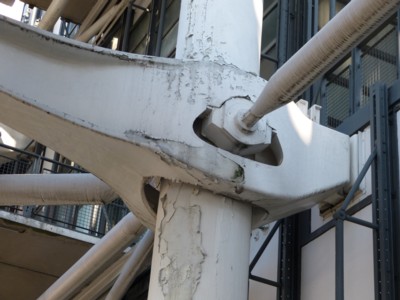
I have noticed that more recent examples in London of this now very common style have started out looking pretty good, but have then started to look … not so good. The trouble with decorative steel work is that it is very hard and very expensive to keep clean and smart, what with it being so very much more complicated than a mere flat surface, and so much harder to get at. And sure enough, there are Pompidou Centre details – details in full view of us visitors – which now look decidedly grubby, or worse.
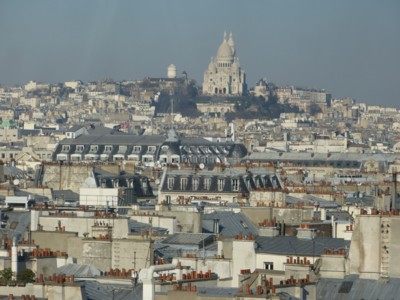
The big outdoor staircase which is such a feature of the Pompidou Centre is a wonderful place to look out across (approximately speaking) the centre of Paris. The view of Montmartre and the Sacre Coeur is, in particular, spectacular.
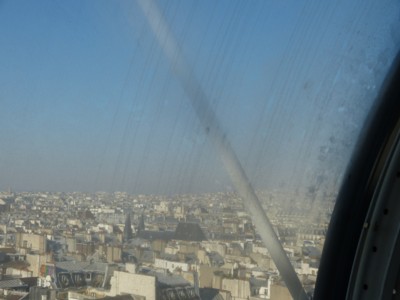
And thank goodness for the glass, because without it the cold would have been unbearable. But, the glass is rather dirty, and a photographer like me, in among whooping with delight at the views, needs to pick his spot carefully.
And it gets worse. I was actually quite shocked to see things like this:
You expect this kind of run-downness in a now-aging provincial railway station, built in the eighties, given its last face-lift in 2000, and now in need of another. But in a prestige project in the middle of Paris, devoted to “culture” (which the French take very seriously indeed), named after a President? How did they let that happen? Answer: it’s very difficult and expensive to stop it.
I just read the above to Antoine, and he said: It’s the classic problem with a prestige project. There’s a huge photo op when it opens, but no photo op for just slapping on some new paint. Indeed. But, photography by just anyone (by which I mean the likes of me) rather changes that, doesn’t?
Inside the Pompidou Centre there was Art, which we also looked at. I hope to blog about this later, but promise nothing.
An interesting take on vigilante films, such as Death Wish and for that matter, Dirty Harry:
“But film critics are such inveterate moralists, directing their principled scorn on every deviation from strict correctness and crossing with the light, right? Not in any world we’ve seen. Something in the vigilante film seems to foment a strident exception to typically (and reasonably) agnostic views toward violence in the review community. There’s a limitless history of criminal anti-heroes, and their violence never seems to invoke much explicitly “moral” response. Pauline Kael hated Dirty Harry and loved Bonnie and Clyde. To brand (frequently murderous) “youth on the run” films as objectionable would only earn rapid branding as a hopeless scold, while ex cathedra warnings against the evils of vigilante cinema seem almost a critic’s sworn duty. How to explain this double standard? It’s, well, simply a strain to explain this without looking to the political connotations of the works in question.”
A problem that I, as a classical liberal, have with vigilante films is how sometimes the issue of due process of law tends to get mocked a lot. There is a line from Dirty Harry where our Clint, in his legendary way, takes the piss out of the “Miranda” rule about searches and so on. Various Amendments are shown to be jokes. And let’s remind ourselves that when you watch a film starring Charles Bronson or Clint Eastwood shooting down a bad guy, you, the viewer, know that the bad guy is a bad guy and naturally cheer the flinty-eyed man with his .44 revolver. But in real life, the guilt of that odd-looking person is not so obvious. Hence why we have things like laws, Habeas Corpus, juries, search warrants, and all the rest, and why the likes of us get angry when these things are violated, or mocked by the likes of Tony Blair as signs of “19th Century values”. Indeed, take the case of investigative journalist Radley Balko in the US, who has made a career of showing how the War on Drugs and other campaigns have, when combined with the militarisation of the US police, created a series of disasters.
I can therefore feel the moral force of a film which shows a person taking the law into their own hands when I know, for the brief lifetime of a movie, that the person who gets the bullet is guilty. These are often powerful films about morality, and the better ones also highlight some of the ethical dilemmas well, as the better Eastwood ones often do, for instance; even the old Bruce Lee martial arts films play to that sense of rectifying injustice. All great, in my view. But the problem, of course, is that life is not like a film where guilt is always known. It’s a lot messier, and that is why vigilantism is not generally consistent with a civil, pro-freedom order. This is why, even under stateless societies, some form of order has to exist and someone has to say that “this is how we establish guilt and punish the guilty”.
To make it absolutely clear in case anyone brings this up, vigilantism in my view is not the same at all as the freedom to use potentially deadly force if necessary in self defence. I am talking about people who, having seen or suffered a crime, decide at a later date, on their own initiative and without any process of law, to exact a form of punishment, deadly or otherwise.
“How fashionable to wear clothes that are distressed. The young on the Westside of Los Angeles dress themselves in jeans worn, sanded, and razored to resemble something a six-month castaway might crawl ashore in. Why? They are trying to purchase a charade of victimisation, as the ethos of the Liberal West holds that these victims are the only ones of worth. but how to go about it? For the jeans can cost over one thousand dollars (one might buy them at Goodwill for two bucks, but, I am informed, they would be “seen through” and, though a closer approximation to true poverty, they are ineffective as a concomitant display of wealth.) It beats me hollow. Look at those Old Rich Guys in their Porsche, the young might say, but the Porsche is perhaps not an attempt to display wealth, neither to recapture youth, but to enjoy that which some years of labor have permitted as an indulgence.”
– David Mamet, The Secret Knowledge, page 63.
“And as to neoliberalism laid bare. Yes, the industrial revolution is the only way we humans have found of improving the living standards of the average guy in the street. I, as a liberal (even if neo) would like the living standards of the average guy to increase. Thus I support the industrial revolution. Yes, in all its mess and clamour: for it is making things better. I’m out and I’m proud. As a neoliberal I buy things made by poor people in poor countries. For that’s how poor people and poor countries get rich.”
– Tim Worstall.
I think I can formulate a new “Johnathan Pearce law”. Namely, the presence of the word “neoliberal” in a piece mocking markets and capitalism is almost always evidence that the author of said piece either does not understand what he or she is attacking, or is misrepresenting it, and also regards such ideas as being promoted by some sinister, all-powerful cabal, as suggested by that rather creepy use of the term “neo” in front of something else, such as “liberal”.
Talking to a business contact of mine earlier today, the subject of the Levenson enquiry concerning the alleged hacking of persons’ phones by journalists/others came up. One thing that was mentioned was that the corruption of certain police officers, and possibly other officials with access to important data, highlights the dangers of aggregating large amounts of important data into a few places, since the temptation to abuse this for financial gain – by selling some of the juicy stuff to journalists – will be hard to resist. And that surely is another argument against centralised ID systems of the sort that groups such as No2ID have campaigned against.
Call me optimistic, but at least I hope I can say that for the moment, the case for compulsory ID cards is off the table in the UK. That does not, of course, mean that the Database State is not advancing, quite the reverse. But at least some of the more brazen examples of this are not advancing, and the public are getting a very good education in the dangers of data aggregation and the abuse of data by those who are entrusted to defend the public.
I am in Paris, staying with occasional Samizdatista Antoine Clarke.
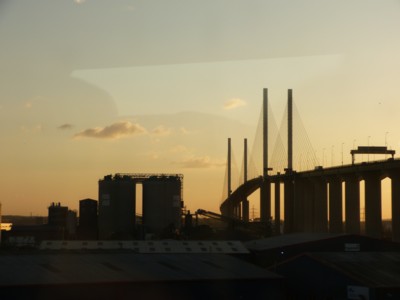
Photoed out of the Eurostar on the way, the M25 bridge over the Thames:
When I got there and after I’d settled in, we went out for supper and then went walking for a while.
Arc de Triomphe:
Old internal customs duties office, which ceased functioning in 1943:
Antoine on Twitter this morning:
Ice cold in Paris … And those nice straight boulevards make wonderful wind tunnels.
Michael Jennings on Twitter:
Brian is having a good time then?
Antoine:
Likes this.
Bastard.
We were going to go out walking today, but instead will be indoors, either at Antoine’s home or in some museum.
|
Who Are We? The Samizdata people are a bunch of sinister and heavily armed globalist illuminati who seek to infect the entire world with the values of personal liberty and several property. Amongst our many crimes is a sense of humour and the intermittent use of British spelling.
We are also a varied group made up of social individualists, classical liberals, whigs, libertarians, extropians, futurists, ‘Porcupines’, Karl Popper fetishists, recovering neo-conservatives, crazed Ayn Rand worshipers, over-caffeinated Virginia Postrel devotees, witty Frédéric Bastiat wannabes, cypherpunks, minarchists, kritarchists and wild-eyed anarcho-capitalists from Britain, North America, Australia and Europe.
|









Recent Comments