We are developing the social individualist meta-context for the future. From the very serious to the extremely frivolous... lets see what is on the mind of the Samizdata people.
Samizdata, derived from Samizdat /n. - a system of clandestine publication of banned literature in the USSR [Russ.,= self-publishing house]
|
A British muslim in the Royal Air Force has been successfully prosecuted for going AWOL after claiming he did not want to help kill fellow muslims in Iraq.
It seems to me that an excellent reason for refusing to join a nation’s military is the simple desire to not shoot at, or facilitate shooting at, people that you might not feel should not be shot at. If you have a goodly distrust for the wisdom of the state to begin with, taking the view that you are not going to kill someone just because the government wants you to is a very reasonable default position to adopt.
Now of course all states and their militaries are not the same. If you voluntarily contract to do the bidding of the government of Sweden or the Vatican or Switzerland or Costa Rica or Swaziland or Belize or Luxembourg… nations who are certainly not ‘military extroverts’… then the range of things you could reasonably expect to be asked to do will generally not include going to far off places you had never previously heard of and dropping bombs on the locals.
However…
If you do elect to join a military in circumstances other than fighting off the clear and present danger of an invasion, it seems to me that you are offering to allow the state make the decision for you of when it is appropriate to shoot and at which particular people. Moreover, if you join a military of some place like Britain, France or the USA, i.e. states who frequently sent their soldiers off to kill folks in far off lands for all manner of reasons other than the direct self-defence of the homeland, then it seems a bit rich to take the state’s pay checks for several years but then act surprised if you get asked to, well, help kill folks in far off lands.
Read the damn job description before you take the shilling.
It seems as though I have not really paid much attention to domestic issues in quite some time. Perhaps its because the domestic front has been locked into near-total stasis, with little movement, much less progress, of any kind.
The political scene has resolved itself into the party of 80% hostility to a libertarian agenda (the Republicans), the party of 95% hostility to a libertarian agenda (the Democrats), an irrelevant fringe, and a legacy media complex to whom anything other than the cult of the the state is simply incomprehensible. Frankly, I do not see any significant changes in the relationship between the state and the citizenry in the offing, just a long expansion of the state sphere until something catastrophic/revolutionary occurs. What that might be and when it might happen, I have no idea.
On the domestic political front, I am left rooting for the slightly less bad option, which is not exactly energizing.
All the action and energy seems to be around foreign affairs, and specifically how we stop the Islamic world from oozing its toxic Wahhabist/fascist effluent into our societies. I find the current debate in the US on this issue to be less than enlightening. The Bush campaign has done a terrible job of explaining why they are doing what they are doing, and the Kerry camp is too busy straddling and flopping to make any contribution at all. Suffice it to say that I remain convinced we will not see the end of this without nuclear weapons being used.
For those of you interested in business oriented blogging, I have written an article called Business Hippos and Blogging Birds over at the Big Blog Company. I have always seen business blogs as the best manifestation of the whole Cluetrain vibe.
That essential source for civil liberties issues, vigilant.tv is showing signs of life again after a long absence from the blogosphere. That can only be a good thing.
Where do political ideas end and terrorist acts begin? Is every destructive behaviour in the name of any political ideology just dandy, fine and justified, or are some societies distinguishable from others precisely because they employ civilised means of political expression and government (voting, debate, free speech) as opposed to ruling and arguing by violent threat and patently, deliberately, terrorising violence?
Call me a pro-life extremist but in my view, organisations cease to be mere political debating circles as soon as they reject real opportunities for reasonable discussion in favour of blowing people’s heads off.
The United Nations does not agree. Peter Hansen, the UN relief agency chief in Gaza, says:
Hamas as a political organisation does not mean that every member is a militant and we do not do political vetting and exclude people from one persuasion as against another.
Israel begs to differ:
Israel’s ambassador to the UN criticised Mr Hansen’s comments. “The very idea that individuals with clear links to the Hamas terrorist network may be on the Unwra payroll is totally unacceptable and should be properly investigated,” Dan Gillerman said.
→ Continue reading: Beneath politics
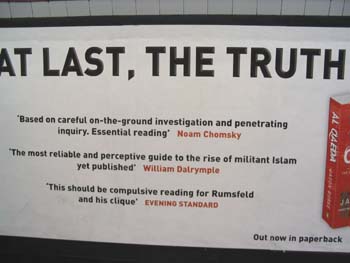
The other day, I snapped the following photo, in the London Underground. I tried as hard as I could to get the entire thing in my picture. Had I stepped back any further I would have been (a) electrocuted and then shortly after that (b) run over by a train.
I have not read this book, which is by Jason Burke. But: Naom Chomsky? “Rumsfeld and his clique”? Something tells me that whatever the nuances of the truth here revealed, America will get the blame for it all and Islam hardly any.
William Dalrymple should not be confused with Theodore Dalrymple. Read what Theodore has to say about William (no relation), in this article, this sentence being the one that seems to me to matter most:
… Dalrymple comes perilously close to condoning what he is trying to explain…
I did an earlier posting about William Dalrymple, and the comments there are also well worth looking at to learn more about the man and his views.
Politicians do love their Olympic Games. They make them feel so important. There are people to be expelled from their home, blameless businesses to be relocated into bankruptcy, photogenic new sports stadia and shiny new transport links to be constructed, opening ceremonies and firework displays to be arranged, all at vast public expense, and involving vast opportunities for grandiose displays of political self-importance, to say nothing of more private sorts of gain.
Nevertheless, the following story about the mutual impact of the Olympics and politics takes this natural affinity to a whole new depth of creepiness. I am rather surprised that David Carr has not beat me to noticing it. I guess (see immediately below) he has other worries on his mind:
London’s mayor, Ken Livingstone, today called for his term in office to be extended if the capital succeeds in its Olympic bid.
Mr Livingstone was speaking after an intense hour-long grilling by Conservative London delegates at the Tory party conference in Bournemouth.
Speaking of his hopes for a successful Olympic bid following forceful lobbying by a team spearheaded by the Olympic gold medallist and ex-Tory MP Sebastian Coe, Mr Livingstone said that if London won, the mayoral term would need to be extended by a year to ensure that preparations for the games were not disrupted.
I know that it is not received opinion here to be any sort of admirer of democracy, but I actually do rather admire it, basically because it is so vastly preferable to civil war as a method of swabbing out one bucketload of politicians who have become frightful beyond all redemption, and squirting in another lot who are not yet quite so terminally disgusting. And I believe that it has other benefits, many of them quite subtle, and unexpectedly non-collectivist, despite the fact that at the heart of democracy lies the brutal and morally repulsive idea of majorities – more precisely their elected representatives – being able to do whatever they please.
See for instance this New York Times article, which argues that democracy, far from depending on economic development, is actually the way to get economic development. For reasons I hope Real Soon Now to be writing about here, I am greatly attracted by this hypothesis, despite the fact that, in terms of the stark principles involved, democracy is just the latest of many negations of the idea of individual liberty.
But if democratic politics is to work, even by its own crude standards, one of the most basic rules is that the rule for when the next election is to be held must be stuck to. Postponing an election, for whatever reason, is a step down a very slippery slope indeed, at the bottom of which lies naked tyranny.
Has any elected politician in modern Britain ever made a suggestion like this before? Except during a major war? If any has, I missed it.
I bet that if I mention the term coup d’etat it conjures up images of heavily-armed soldiers on the streets, tanks on airport runways and besieged radio stations.
In truth, though, that is precisely the means by which such things are usually conducted. But they happen in faraway, third-world countries. It is the kind of thing we have come to associate with Oxford-educated ‘Generals’ who manage to wrest power from their tribal rivals in some African shanty-nation or with bandoliered, mustachioed Bolivians firing their carbines into the air and shouting “Viva El Nuevo Presidente” while the still-warm body of the old ‘Presidente’ swings from a nearby lamppost.
But this is not the kind of thing that happens in developed countries like Britain. No, this is a stable country with a proper economy and elections and democratic governments and political parties and judicial independence and free speech and the such.
I suppose it is, in part at least, because complacency caused by all those institutions appearing to be extant that we are about to taken over in a quiet, stealthy and bloodless coup d’etat all of our own. → Continue reading: A very British coup
Money can not buy friends, but you get a better class of enemy.
– Spike Milligan
Some may find the following comments to be unserious, in poor taste and reflecting the laddish tendencies of some Samizdata contributors. If you do reach such a conclusion, you will of course be dead right.
The great Tory MP, Spectator editor, game show contestant and budding novelist (does this man have no limitations?) Boris Johnson, has contributed greatly to the gaiety of national life through such jolly japes as hiring sacked BBC journalists like Andrew Gilligan or driving cars on Top Gear.
But surely among his greatest achievements was the identification of what in retrospect was obvious to all but which struck like a thunderclap at the time. In the mid 1990s, when “New Labour” was on the rise, our Boris, then a humble scribe for the Daily Telegraph, created what he called the Tottymeter. The Tottymeter aims to reflect the representation of attractive young women – preferably unnattached – in a political party. Blondes, redheads, brunettes – it does not matter. If your political party has a fair showing of the Fair Sex, then chances are that your party is headed for power rather than for Skid Row. Women, so he argued, are attracted to successful men. (Success rather than looks, given that the average political male is not exactly Sean Connery).
Serious types will sneer, saying I am showing a sexist attitude, suggesting that women do not have a serious reason for joining a party. But I think when looking at success in a field like politics, you can tell a lot from the sort of folk who are joining a party as well as those who are leaving it.
I found Boris Johnson’s thesis convincing. In the mid-1990s when I attended a Labour conference in the course of my job, I was struck by the relatively high number of pretty, and very ambitious young women. (Mind you, when the average young NuLab type opens their mouths, my interest disappears, even if they look like Gwyneth Paltrow).
I think one key contribution of bloggers to modern political reporting should be trying to record this phenomenon and indeed analyse it.
It is a sad reality that racism and xenophobia have not yet been totally eradicated from our planet. To that end, Ofcom – the regulator for the UK communications industries, which claims that it “exists to further the interests of citizen-consumers as the communications industries enter the digital age” – has admonished a sports commentator for daring to suggest that a non-native English speaker might not speak English perfectly. According to a nameless Ofcom spokesperson:
We believe the experienced presenter should have been more alert to the implications of his comment.
The implications being that some ridiculous government super-regulator will inevitably smear you with the intimation that you are a racist, and your employer will be forced to impress upon you the importance of “the careful use of language”. And gosh, isn’t our country and our planet all the better for this speech monitoring service our government provides at our expense?
On this day when the prize for private space flight was finally won I tuned in to the Conservative Party Conference – the Conservative Party is (at least since the Liberal party was taken over by radicals like Harcourt in the 1890’s) the closest thing we have to a party of private property and free enterprise in Britain.
Dr Fox (the Chairman of the Conservative Party) made the first speech. “We must reclaim the colours of the national flag from the extremists [I believe that Dr Fox meant the BNP], we must reclaim the Red, White and Blue” said Dr Fox whilst pointing to the great board behind him.
Unlike some people, I rather like this patriotic stuff (indeed I type this in sight of my own little Union flag). However the great board to which Dr Fox pointed was not Red, White and Blue – it was a blue board with black writing on it.
Now I have nothing against blue and black, they are the colours of the Estonian flag (a nation I much admire) and, in heraldry, blue and black are the colours of loyality and constancy (steadfastness) – things that the Conservative party lost in 1989 and is now (I hope) trying to get back to.
However, to the television viewers, Dr Fox and the people who cheered him in the conference hall seemed to be either colour blind or insane. I can only assume that what was seen by the people in the conference hall was different from what was seen by the people at home.
Perhaps the great board was a screen and at a key moment the Union flag appeared on it, and the television cameras did not capture the key moment… a plot by the BBC?. But it was all very odd.
|
Who Are We? The Samizdata people are a bunch of sinister and heavily armed globalist illuminati who seek to infect the entire world with the values of personal liberty and several property. Amongst our many crimes is a sense of humour and the intermittent use of British spelling.
We are also a varied group made up of social individualists, classical liberals, whigs, libertarians, extropians, futurists, ‘Porcupines’, Karl Popper fetishists, recovering neo-conservatives, crazed Ayn Rand worshipers, over-caffeinated Virginia Postrel devotees, witty Frédéric Bastiat wannabes, cypherpunks, minarchists, kritarchists and wild-eyed anarcho-capitalists from Britain, North America, Australia and Europe.
|






Recent Comments