We are developing the social individualist meta-context for the future. From the very serious to the extremely frivolous... lets see what is on the mind of the Samizdata people.
Samizdata, derived from Samizdat /n. - a system of clandestine publication of banned literature in the USSR [Russ.,= self-publishing house]
|
Take a look at this short video featuring Bill Browder, founder of the investment firm Hermitage, who several years ago was suddenly denied entry into the former Soviet Union for the “crime” of asking awkward questions about various Russian firms he had invested in. As I say, this sudden refusal of entry came to light a few years ago, but for some reason the video got made recently, and has stirred up fresh controversy about Mr Browder, and his treatment. I hope he has got decent security and takes care of himself.
To be honest, whenever I have an off-the-record chat with any private banker strategist, hedge fund manager etc., they tell me the same thing: avoid Russia if you do not want the risk of having your wallet lifted, or worse. It is that bad now.
But then I consider how the bond-holders in the US auto industry got the shaft during the recent bailout of said as orchestrated by Mr Obama and his pro-union political allies. The abuse of property rights knows no national boundaries.
Okay, be honest now… this time last week, how many of you had heard of Georgian blogger Cyxymu? Hello? Anyone? No, I suspected as much. Me neither.
So… imagine you are some Russian nationalist jackanapes hoping to silence a critic of Russian foreign policy and you get a bright idea:
“Hey Boris! Lets unleash the bots of war and do a massive world wide takedown of Twitter, facebook and Livejournal so that no one will read those nasty things mean old Cyxymu is saying about Mother Russia!”
Pure genius. Now, does anyone who reads the tech press (or indeed the mainstream media) not now know who Cyxymu is?
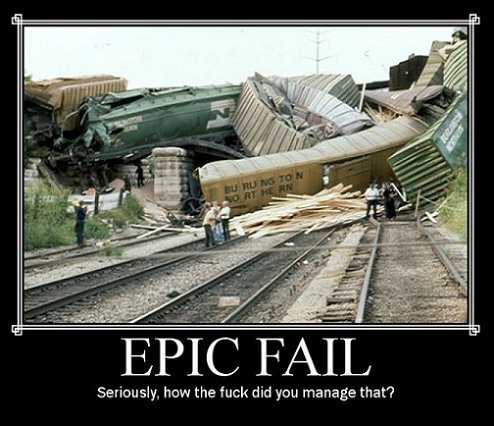
Although Russia abounds with fascistic nationalists who could have done this off their own initiative, in truth an epic fail of this magnitude anywhere in the world generally implies government involvement.
Russia continues its steely eyed march into hilarious self-parody and irrelevance (unless you happen to be a tiny powerless neighbour)…
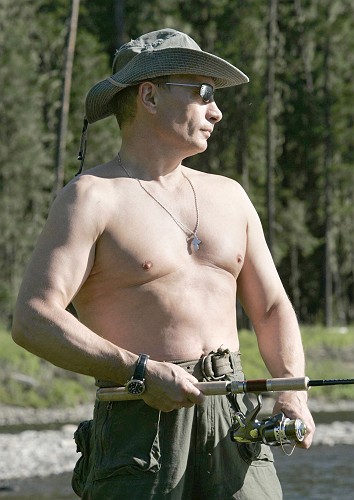
… get yer pecs out Obama, your soul mates want to play.
Nicolas Bourbaki presents a very interesting insider’s view of the how things are developing in Russia. Several of the article’s links require registration at the linked site.
The summer of 2007 was a busy year for the Russian oil and gas business. In April of that year, the state-run energy company Gazprom finally exerted enough pressure on the Sakhalin II consortium to wrest control of the giant project in Russia’s Far East from Shell, who had hitherto been the majority owner and manager of the development. In return for a cash payment of $7.45bn, at the time seen as a knock-down price, Gazprom acquired a 50% plus one share stake in the project. The deal was struck after months of the Russian environmental regulator exerting pressure on the consortium, Sakhalin Energy, resulting in works being delayed, stopped, and threats being made to withdraw the license to continue the development altogether. Despite there being genuine concerns regarding environmental damage incurred by the development, not to mention the doubling of project costs to $22bn, few believed that the governmental pressure exerted on Sakhalin Energy was anything other than a naked attempt by the Russian government to gain control over the project, its resources, and its revenues by force. Sure enough, within weeks of Gazprom taking the keys to Sakhalin II, the environmental regulator cheerily announced that all concerns had been resolved to its satisfaction and not a peep has been heard from them since. The outcome at Sakhalin II was presented by the Russian government, and accepted by many Russians, as a significant victory of the resurgent Russian state in reversing their exploitation at the hands of foreign powers when they were weak, and regaining control over Russia’s strategic resources, its wealth, and its independence.
Buoyed with confidence from their coup on Sakhalin, the month of June saw the Kremlin use alleged breaches of license obligations to ‘persuade’ BP to sell its 62.85% stake in Siberia’s Kovykta development to Gazprom for $900m in cash, a figure many people thought better than what was feared, i.e. nothing. Two months later, in August 2007, the Russian government moved to deny the Exxon-led Sakhalin I consortium the right to export gas from its development in an attempt to force the sale of the gas to Gazprom at artificially low domestic prices, after which Gazprom would be free to export it via pipeline or LNG carrier at international prices.
Now that Russia’s foreign-run developments were back under government control or suitably compliant, the government ensured that all future developments would remain similarly tied to the Kremlin with limited foreign influence. In April 2008, the Russian parliament approved a new law which effectively handed monopoly rights for all future developments of the Russian continental shelf to just two companies: Gazprom and state-owned Rosneft. By now, the bulk of Russia’s enormous hydrocarbon wealth both present and future was firmly in government hands, a situation which was looked on with gleeful satisfaction by Russians and allowed them to wield considerable influence beyond their borders. Soon followed grand plans for Gazprom to build a pipeline across the Sahara desert, buy all of Libya’s gas, and build LNG plants in Nigeria. Energy nationalism at home and the loudly announced forays abroad as personified by Vladimir Putin helped ensure the Russian population returned approval ratings of over 80% for their then president, now prime minister. Russia had picked itself up off its knees, Russia was strong once more, Russia could once again command respect from others. Russia was back. → Continue reading: Russia’s descent into reality
The EU is bleating as people go cold due to Russian gas being shut off due to its disputes with the Ukraine. And the ever dependable Russian polity, moonbats to a man, blame the USA for the crisis.
The pragmatic Slovak government has made the very sensible decision to possibly restart Soviet era nuclear power plants that they were decommissioning as part of their accession to the EU, if the crisis drags on… and in doing so, they show the simple and ‘carbon footprint’ friendly (as if I care) solution to this and oh so many problems… nuclear power. How can a solution that dooms both the Kremlin and Middle East to long term strategic insignificance not be a Truly Many Splendored Thing?
Just when you start believing Russia has returned to its old ways, something like this happens. A religious group attempted to get the license of a TV station pulled because it felt a South Park cartoon was hateful to Christians and Muslims. In return Russians rallied behind South Park, demonstrated, collected signatures on petitions… and… won????
The people’s voice, apparently, was heard. On September 25, Russia’s Federal Competitive Bidding Commission on Broadcasting voted unanimously to recommend that 2×2’s license be renewed. The final decision is up to another federal agency, but it is expected to follow the recommendation. 2×2, in turn, will comply with the commission’s request to expand its programming to include TV movies and non-animated series, as stated in its official description; the channel’s general director Roman Sarkisov has promised that the new fare will be “faithful to the style of 2×2.” Meanwhile, South Park stays on the air except for the “offending” episode, which has been shelved pending further investigation of “extremism.”
I think this shows the danger of oversimplifying your view of a large nation with a complex political history. Russia is what it is and does not fit neatly into any of the categories we have heretofore used to describe it. Russia is no longer a simple ‘evil empire’. Today it is simultaneously many things, some of which are opposites. It is a place where organized crime has great power; where ex-KGB officers long for the old days; where very smart and well educated people create new ideas and companies; where old imperialist ideas and suspicion of foreign influence exist and the Orthodox church has regained much power over society. It is such a hodge-podge of pulls and counter-pulls that virtually anything I can say about it will be wrong.
This of course makes it a fascinating place to watch.
One of the blogosphere’s brightest lights, Michael Totten, once again finds himself up the sharp end and brings some interesting reportage from Georgia. If you are interested in the real chronology of events and understanding why Russia, not Georgia, is the prime mover of this regional tragedy, check out his article.
A few days ago, the venerable Glenn Reynolds linked to an article published in the Asia Times titled Americans Play Monopoly, Russians Chess. The article, written by pseudonymous columnist Spengler, is something of an interesting read, as it offers up a comprehensively explained and intriguing motive for the former superpower’s recent machinations in Georgia.
Many Western commentators ascribe the recent Russian belligerence to a newly acquired military ability able to act upon the yearning of its current leadership which is trying to recapture the glory days of Soviet power. A good dollop of credible force applied carefully should make Russia’s tiny neighbours wake up to the fact that they are kissing the wrong butt. Spengler contends that the truth is rather less vainglorious; Russia’s recent adventures represent moves in a long-term game in which the country’s very survival is at stake.
After all, it is – as any moderately informed individual knows – facing what present-day figures predict to be a near total demographic collapse in the coming years. Russia is, says Spengler, exercising a grand strategy to eventually absorb the Russians and other ethnic populations living in the nations in its so-called “near abroad”, declaring them all Russian and thus halting the country’s disastrous population decline. This will also ensure the minority status of the Muslim population in Russia (the only ones who are breeding) and, lo and behold, win the survival of the nation in the eyes of those pulling the levers in the Kremlin. It is an insightful alternative analysis of what is driving the crisis in Georgia – not groundbreakingly so, as I am certain a number of Samizdata contributors and commenters could have provided us with much the same explanation – but nevertheless well worth consideration. → Continue reading: An amoral solution to Russia’s existential crisis
The sheer number of articles suggesting that we are seeing a return to the day of the ‘Cold War’ are such that frankly I cannot even be bothered to link to one. Certainly the Russian Bear has been more overtly unfriendly as of late, and I do think Russia needs to be taken seriously in the way any collection of armed thugs need to be taken seriously.
However it is absurd to contend that Russia as a long term threat in the way the Soviet Union threatened the world for more than fifty years. Hapless Russia has a near mono-culture economy (GDP the size of Italy, for gawd’s sake) and catastrophic demographics that make Europe seem like a stud-farm (Germany, Poland and Austria more or less total the same population as Russia’s ‘hordes’). The appropriate personification for Russia circa 2008 is not an oil fuelled Genghis Khan, threatening to surge once more across Eurasia… no, it is more like a drunk with a knife unable to admit they have terminal liver disease… a vodka fuelled Genghis Khan’t if you will.
Surely a policy of political containment is really all that is needed while nature, rust and liver sclerosis on a Biblical scale do the rest. Probably the most damaging thing we could do to hasten the deflation of the absurd delusions of the thuggish Russian political class would be to make it easier for young Russians, and Russian money, to get the hell out of Russia and move west.
Yesterday in the British Press, much was made of the Soviet, sorry, Russian threat to nuke Poland if it hosted American, sorry, NATO defensive missile systems.
THREAT TO NUKE POLAND… well, really? What the Ruskies are saying is not “if you allow these systems on your soil, we will nuke you”, but rather “in the event of a war between NATO and Russia, we will attack military targets in Poland, which is a NATO member”.
Well no shit? This is hardly a revelation. Yet to read many of the article headlines you would think it was a clear and present danger, which it clearly ain’t. Move along, not much to see here.
That said, clearly what the Russian general said is a crude attempt to intimidate Poland, albeit politically and not actually by making a threat of imminent action. Also predictably it has stiffened already deep hostility to Russia across Central Europe. Good, it is probably exactly what Europe needed.
This press briefing by Secretary Gates is the best summary of the situation I have run across thus far:
There is a certain level of bluntness in his delivery that I quite enjoyed.
Earlier this afternoon Perry and I had a lengthy editorial telephone discussion on the subject of Georgia. While we agreed broadly there was one area in which we had intense debate until I finally figured out how we were talking past each other.
The question is, how the hell did US intelligence assets miss the Russian Black Sea fleet movements? How did they miss the massive transport job of the troops and their logistical tail? They did not just materialize in position. It takes time and planning to make such moves. I will leave the detail of that to Perry as he seems to have been thinking about it in great detail.
My take is there is a limited amount of time available on the black satellites. The manpower and resources have been re-targeted on the Middle East. Orbits have been shifted to give maximal coverage in those areas of interest and experienced personnel have moved to ‘where the action is’.
This is not to say Russia is being ignored. It is however a very big place and I am going to guess that the time between scanning particular areas has greatly lengthened. Russian troop movements are mainly rail based and with enough eyeballs and Cold War era periodic coverage one might hope to pick up changes in traffic patterns and notice “something is going on”. But… this requires a certain periodicity in coverage. Changes in static positions like silos and strategic air bases are much easier to pick up even with occasional coverage. Dynamic changes, such as train and road movements are a different story. You have to have a satellite taking pictures at just the right time or often enough to pick up a signal just by chance.
This is what took Perry and I awhile to meet minds on: I have been thinking of this issue as a communications/information theory problem. How often do you have to sample an area to notice a change in the density of train traffic? I would posit it would have to be several times a week at the very least if the spike in traffic was huge and extended; if the spike were smaller and flatter you would need to sample daily or multiple times daily. You would have to do it at night and through clouds as well if you were to get a statistical value high enough to ring alarm bells. It is an issue of sampling rate versus the highest detectable signal frequency, pure and simple.
I doubt they have even been scanning large areas of Russia more than a few times a week (I suspect much less often) except in areas of nuclear strategic interest. They could easily miss large troop movements in a part of Russia which is not of great national interest to the United States.
Let the discussion begin. There is a lot of meat on this bone!
|
Who Are We? The Samizdata people are a bunch of sinister and heavily armed globalist illuminati who seek to infect the entire world with the values of personal liberty and several property. Amongst our many crimes is a sense of humour and the intermittent use of British spelling.
We are also a varied group made up of social individualists, classical liberals, whigs, libertarians, extropians, futurists, ‘Porcupines’, Karl Popper fetishists, recovering neo-conservatives, crazed Ayn Rand worshipers, over-caffeinated Virginia Postrel devotees, witty Frédéric Bastiat wannabes, cypherpunks, minarchists, kritarchists and wild-eyed anarcho-capitalists from Britain, North America, Australia and Europe.
|





Recent Comments