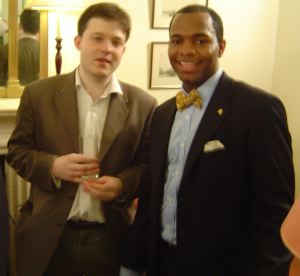
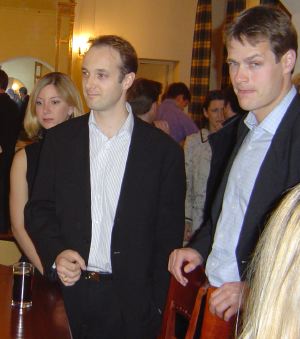
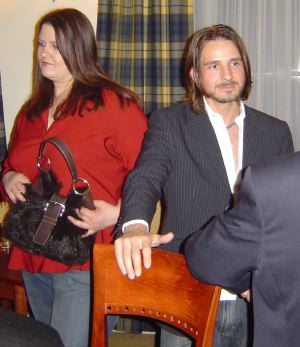
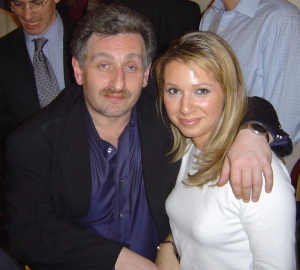
St. George’s Day Party at the New Cavendish Club, ergo more drinking and less blogging 




|
|||||
|
April 23rd, 2004 | 16 comments - (Comments are closed)
 Anyone who frequents our comment sections can hardly have failed to notice that several of our serial commenters are profoundly collectivist racists who like to call themselves ‘race realists’, whilst at the same time affecting implausible pretensions to be supporters of liberty. Fortunately this does not seem to fool anyone if the reactions of other commenters are anything to go by. A person may hold whatever prejudices they wish but when they make it clear they value their notions of the good of some collective volk over the rights of individuals to pursue inter-racial relationships, and would use the state to give those notions the force of law, it should be clear that person has little conception of what ‘liberty’ means. Now as this blog is private property, we can delete comments and/or outright ban people for no better reason than the editorial pantheon simply feels like it. Although we do not use pre-publish comment moderation, just as a newspaper editor can publish (or not) whatever letters are in keeping with the mores of the publication in question, we too have that right post-publish and we do indeed occasionally exercise it when we delete unwelcome comments from spammers or blogroaches. However although we are within our rights to handle our comment section as we wish, we dislike excluding contrary views to those expressed in our articles unless we see a very good reason to do so. Whilst reader comments are an optional adjunct to blogging (many highly successful blogs do not have them at all), at Samizdata.net we do indeed appreciate the contribution commenters make and thus are loath to over-manage what they write, provided a reasonable degree of civility and topicality to the article are observed. However when collectivist racists start using Samizdata.net to consistently promote an agenda, and are condescending and misogynistic to boot, it is time to show them the door without insincere regrets. Now I realise that given the personalities involved, this will be seen as proof of the irrefutability of their positions regardless of the fact they have repeatedly had the sand kicked out of them intellectually on many occasions by some very insightful people. To put it bluntly, I am not unduly concerned and a certain Monty Python episode comes to mind. For me as editor the final straw was hearing that one of our contributors was loath to write on certain topics because of the near certainty that the discussion would be immediately hijacked with the same flawed but stridently put arguments that had been convincingly demolished time and time again in earlier comment threads. Although I always urge our contributing writers, the Samizdatistas, not to actually write with comments in mind but rather what is on their mind, this for me was intolerable and more or less mandated action on my part. Henceforth comments by the people in question will be summarily deleted from the blog. As you might surmise, I am not writing this article for the people who are being banned from commenting but rather for other readers whose opinions (and disagreements) I value more highly, and also for the Samizdata.net contributors as both an ex cathedra editorial policy statement and a not uninteresting discussion point on the nature of blogs such as Samizdata.net and internet discussion generally in its varied forms. April 21st, 2004 | 59 comments - (Comments are closed)
Many sound folks are already rubbing their hands with glee at the prospect of the long sought UK referendum on adopting the terrifying EU constitution. The general received wisdom is that the anti-Constitution faction will win and that will be the end of Tony Blair’s political career… and certainly if it was held today it is hard to see any outcome other that a crushing victory for the anti-EU side and political ruin for Teflon Tony given that the latest YouGov poll (pdf file) shows only 16% would vote for the UK adopting the EU constitution, 28% were unsure and a whooping 53% would vote against it. Rule Britannia indeed! But the promised referendum will not be today but rather at a tactical moment of Tony Blair’s choosing. People who see this ‘surrender’ to the idea of a referendum as a fortuitous laps of judgement of epic proportions would do well to ponder the effect that having notoriously Eurosceptic Britain go to the polls will have on the current negotiations with Britain more Federalist European ‘partners’ regarding the so called ‘red line’ issues of foreign policy, defence, social security and the British budget rebate. Knowing that only if Blair can return home with ostensible triumph on those issues will he be able to credibly spin the EU constitution as a ‘British victory’, the Federalists will be faced with either the complete overthrow of their plans (Denmark or Ireland might be either ignored or finessed, but a British rejection is a rather different matter) or they can settle for a more gradualist victory for their cherished superstate. Thus the prospects for Tony Blair arriving back and waving a piece of paper with Romano Prodi’s signature on it promising ‘Euro-peace in our time’ is by no means a fantastical scenario… and given the sheer ineptitude of the Tory party and the lemming-like Europhilia of the LibDems, it would be a brave man who predicts with confidence that this would not pull the Euro-sceptic’s political teeth. Yes, with a little luck it could, and hopefully will, all go horribly wrong for the UK government and we could see the dismal Conservative party back in the saddle in Westminster in the aftermath of a Euro-Political meltdown of not insignificant proportions. However the prospects of Blair indeed getting Britain to sign up to a first iteration of the EU constitution if the Federalists play ball is by no means beyond possibilities. And if that happens, it means it is only a matter of time before the other issues are gradually chipped away in the years to follow. At that point there will be nothing left to fight for and I for in will be in the market for some property in New Hampshire. Do not underestimate Tony Blair.  April 21st, 2004 | 21 comments - (Comments are closed)
In many ways I would not get so put out by the machinations of the French political class if they were just more upfront about what motivates them. If they just came out and said “we could not care less about the fact the Iraqi people are ruled by a mass murderous tyrant, we are just interested in protecting our economic sweetheart deals”, I would still think that was appalling, but at least one could hardly help but admire their brazen pursuit of self-interest at the expense of others. What is another 20 years of Ba’athism when a sweet below-market oil deal is at stake? No (Ba’athist) blood for (French) oil, please? But no, Dominique de Villepin and Jaques Chirac actually have the bare faced effrontery to claim the moral high ground when anyone with a passing knowledge of French economics and a ‘who’s who’ of French interests has been able to see what is really going on from day one. It is a measure of the web of corruption that lies over the French media and chattering classes that ‘The Big Lie’ is accepted so widely in France. Perhaps Colin Powell should have just responded to one of de Villepin ambushes in the UN during the lead up to the recent Gulf War by simply reading out a list of the names of the great and good in France and their interests in Iraq, without further comment. Not that the French political class are alone of course, not by any means… they are just the most cynically sanctimonious about it. April 19th, 2004 | 20 comments - (Comments are closed)
The Confederate crew of world’s first submarine (or more correctly ‘submersible’) use effectively used in combat, were buried with military honours yesterday in Charleston, South Carolina. Their boat, the CSS Hunley, was discovered in 1995 and raised in 2000 from where it sank in Charleston harbour in 1864. The Hunley went down shortly after having sunk a blockading US Navy armed sloop, the USS Housatonic. This is an interesting end to a fascinating chapter in military history 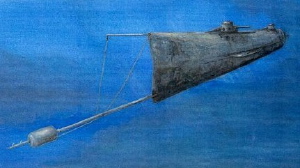 April 17th, 2004 | 4 comments - (Comments are closed)
Much as I respect the analytical abilities of the CIA, surely I am not the only one who thinks the audio tape of ‘Osama bin Laden’ offering the hand of peace to Europe, provided Europe withdraws its troops from Muslim lands, is completely bogus. Are we to believe that the head of that nasty global franchise called Al Qaeda cannot afford to purchase a cheap camcorder in a medina somewhere in Pakistan to reproduce the distressingly effective spectacle of Osama waving his finger at the USA and going “Nah nah, you can’t get me”? The notion he is hiding what he looks like after radical plastic surgery is, I suspect, the product of watching too many Hollywood movies. Sorry, but I do not buy it. If I was a betting man, I would wager that Osama bin Laden died in Afghanistan years ago either when that group of people was attacked by US aircraft and ‘an unusually tall man was with them’ (can anyone point me at a link to that story?) or he was buried in a collapsed tunnel after one of a number of heavy US air attacks. Only time will tell for sure but although Al Qaeda lives, I very much doubt Osama bin Laden does.  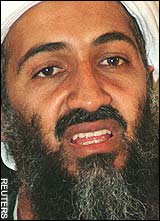
Both still dead April 16th, 2004 | 27 comments - (Comments are closed)
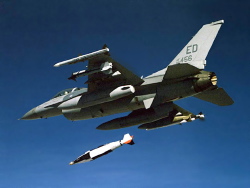
It is not often I quote Nikita Khrushchev in any context, but Al Qaeda is quite correct that western civilization poses a clear and present danger to their cherished notions of a universal social life centred on submission to God. An economically successful western civilisation underpinned by severalty and free intellectual enquiry is caustic to a civilisation based on the submission to non-rational ideas which are propagated by force. To put it bluntly, we will enervate them and eventually destroy them by gradual assimilation. The best and brightest muslims are already hard pressed to not see the glaring practical and intellectual flaws in their societies and want better for themselves, and as a result there is already a small but fairly well integrated middle class of secularized American and Euro-Muslims who can be observed in the markets, cinemas, offices, pubs and bars of the west. But far more dangerous to the broader Islamist project is the example not of western thought but of western affluence and the ease and secular self-direction it yields. The sheer material wealth of the more advanced west is almost guaranteed to subvert the broad masses who come in contact with it. The current difficulties in assimilating the lower parts of the socio-economic western muslim population should not blind us to the fact that western culture’s corrosive effects on the Islamic world view really counts far more when they are felt in Peshawar, Ankara and Cairo than in Marseilles, London and Chicago. In that theatre of the war of civilisations our truly effective weapons are not the gunship helicopters, laser guided bombs and 5.56mm small arms being used in Iraq right now, but rather our cheap DVD players, Internet connections, music/porn/action videos and smorgasbord of good, accessible but inexpensive Tex-Mex, Thai, Italian and Lebanese foods that globalisation has brought us, etc. etc. I have made this point before but as we concentrate on the more local and violent issues being resolved in the streets of Iraq, it does not hurt to put it all in the broader context within which our enemies certainly see things. It is the horror of this viral characteristic of western consumer culture which really lies at the heart of the antipathy of the Islamists to the west: as secular society and severalty is the true heart of our civilisation, by our very nature we cannot and will not just ‘leave them alone’. It is not a matter of what western governments want to do, because western businesses and cultural influences will go wherever there are receptive markets and audiences. It is not a western ‘conspiracy’ to subvert Islam, merely the very nature of western civilisation at work. Short of turning the entire Islamic world into a hermit empire like North Korea writ large, the mullahs and ayatollahs cannot avoid their flocks hearing our siren songs. 
Our weapons are varied and effective April 13th, 2004 | 34 comments - (Comments are closed)
I can only hope that the Americans keep their nerve and use the wide scale of the uprising to not just decapitate the more florid Islamist leadership but also place clear ‘markers’ as to what the response will be to armed uprisings during the de facto ‘protectorate’ phase of Iraq’s post-Ba’athist reconstruction. As things are developing day by day, it is pointless for me to just reiterate the reports filling the news media as to the current state of the cut and thrust on the ground, but there may indeed be an analogue with the Vietnam war here… and it ain’t a ‘quagmire’… the Tet offensive may have been a political disaster for the USA but it was a military triumph and more or less wiped out the Vietcong as a significant military and political force. If the US can do the same to not just Muqtada al Sadr’s Islamo-fascist militia but also to any the militias of any who make the mistake of supporting him, it will have profoundly useful effects long after the fighting fades into history and the US and UK forces have gone home. 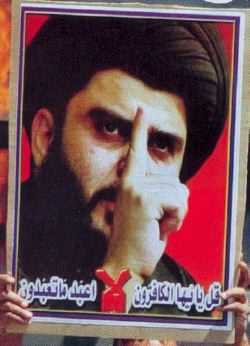 Translation: Follow my finger and shoot… here Although Ali Sistani is, in the overall scheme of things, someone that the occupying powers can probably do business with (though that remains to be seen), it can only be helpful to his education if Muqtada al Sadr, that heir to the ‘Mad Mahdi’, can be seen to come to a fairly public and messy end surrounded by as many of his supporters as possible. Notions of putting this man on trial are to say the least ‘unhelpful’. If a successful confederated Iraqi republic is going to come out of this without falling into a democratically sanctified ‘popular Islamic’ tyranny like that which so many in Iran are trying hard to throw off with their own efforts right now, it is going to take some serious stick, and not just carrot, to make things come out more or less the right way. That is, alas, the way the real world works and hopefully the US and UK have the fortitude to see it through to its conclusion without cutting and running prematurely. So far the signs are reasonably good as only the usual suspects are bleating for political defeat to be plucked from the jaws of eventual military victory. April 12th, 2004 | 75 comments - (Comments are closed)
Unpersons alerted us to the news that from today British police may legally and against the will of any law-abiding subject, take DNA samples and fingerprints from any arrested person without that person having even been charged with committing a criminal act. We can but echo the good Unpersons concerns:
This has not been a good week. April 7th, 2004 | One comment - (Comments are closed)
What seems to be developing into an open revolt in Iraq by Shi’a Islamists could be a Godsend to the coalition and secular elements of Iraqi society in the long run… in openly taking up arms against the coalition and its Iraqi supporters, radical leader Muqtadar al-Sadr has changed the equation: what could have been a long term intractable political problem has been turned onto a military problem with a fairly obvious and direct solution. April 5th, 2004 | 103 comments - (Comments are closed)
Blair is a liar. But of course the notion any politician does not utter more than the occasional porkie pie is a very uncontroversial one. But as I said in the wellspring of lies yesterday, one can but marvel at the bare faced effrontery of it when our political masters stand up and state something is true when any person not wilfully blind (or David Blunkett) can see it is patently untrue just by reading a few newspapers or one of several thousand blogs and websites.
Risks antagonising? Civil rights campaigners no longer object to the idea? Excuse the French, but, what the fuck? Blair is a bare faced liar. The only other alternative to that is that he is so ignorant of goings on outside the cloistered world of 10 Downing Street as to be completely deluded. I will try my damnedest to refuse to get an ID card and I will openly declare that I do not have one when the sun rises on that evil day. I urge as many people as possible to not just resist but to do so openly when the time comes. They will try to make it very difficult to live without one so we must make the system unworkable by using whatever civil disobedience and intelligent resistance is needed. Do not cooperate with your own repression. Time to get creative, people. Time to get angry.  Cross-posted from Samizdata.net April 2nd, 2004 | 5 comments - (Comments are closed)
Blair is a liar. But of course the notion any politician does not utter more than the occasional porkie pie is a very uncontroversial one. But as I said in the wellspring of lies yesterday, one can but marvel at the bare faced effrontery of it when our political masters stand up and state something is true when any person not wilfully blind (or David Blunkett) can see it is patently untrue just by reading a few newspapers or one of several thousand blogs and websites.
Risks antagonising? Civil rights campaigners no longer object to the idea? Excuse the French, but, what the fuck? Blair is a bare faced liar. The only other alternative to that is that he is so ignorant of goings on outside the cloistered world of 10 Downing Street as to be completely deluded. I will try my damnedest to refuse to get an ID card and I will openly declare that I do not have one when the sun rises on that evil day. I urge as many people as possible to not just resist but to do so openly when the time comes. They will try to make it very difficult to live without one so we must make the system unworkable by using whatever civil disobedience and intelligent resistance is needed. Do not cooperate with your own repression. Time to get creative, people. Time to get angry. Cross-posted to: April 2nd, 2004 | 51 comments - (Comments are closed)
|
   |
||||

All content on this website (including text, photographs, audio files, and any other original works), unless otherwise noted, is licensed under a Creative Commons License. |
|||||


Recent Comments