We are developing the social individualist meta-context for the future. From the very serious to the extremely frivolous... lets see what is on the mind of the Samizdata people.
Samizdata, derived from Samizdat /n. - a system of clandestine publication of banned literature in the USSR [Russ.,= self-publishing house]
|
Recently, I was wandering along a back street in the former Vietnamese Imperial capital of Huế, perhaps best known outside Vietnam as the site of one of the bloodier battles of the Vietnam War. This was a street full of the sort of shops that would once been have referred to as a “General Stores” in English: shops full of many goods that are likely to be useful to many people, but that sometimes seem to have a tenuous relation to one another.
In such a store, I stopped and started photographing a colourful display of western trademark violating motorcycle helmets. After I had been doing this for a short while, the shopkeeper came up to me, basically just to say hello. He didn’t mind me photographing his merchandise and was not putting any pressure on me to buy anything, but he clearly didn’t get Westerners wandering into his shop to take photographs every day. Huế is a tourist destination, but despite its easy accessibility (the Americans having built an airport) it is not nearly as big an attraction as places such as the nearby ancient town of Hoi An. One does not have to walk far from the centre of town for the presence of foreigners to be rare.
What happened next was more interesting. He gestured for his son to come over and pose for a photograph. The lad must have been only about two years old, but there was a serious amount of proud father syndrome on display. This gentleman wanted the whole world to see how proud a father he was. So they posed and I took a photo. Alas, the white balance isn’t perfect.
As an added bonus, the father decided that he would pose for the photograph with a cigarette in his mouth.
Of course, this gentleman had no idea how many western taboos he was breaking. If he had, I am sure he would have thought we were all idiots. Quite accurately.
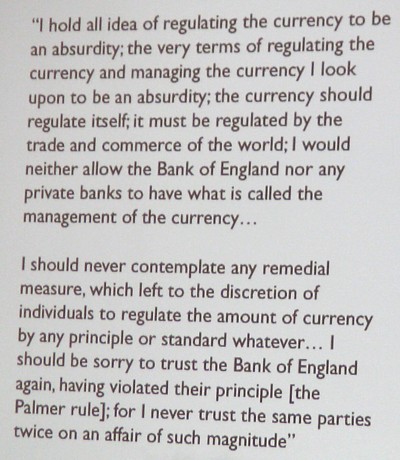
– Richard Cobden (1804-1865), quoted at the Cobden Centre website. Quoted again by Steven Baker MP at the end of his presentation this morning to the Libertarian Alliance, and featured in his final slide, of which the above is my somewhat wonky photo.
Great essay by Sean Gabb on the UK government and supposed plans to reduce public spending. The article contains a lovely line in relation to Peter Mandelson, the disgraced former Cabinet minister.
Along with Sean and others, I will be at the two-day Libertarian Alliance annual conference tomorrow, held at that ancestral seat of 19th Century liberal politics, the National Liberal Club.
[with apologies to the Four Yorkshiremen]
A fantasy writer produced this:
But there’s a dark side as well. We know about the real world of the era steampunk is riffing off. And the picture is not good. If the past is another country, you really wouldn’t want to emigrate there. Life was mostly unpleasant, brutish, and short; the legal status of women in the UK or US was lower than it is in Iran today: politics was by any modern standard horribly corrupt and dominated by authoritarian psychopaths and inbred hereditary aristocrats: it was a priest-ridden era that had barely climbed out of the age of witch-burning, and bigotry and discrimination were ever popular sports: for most of the population starvation was an ever-present threat. I could continue at length. It’s the world that bequeathed us the adjective “Dickensian”, that gave us a fully worked example of the evils of a libertarian minarchist state, and that provoked Marx to write his great consolatory fantasy epic, The Communist Manifesto. It’s the world that gave birth to the horrors of the Modern, and to the mass movements that built pyramids of skulls to mark the triumph of the will. It was a vile, oppressive, poverty-stricken and debased world and we should shed no tears for its passing (or the passing of that which came next).
Oh really? Try this from the Old Bailey’s website:
1760-1815
From approximately three-quarters of a million people in 1760, London continued a strong pattern of growth through the last four decades of the eighteenth century. In 1801, when the first reliable modern census was taken, greater London recorded 1,096,784 souls; rising to a little over 1.4 million inhabitants by 1815. No single decade in this period witnessed less than robust population growth.
In part this urban bloat resulted from a marked decline in infant mortality brought about by better hygiene and childrearing practices, and a changing disease pattern. By the 1840s children born in the capital were three times less likely to die in childhood than those born in the 1730s.

Bangkok, Thailand. October 2010
Here:
In a fascinating 36 minute interview, Cobden Centre Radio’s very own Brian Micklethwait speaks to James Tyler, the Chief Executive of Tyler Capital and a member of our Cobden Centre advisory board.
I’ll surely have more to say about this, but busy day today. So suffice it to say, for now, click on this to listen to the mp3, or follow the top link to find it as a podcast.
My main general impression of James Tyler was what a good and thoughtful person he is, very much his own man in how he thinks about things and goes about things, yet in no way scornful of or unsympathetic towards others who take the road more travelled. If the propaganda fence to be got over is that Austrian economics, once you’ve been told about it by your resident lefty, is an excuse for billionaires to piss on everyone, then a man like Tyler is just the sort to get you thinking that it’s a whole lot better and more intelligent than that.
His central point was that nobody should have the kind of power over economic life that our current powers that be (“crony capitalism”) do now have.
Chris Dillow, over at his Stumbling and Mumbling blog, writes this:
“A few days ago, the great Paul Sagar noted an asymmetry in the Tory attitude to “fairness” – that whereas they are keen to point to the “undeserving poor”, they are silent about the undeserving rich. I was reminded of this by listening to Nick Clegg on Desert Island Discs.This provoked the question: why do the undeserving rich not recognise their undeservingness?”
The reason why they do not “recognise their undeservingness” is that they are not asking that the state, with its violence-backed power to tax, should give them something, only that they should be left alone to enjoy their wealth, whether it be undeserved or not. On the other hand, if we are going to have a state with these powers to make transfer payments, then it follows that people are more likely to support such coercive transfers if they are made to people who are considered, by some measure, to “deserve” these transfers. Seems a fairly simple argument to me.
More broadly, though, the idea of “deserving” poor or “underserving” rich is, in my view, loaded with ideological significance, depending on who is using the term. Clearly, people feel a lot more relaxed about handing out money – either from a charity or from a government department – to people who are down on their luck but of good character, than they are about handing it out to the feckless. Similarly, it follows that there is more support for taxing supposedly “undeserved” wealth than “earned” wealth. The trouble with such words, of course, as has been shown by FA Hayek in his famous demolition of payment-by-merit in The Constitution of Liberty, is who gets to decide whether our circumstances came about due to “desert” or not. Such a person would have to have the foresight of a god. It is, as Hayek argued, impossible to do this without some omipotent authority being able to weigh up a person’s potential, and then being able to measure whether that person, in the face of a vast array of alternatives, made the most of that potential.
Another point for redistributionists of all kinds to remember is this: if person A does not, according to some yardstick, “deserve” his or her wealth, then neither does anyone else “deserve” that wealth, either, since why should they presume to grab the benefits of such unearned luck? The logical result, surely, would be to destroy that wealth, so that no-one receives it at all.
Of course, whether Nick Clegg or David Cameron would give such a comment is unlikely; I guess they’d go on about how their good fortune means they have an “obligation” to “society” in some form. That seems to be the view of a lot of those who come into the world with a lot of good advantages. It is by no means a fake or ignoble motive, at all; there is some sense, after all, that a lot of people are dealt a shitty hand by natture or Providence and that there ought to be a way that those down on their luck can get something better. But such a point of view in no ways sanctions state thieving (tax), in my view.
 Hanoi, Vietnam. October 2010

Apparently, it takes about a third of a century for the remains of a B-52 that fell into a lake after being shot down to turn into an interesting piece of municipal sculpture in a nice part of town.
Okay…
Karl Rove, a leading advisor for George W. Bush and therefore one of the people who made the Obama presidency possible, has launched another attack on Sarah Palin.
If I were her, I would be grinning from ear to ear.
Incoming from Sam Bowman of the Cobden Centre (and also the Research Manager and Blogmeister at the Adam Smith Institute – most recent blog posting here):
This Thursday 28th October, the world’s leading economist of the Austrian school – Jésus Huerta de Soto – will be giving the first annual Hayek Lecture on the topic “Financial Crisis and Economic Recession”. The lecture is a great chance to hear about the Austrian Business Cycle Theory from its leading living theorist. It’s free, no advance tickets are needed. It starts at 6:30pm and full details are available here.
That event has already been flagged up (although somewhat imperfectly!) here. The Cobden Centre head honchos are hoping for a good-to-bursting type turnout, to keep the buzz they are already creating buzzing along and buzzier. So if you can just show up, do. No compelling need to listen to everything that carefully, or not first time around, because unless things go badly wrong the event will be recorded. I will be going, and I expect to learn a lot.
And there’s more:
A conference is being put on in London on Saturday 13th and Sunday 14th of November by the Positive Money campaign. The conference is not Austrian – there will be speakers from a range of intellectual viewpoints – but it will focus on the issues of money and banking and will have lectures from several Cobden Centre board members, including Toby Baxendale, James Tyler and Steve Baker MP. Full details are available here.
One of the things I most like about the Cobden Centre is how they cooperate so enthusiastically and helpfully with other groups which have broadly (rather than merely narrowly) similar agendas, that latter event being typical of this mind-fix.
It may be surprising to present-day readers to think that it was once thought a “soft option” to transport a convicted criminal to a colony such as Australia’s Botany Bay. But as this letter shows, that is what some influential people thought at the time:
“the sentence of the Court is that you shall no longer be burdened with the support of your wife and family. You shall be immediately removed from a very bad climate and a country over burdened with people to one of the finest regions of the earth, where the demand for human labour is every hour increasing, and where it is highly probable you may ultimate regain your character and improve your future. The Court has been induced to pass the sentence upon you in consequence of the many aggravating circumstances of your case, and they hope your fate will be a warning to others.”
Sydney Smith, Whig clergyman and wit, as quoted in Robert Peel, by Douglas Hurd, page 78.
As an aside, Peel was involved in two issues – re-connecting bank notes to bullion, and the 1844 Bank Charter Act – that have enduring relevance to our own time. Hurd’s biography is very readable and has a nice tone to it; in my view, however, Norman Gash’s study remains the definitive one.
|
Who Are We? The Samizdata people are a bunch of sinister and heavily armed globalist illuminati who seek to infect the entire world with the values of personal liberty and several property. Amongst our many crimes is a sense of humour and the intermittent use of British spelling.
We are also a varied group made up of social individualists, classical liberals, whigs, libertarians, extropians, futurists, ‘Porcupines’, Karl Popper fetishists, recovering neo-conservatives, crazed Ayn Rand worshipers, over-caffeinated Virginia Postrel devotees, witty Frédéric Bastiat wannabes, cypherpunks, minarchists, kritarchists and wild-eyed anarcho-capitalists from Britain, North America, Australia and Europe.
|